
AstroCarto vs Nebula for Astrocartography
Start with AstroCarto if you want to use astrology to choose between places to live, work, or travel. Build a city shortlist, compare the support and cautions around your goal, and keep the reasoning in a report you can ask questions about. For a shared move, examine what each destination means for both people before narrowing your options.
Nebula combines birth-chart and planetary tools with relationship readings, horoscopes, and live advisor conversations. Both products support personal chart and relationship questions. AstroCarto brings those interests into location research through city comparisons, detailed reports, and AI follow-up. This comparison focuses on choosing places and deciding which way of researching them suits your plans.
AstroCarto or Nebula: which should you pick?
Choose AstroCarto to turn location research into a plan
For a shortlist you can compare and revisit yourself, start with AstroCarto. Compare Cities puts two to four destinations under the same goal, with their relative order, supporting signals, and cautions. If one city has stronger career support, use the cross-goal matrix to check how its home or relationship reading changes the choice. A Full AI City Comparison Report explains the selected cities, gives you material for follow-up questions, and provides a PDF to keep.
If you have no candidates, Find My Best Places starts from your goal and region. A Personal Astrocartography Report explores priority places and life themes more broadly. When you are planning together, the shared-place results show each person's support and cautions in the same cities. These steps help you decide which destinations deserve closer attention and which involve compromises you need to examine.
Choose Nebula if you prefer a conversation with an advisor
Nebula suits readers who prefer discussing career direction, relationships, or life changes with a human advisor, including questions about working abroad. Its natal, compatibility, and transit readings can help frame those questions. For choosing between specific destinations, start with AstroCarto: compare the cities under one goal, examine each city's support and cautions, and keep the reasoning in reports you can revisit and ask questions about.
Features at a glance
Compare the task, the output, and what you can do next. A personal chart, a conversation, and a city assessment answer different kinds of questions. Product information was checked on October 25, 2026. “Not confirmed” means the corresponding capability remains unverified; it does not mean it is unavailable.
| Task or feature | AstroCarto | Nebula |
|---|---|---|
| Find candidate places | Find My Best Places returns up to ten ranked cities by goal and region, with reasons and trade-offs. | Chart tools and personal guidance address individual interests. A self-service city shortlist by goal and region is not confirmed. |
| Compare cities around a goal | Compare two to four destinations with support, cautions, relative order, and a cross-goal matrix. | Advisors discuss career, relationships, and life changes. A structured group city comparison and goal-based ranking are not confirmed. |
| Create a personal location report | Priority places, detailed city readings, five life themes, an interactive evidence map, sensitivity checks, and PDF output. | Birth-chart readings and relationship compatibility reports focus on the individual or relationship. |
| Keep a detailed city comparison | Keep the selected cities' reasoning, trade-offs, and next checks in a Full AI City Comparison Report PDF. | Relationship reports are delivered by email with PDF viewing or download. A city-comparison report is not confirmed. |
| Ask AI about the results | Ask with calculated map, city-comparison, or completed-report context attached. Individual chart tools also support AI readings of their results. | Live advisor chat provides personal interpretation. AI follow-up with calculated location results is not confirmed. |
| Research places for two people | Discover shared candidates, check one city, or compare up to six cities with each person's support, cautions, and trade-offs. | Compatibility tools, reports, and advisor readings explore relationships, including planetary and house factors. |
| Research when to move | Choose a city, goal, and 3-, 6-, or 12-month range to explore moving windows and cautions. | Transit readings and personalized horoscopes address changes over time; advisors also discuss the timing of life events. |
| Read a location in depth | Check City and In-Depth Location Readings explain nearby lines, distances, strengths, and available angle-aspect or Paran signals. | Natal readings explain placements and houses. A destination reading with nearby geographic lines and distances is not confirmed. |
| Explore combined planetary influences | Where Planets Work Together connects planetary combinations to a goal and candidate cities. | Chart interpretation includes planetary relationships and aspects. Geographic Paran exploration is not confirmed. |
| Explore planetary lines | Interactive world map with planetary angle lines, including Venus, Jupiter, Saturn, Pluto, and Lunar Node. | Birth-chart wheels and planetary or rising-sign tools are available. An astrocartography world-line map is not confirmed. |
| Study a relocation chart | A separate calculator compares natal and relocated Whole Sign houses and angles; personal reports also examine relocated-chart evidence. | Natal charts and advisor readings are available. A dedicated natal-versus-relocated chart workflow is not confirmed. |
| Save a map image | Download an HD astrocartography map for saving, sharing, or printing. | Relationship PDFs can be kept. Geographic map-image export is not confirmed. |
Check City examines signals near one destination; the relocation calculator compares that destination's houses and angles. A Personal Astrocartography Report explores a broader location picture, while a Full AI City Comparison Report focuses on the two to four cities you selected. Choose the output that matches the decision you are working on.
How AstroCarto and Nebula differ
Pricing: plans and usage
AstroCarto
AstroCarto's plans support location research you can return to as your options change. You can check more cities, compare the places you are considering, keep detailed reports, and continue with questions about the results.
As of October 25, 2026, Pro is US$19.90 for 5 Personal Astrocartography Reports and 1,500 AI credits. Ultimate is US$39.90 for 20 personal reports and 10,000 AI credits, plus the complete Find My Best Places result, Full AI City Comparison Reports, and saved AI chat history. Both are one-time purchases and include planetary lines, in-depth location readings, unlimited city checks and basic comparisons, HD maps, shared-city tools, and the full moving-time calendar.
Choose Ultimate for the complete candidate and comparison-report workflow described here. AI questions and full comparison reports use credits; the applicable amount is shown before generation. You can begin with a map and limited tool trials. See the pricing page for current allowances and plan differences.
Nebula
Nebula has free planetary and sign calculators, advisor conversations charged by the minute, and app subscriptions and other purchases. Advisor prices vary: examples on October 25, 2026 included $3.99, $4.49, and $4.99 per minute. These are individual advisor prices, not one platform-wide rate.
Android subscription options checked on the same date were $7.99 per week, $24.99 per month, and $29.99 per three months, with automatic renewal. Website and iOS offers can differ. Relationship reports are also available through report-order flows; check the particular offer for its contents, price, and renewal terms. An app plan, a report order, and a live conversation should not be assumed to have the same inclusions.
Interface: comparing cities and reading a personal chart
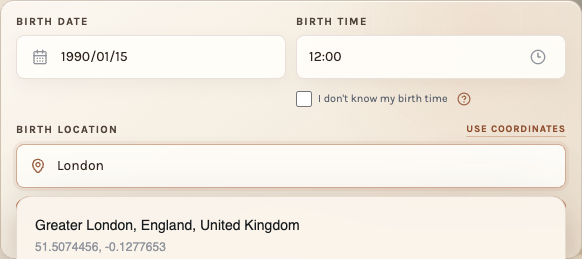
Suppose Paris, Berlin, and Lisbon are realistic options for work abroad. You want to understand their career trade-offs before choosing which places to investigate. The AstroCarto example uses fictional birth details—January 15, 1990, at 12:00 in London. The Nebula example comes from its published Vanessa Hudgens natal-chart reading and uses separate birth data.
AstroCarto
Generate your map, add the three cities to Compare Cities, and select Career & recognition. Read the support and cautions behind their order, then check other priorities in the cross-goal matrix. This keeps the destinations together while you examine how the choice changes when home or relationships matter too.
Open a Full AI City Comparison Report for the city-by-city reasoning. With the comparison context attached, ask, “Which signals make Lisbon a mixed option for my career, and what should I examine before choosing it over Paris?” You can return to the same cities and evidence as you refine the question. If you are planning with a partner, their birth details belong in the shared-place tool; this individual comparison does not represent both people.
Nebula
Nebula's Vanessa Hudgens reading pairs a natal chart wheel with planetary-position and Placidus-house tables. It places the Sun in Sagittarius in the eighth house and the Moon in Pisces in the eleventh, then explains themes such as shared resources and connections with groups. You can trace a listed placement into its written interpretation.
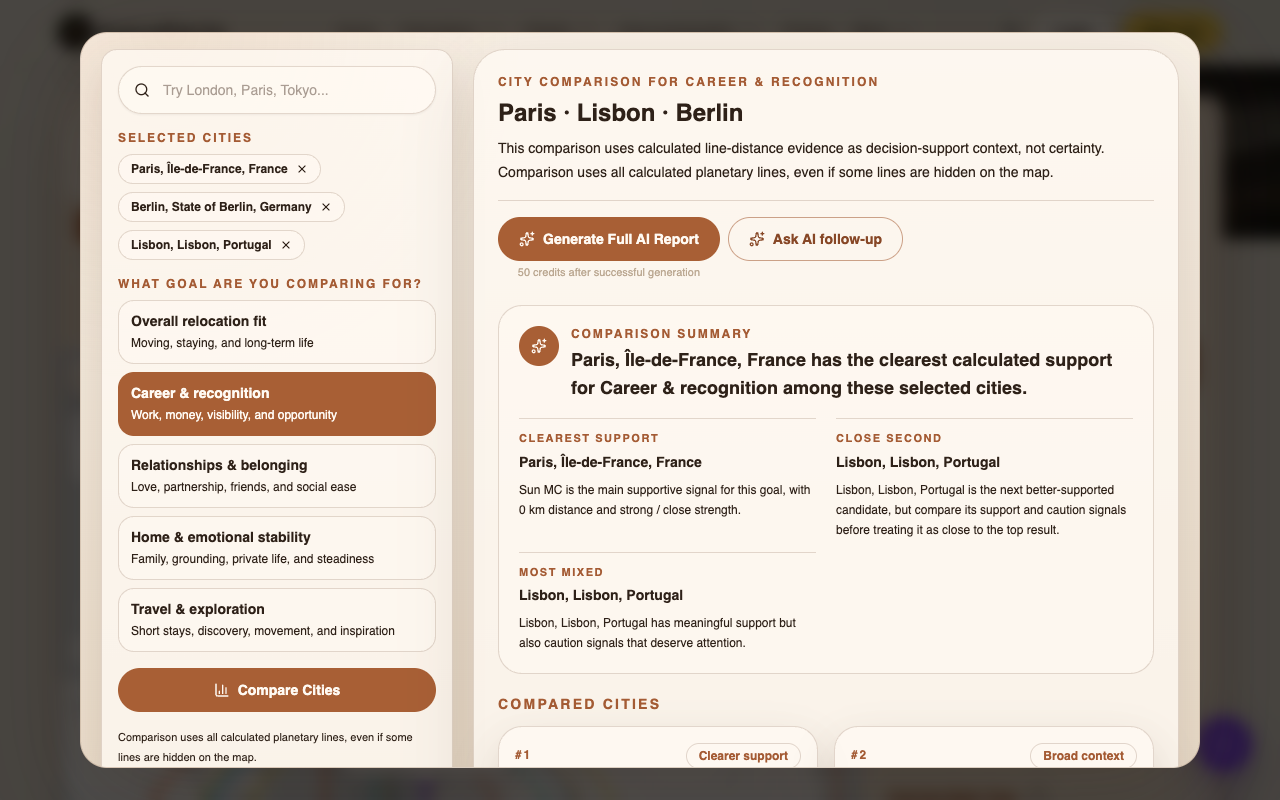
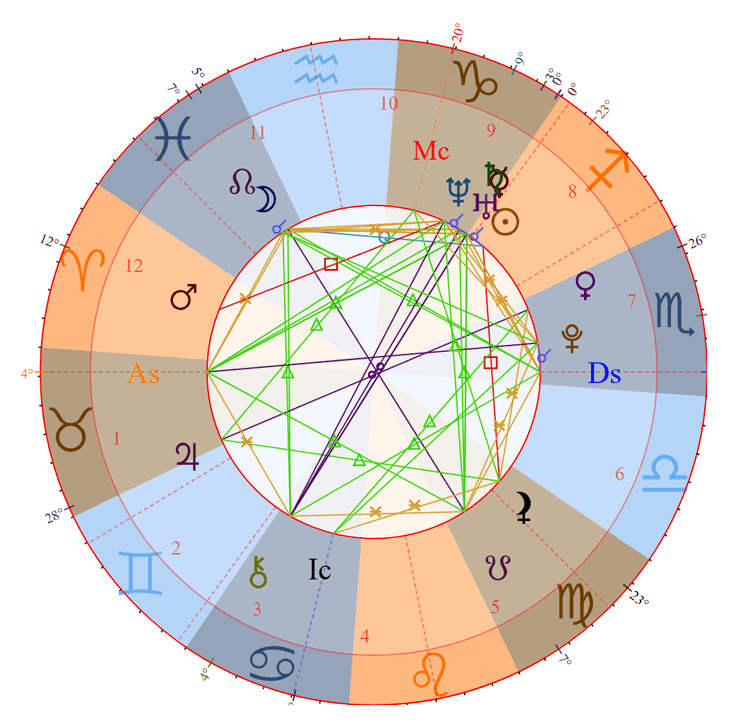
The AstroCarto result identifies Paris as the clearest support and Lisbon as the most mixed, giving you specific trade-offs to investigate. The Nebula reading connects natal placements to personal themes through its tables and written sections. These are independent examples of different outputs, not a same-data accuracy test. To compare possible destinations, AstroCarto keeps the named cities and their support and cautions together under your chosen goal.
Features: from personal questions to choices about places
AstroCarto
Start with your goal and region in Find My Best Places. Read why each candidate appears, then bring two to four realistic options into Compare Cities. Keeping the goal consistent helps you see differences in support and caution before considering another priority. The result gives you a shortlist to investigate alongside practical conditions such as work, housing, and travel arrangements.
A Full AI City Comparison Report develops the reasoning for those selected cities, with a PDF to keep. A Personal Astrocartography Report explores more broadly: priority places, detailed city readings, five life themes, an interactive evidence map, and birth-time and house-system sensitivity checks. The sensitivity checks help you see where assumptions call for a more cautious reading.
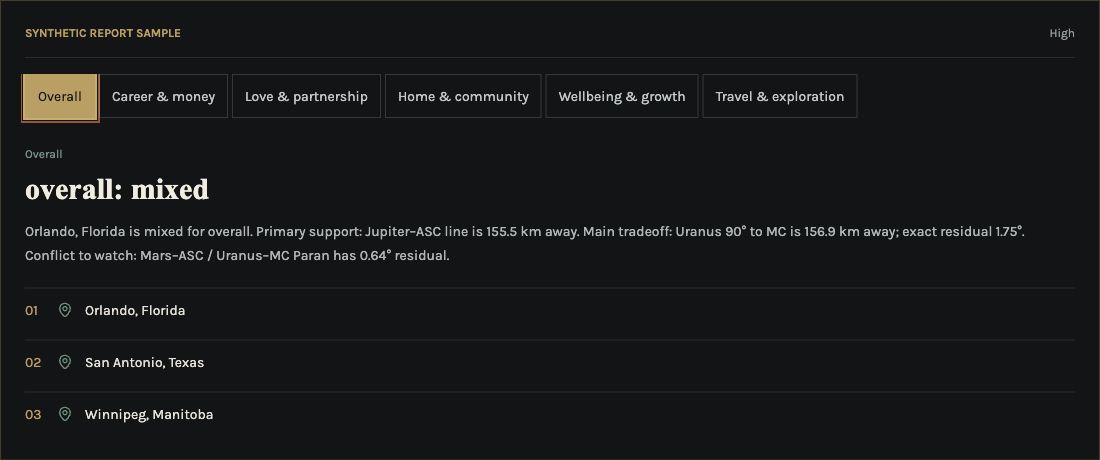
The complete personal report example shows why a leading city still needs an explanation. Orlando leads its place portfolio but receives a Mixed assessment, with supporting Jupiter ASC evidence alongside caution and conflict signals. This is a separate synthetic example from the Paris comparison. With your own completed report attached, you can ask which signals deserve attention before favoring a city; its position in the list does not remove its trade-offs.
For a shared move, consider a hypothetical choice between joining your partner, having them join you, or moving somewhere new together. Find the Best Places for Two People lets you examine both people's support and cautions in those destinations. If a place supports one person's home priorities but shows pronounced cautions for the other, compare another candidate before favoring it. Where a reference-city comparison is available, look at what each person gains or gives up. With sufficiently precise birth times, the multi-city results also show candidates by career, relationships, and home; tied options or no clear recommendation remain possible. This describes how to read the tool, not a calculated outcome for a named couple.
AstroCarto also provides a synastry calculator with AI explanations of its inter-aspects and house overlays. Its natal, composite, and transit tools support questions about their own results too. Use the shared-place tool when you want to investigate the same destinations for both people. Once you have a city, Best Time to Move explores windows for your own birth details and goal over 3, 6, or 12 months; each person's timing remains a separate question.
Nebula
Nebula's chart tools and astrology advisors support personal, career, and relationship exploration. A rising-sign result identifies the natal Ascendant sign; birth-chart readings develop planetary placements and houses. Relationship readings can consider both people's Sun, Moon, and Rising signs as well as aspects and house factors. Transit readings address changing planetary relationships over time.
Live conversations let you discuss your question with an advisor, and relationship reports provide a written reading to keep as a PDF. In one Nebula career-reading example, the second house in Libra and Venus in the ninth house are interpreted in terms of creative work and overseas opportunities. That example explores a career direction. If your next question is whether Paris, Berlin, or Lisbon better supports your goal, AstroCarto brings those cities' calculated support and cautions into one comparison, with reports to save and follow-up questions grounded in the results.
Create your astrocartography map
Enter your birth date, birth time, and actual birthplace. Generate your map, then select destinations in the city tools while keeping your original birth details fixed. You do not need a Nebula account, chart, or report to begin.
For shared-place research, add the second person's original birth details in Find the Best Places for Two People. Use the most reliable birth times you have, because precise angles and line locations depend on them. For moving dates, choose a city and goal for the individual whose timing you want to research.
Do more with AstroCarto
Find My Best Places
Get up to ten ranked candidates for your goal and region, with supporting lines and trade-offs to help narrow the places worth researching.
Compare Cities
Review two to four cities around one goal, then use a Full AI City Comparison Report for their evidence, trade-offs, and next checks. Keep the PDF as your shortlist develops.
Personal Astrocartography Report
Explore priority places, detailed city readings, and five life themes, with an interactive evidence map and a PDF you can return to.
Ask AI about your results
Ask why a city ranks highly or how conflicting signals affect its reading, with your AstroCarto map, city comparison, or completed report attached as context.
Find the Best Places for Two People
Find shared candidates and examine each person's support and cautions in the same places. See where your priorities align and who faces the larger compromise.
Best Time to Move
Research windows for a chosen city and goal over 3, 6, or 12 months, with explanations and cautions to consider alongside your actual moving arrangements.
Start with the question you have
Generate your map from your own birth details, then follow the workflow that matches your question:
- “Which European cities should I research for my career?” Create your map, open Find My Best Places, and choose Career and Europe. Read why each candidate appears, then compare the options you could realistically consider.
- “Paris, Berlin, or Lisbon—and what would I gain or give up?” Create your map, add the three cities to Compare Cities, and choose your goal. Read the support and cautions, then open a Full AI City Comparison Report and ask about the trade-off that matters most to you.
- “Should I join my partner, should they join me, or should we move somewhere new?” Create your map, open Find the Best Places for Two People, and add their birth details and your candidate cities. Compare both people's support and cautions, keeping any uneven pressure visible when narrowing your choices.
- “I have chosen a city. When should I investigate moving?” Create your map, open Best Time to Move, and select your city, goal, and time range. Review the windows and cautions alongside your work, housing, and travel constraints.
Frequently asked questions
How is a personal report different from a city comparison?
Compare Cities organizes two to four places you choose around one goal; its Full AI City Comparison Report expands the reasoning for those cities. A Personal Astrocartography Report explores a broader picture through priority places, detailed city readings, five life themes, and an evidence map. Use the comparison for a fixed shortlist and the personal report for wider location research.
Do I need a Nebula chart or report to use AstroCarto?
No. Enter your own birth date, time, and birthplace to generate a new AstroCarto map. You can go directly to candidate discovery, city comparisons, and reports. This workflow does not import a Nebula chart, PDF, advisor conversation, or saved profile.
Why do a Nebula birth chart and an astrocartography map look different?
A birth-chart wheel organizes planetary placements around the natal chart. An astrocartography map places planetary angle lines across the world, and AstroCarto's city tools examine the signals around destinations. The outputs answer different questions. When comparing calculations, check the birth time, time zone, coordinates, and kind of chart before treating a different display or interpretation as an error.
How does AI use my chart or report?
AstroCarto can attach calculated map evidence, a city comparison, or a completed personal report to follow-up questions. You can ask why one city ranks highly, which lines support the reading, or where cautions change the picture. Nebula's advisor conversations provide human interpretation; an equivalent location-result AI workflow is not confirmed. AstroCarto's follow-up uses its own results and does not turn them into a guarantee of what will happen in a place.
Where should I start if I have no candidate cities yet?
Start with Find My Best Places in AstroCarto. Choose a goal and region, read the reasons and cautions behind the candidates, and bring your realistic options into Compare Cities. If your first priority is discussing a personal concern with a human advisor, Nebula offers that conversation. For forming a city shortlist yourself, AstroCarto provides the direct starting point.
Which should I use if I already have several candidate cities?
Start with AstroCarto's Compare Cities to organize two to four places around the same goal. Open a Full AI City Comparison Report to examine their evidence and trade-offs, ask follow-up questions, and save the PDF. This gives you a structured comparison you can return to as your practical plans change.