
AstroCarto vs Astroline for Astrocartography
Start with AstroCarto to explore where to live, travel, or develop your career. Discover candidate places for your goal, compare cities and their trade-offs, then explore the reasoning in a full report and ask AI follow-up questions with your results attached.
Both AstroCarto and Astroline offer maps and personal location reports. Astroline combines location readings with astrologer discussions and a wider set of astrology tools. AstroCarto connects city selection with report evidence, shared-place research, and moving-date questions.
AstroCarto or Astroline: which should you pick?
Choose AstroCarto to find and compare places for your goals
For choosing a destination, we recommend starting with AstroCarto. Find My Best Places turns your goal and preferred region into a shortlist with reasons and cautions. When you have two to four realistic options, Compare Cities brings their support, cautions, and cross-goal differences into one ordered result. A Full AI City Comparison Report expands the reasoning, and AI follow-up lets you investigate a particular trade-off with the comparison attached.
For example, if Paris, Berlin, and Lisbon fit your plans, choose Career & recognition to see which city has the clearest support and which has mixed signals worth investigating. A Personal Astrocartography Report offers a wider view of priority places and five life themes. You can also research how a destination fits two people or which moving-date windows deserve attention.
Choose Astroline for map exploration and advisor discussions
Astroline combines maps and personal location reports with the option to discuss places with an astrologer. That may suit you if advisor discussion is central to your research. To compare a specific shortlist and inspect the reasoning yourself, follow the AstroCarto example below.
Features at a glance
Start with the tasks that help you choose and understand places: finding candidates, comparing cities, and exploring the reasons behind the results. Product information was checked on October 18, 2026.
| Task or feature | AstroCarto | Astroline |
|---|---|---|
| Find candidate places | Find My Best Places returns up to ten ranked candidates by goal and region, with reasons and cautions. | Goal-led map exploration with regional explanations and supportive line clusters. |
| Compare cities around a goal | Compare two to four cities with an ordered result, support, cautions, and a cross-goal matrix. | Compare candidate locations using nearby planetary lines, angles, and regional explanations. |
| Create a personal location report | Priority places, city deep dives, five life themes, an evidence map, sensitivity checks, and a PDF. | Personal report covering cities and countries; view online or download through the purchase-confirmation email. |
| Keep a detailed city comparison | A Full AI City Comparison Report explains the selected cities, ranking, trade-offs, and next checks, with PDF export. | Keep the personal location report for reference, and use its city and country readings when researching your options. |
| Ask AI about the results | Ask follow-up questions with calculated map, city-comparison, or completed-report context attached. | AI natal-chart reports interpret your birth chart; astrologer chats let you discuss location questions. |
| Research places for two people | Discover shared candidates, check one city, or compare up to six cities with each person's support and cautions. | Related tools: zodiac compatibility and a couple's birth-chart report explore how two people's signs and charts relate, including their relationship strengths and challenges. |
| Research when to move | Best Time to Move uses a chosen city and goal to explore date windows over three, six, or twelve months. | Related tools: Transits, Moon Calendar, and Astro Events explain active planetary transits, lunar phases, and major astrological events for broader timing research. |
| Read a location in depth | Check City and In-Depth Location Readings explain nearby lines, distances, strengths, and available angle-aspect or Paran signals. | Personalized planetary-line interpretations describe opportunities and challenges in different locations. |
| Explore combined planetary influences | Where Planets Work Together connects planetary combinations to a goal and candidate cities. | Describes areas where favorable planetary lines intersect or reinforce one another. |
| Explore planetary lines | Interactive map with planetary and angle lines, including Venus, Jupiter, Saturn, Pluto, and Lunar Node. | Maps show planetary lines for ASC, DSC, MC, and IC; the app provides an AstroMap entry. |
| Study a relocation chart | A separate calculator compares natal and relocated Whole Sign houses; personal reports also assess relocated-chart evidence. | Related tools: natal-chart readings for birth placements and astrocartography maps for location research. |
| Save a map image | Download an HD map for saving, sharing, or printing. | Related output: download a personal location report to revisit later. |
Check City examines one location's nearby signals; a relocation chart explores that destination's houses and angles. A Personal Astrocartography Report takes a wider view of places and life themes, while a Full AI City Comparison Report focuses on the two to four cities you selected. Having a report does not necessarily mean having the same kind of result.
How AstroCarto and Astroline differ
Pricing: plans and usage
AstroCarto
AstroCarto plans let you keep researching a location question: read the local evidence, compare options, retain a personal report, and use AI credits for follow-up. Shared-place and moving-time tools extend the research when another person or a date becomes part of the decision.
As of October 18, 2026, Pro is US$19.90 for 5 Personal Astrocartography Reports and 1,500 AI credits. Ultimate is US$39.90 for 20 personal reports and 10,000 AI credits, plus the complete Find My Best Places list, Full AI City Comparison Reports, and saved AI chat history. Both are one-time purchases and include the planetary lines, in-depth location readings, unlimited city checks and basic comparisons, HD maps, shared-city tools, and the full moving-time calendar.
AI questions and full comparison reports use credits; the applicable amount is shown before generation. You can start with a map and limited tool trials. Check the pricing page for current allowances and plan differences.
Astroline
Astroline offers subscriptions and one-time purchases. Subscriptions renew until canceled, and advisor chats use credits. When comparing costs, check which report is included, the billing period, and the advisor-credit allowance for the offer you choose.
Interface: researching places for your career
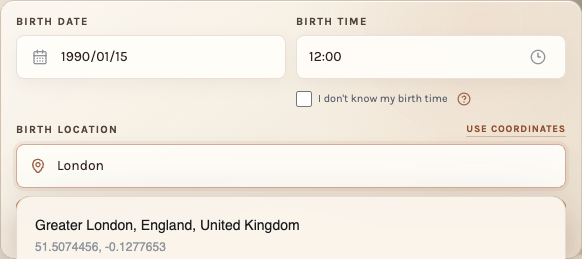
Consider Paris, Berlin, and Lisbon for your career. Our AstroCarto example uses fictional birth details: January 15, 1990, at 12:00 in London. The useful question is how each workflow helps you compare these places and explore the reasons behind your choices.
AstroCarto
Generate your map, add the cities to Compare Cities, and select Career & recognition. The result brings their order, support, and cautions into one view. The cross-goal matrix lets you examine how those same places compare for other priorities before narrowing your choices.
Open a Full AI City Comparison Report to explore the reasoning. You can then ask a question with the comparison context attached, such as: “Which cautions should I investigate if I prefer Lisbon?” Check City and In-Depth Location Readings are useful when you want to inspect one destination's local evidence more closely.
Astroline
Create your map, locate a candidate city, and read its nearby planetary lines, angles, and regional interpretations. For career research, explore Sun and Jupiter lines, particularly around the MC. Use those location readings to compare your options, or discuss your questions with an astrologer.
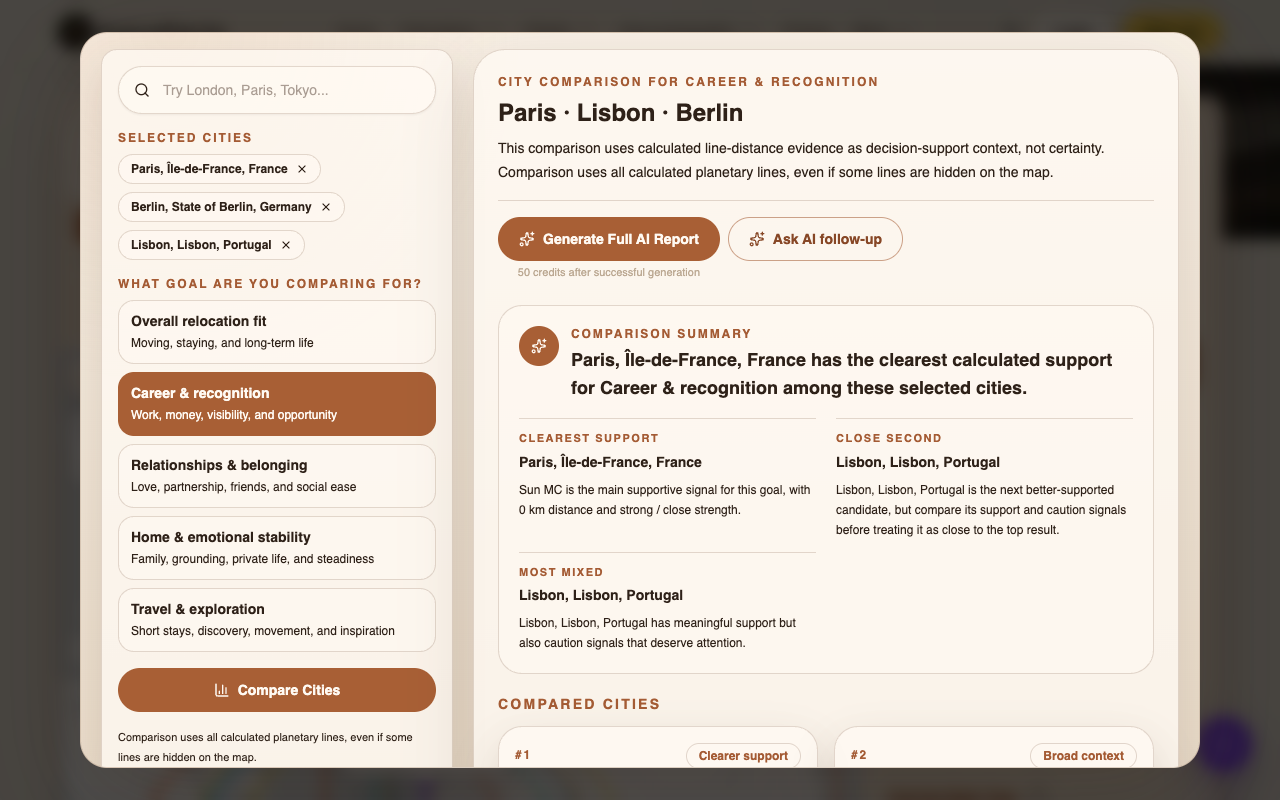
In this AstroCarto example, Paris has the clearest support. Lisbon is both the close second and the most mixed option: a competitive candidate can still have cautions worth examining. That gives you a useful next question: “What supports Lisbon, and which conflicting signals matter for my goal?” Use the summary to identify the question, then investigate the evidence in the full comparison report or through AI follow-up. This ranking belongs to the example birth details; it is not a recommendation of these cities for everyone.
Use the ordered comparison to decide which trade-offs deserve attention first. AstroCarto connects that summary to a full comparison report and AI follow-up with the results attached, so you can move from a ranking to the reasons behind it and the questions you still need to resolve. Calculate your map from your own birth details; no Astroline report is imported.
Features: what happens after you find a place?
AstroCarto
Find My Best Places develops a goal and region into up to ten candidates with reasons and trade-offs. Use those details to decide which places deserve more research, then bring two to four realistic options into Compare Cities. A Full AI City Comparison Report expands the reasoning for that shortlist and provides a PDF to keep.
A Personal Astrocartography Report answers a broader question. It combines priority places, city deep dives, five life themes, an interactive evidence map, and birth-time and house-system sensitivity checks, with PDF output. With the completed report attached, ask AI about a recommendation or a conflict between signals without restating the report in each question.
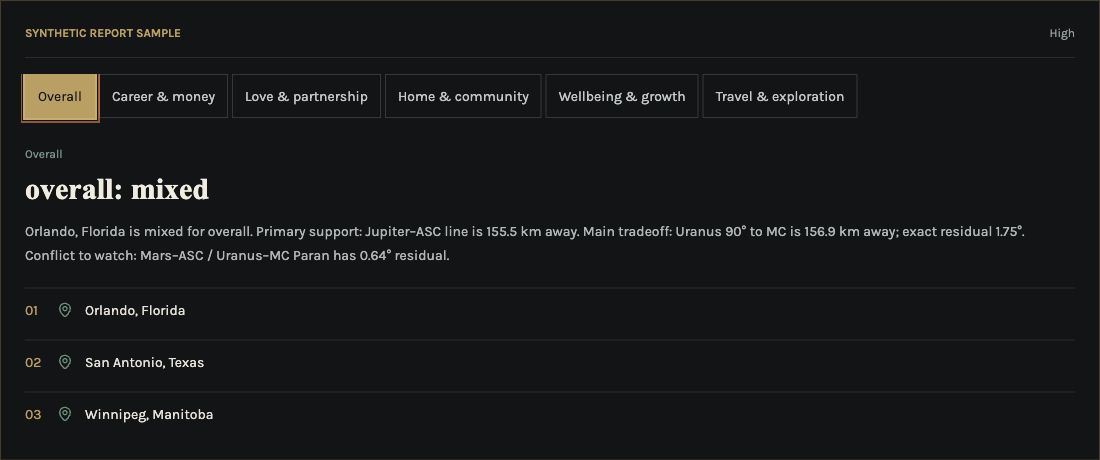
The complete personal report example shows why the explanation matters. Orlando leads its place portfolio, yet the overall assessment is Mixed. Supporting Jupiter ASC evidence appears alongside cautions and conflicts. The useful next step is to examine which factors support the recommendation and which deserve further investigation. This is a separate synthetic example from the Paris comparison above.
For a shared destination, Find the Best Places for Two People shows support for both people and where their needs differ. Once a city is in focus, Best Time to Move organizes date windows around that city and your goal. You can carry the research from choosing a place into understanding the trade-offs for each person and the timing questions to explore.
Astroline
Explore the interactive AstroMap in the app, or open your personal location report through the purchase-confirmation email. Read the report online or download it to revisit your location research.
For questions about a place, choose an online astrologer in Advisors and return to the conversation in My chats. Astroline's separate AI natal report explores work, money, and relationships through the birth chart. For a question tied to your calculated city comparison, AstroCarto lets you carry that result directly into AI follow-up.
Create your astrocartography map
Have your birth date, birth time, and birth city ready. Generate your map, then check a location, find candidates, compare cities, or create a report. Add the second person's birth details for shared places, or choose a city and goal to research moving dates.
Do more with AstroCarto
Find My Best Places
Turn a goal and region into a ranked shortlist, with supporting lines and trade-offs to help you decide which candidates to investigate.
Compare Cities
Compare two to four places around your goal, then explore the reasons and next checks in a Full AI City Comparison Report.
Personal Astrocartography Report
Keep priority places, city assessments, five life themes, and an evidence map together in a web report and PDF.
Ask AI about your results
Ask why a city stands out or which signals conflict, with your calculated map, city comparison, or completed report attached as context.
Find the Best Places for Two People
Explore shared candidates and examine each person's support and cautions before narrowing down a destination together.
Best Time to Move
Research date windows for a chosen city and goal, with explanations and cautions to consider alongside your actual moving plans.
Start with the question you have
Generate your map from your own birth details, then choose the workflow that matches your question:
- “Which European cities should I research for my career?” Create your map, open Find My Best Places, and choose Career and Europe. Use the candidates' reasons and cautions to build a shortlist you could realistically explore.
- “Astroline drew my attention to Paris. How does it compare with Berlin and Lisbon?” Create your map, add the three cities to Compare Cities, and choose your goal. Explore the support and cautions, then use a Full AI City Comparison Report for the reasoning behind the ranking.
- “Where could work for both me and my partner?” Create your map, open Find the Best Places for Two People, and add the second person's birth details. Compare shared support with each person's cautions.
- “I have chosen a city. Which moving dates should I investigate?” Create your map, open Best Time to Move, and select the city and goal. Review date windows alongside your work, housing, and travel constraints.
Frequently asked questions
How is a personal report different from a city comparison?
In AstroCarto, a Personal Astrocartography Report gives a broader assessment of priority places and five life themes. Compare Cities organizes two to four places you choose around one goal, and its Full AI City Comparison Report expands the evidence and trade-offs for those places. Choose the personal report for a wider view or the comparison for a fixed shortlist.
Do I need an Astroline chart to use AstroCarto?
No. Enter your own birth date, time, and birthplace to create an AstroCarto map. If an Astroline reading suggested a destination, you can enter that city for research. The workflow described here does not import your Astroline chart, report, or account data.
Why might the maps or readings look different?
First check that the birth date, local birth time, time zone, and birthplace match. Also identify the result you are reading: Astroline's AI natal report interprets the birth chart, while its astrocartography material concerns places. AstroCarto's Compare Cities evaluates your selected destinations around a goal. A favorable line near Paris and Paris's position among three candidates are different findings. Compare matching outputs before treating different interpretations as a calculation error or a sign of greater accuracy.
How does AI use my chart or report?
AstroCarto can attach calculated map evidence, a city comparison, or a completed personal report to a follow-up question. Ask which signals explain a city’s ranking or why a leading candidate still has cautions. Astroline offers AI natal-chart interpretations and astrologer conversations about places. To investigate your city choices in AstroCarto, open the result and ask with that context attached. Interpretations are research material, not guarantees of what will happen in a place.
Where should I start if I have no candidate cities yet?
Start with Find My Best Places in AstroCarto. Choose a goal and region, review the ranked candidates with their reasons and cautions, then shortlist places that also meet your practical needs. You can take two to four candidates into Compare Cities when you are ready for a closer look.
Which should I use if I already have several candidate cities?
Start with AstroCarto's Compare Cities. Enter two to four places and a goal, examine their support and cautions, and open a Full AI City Comparison Report for the reasoning and next checks. You can ask follow-up questions with the results attached and keep the report as a PDF. Cities you discovered in Astroline or elsewhere can be starting points; the comparison is calculated from your birth details in AstroCarto.