
Planet × angle meanings on your personal map
Astrocartography Line Meanings
Astrocartography lines show where each planet was rising, setting, overhead, or below at your birth moment. Generate your personal map to find your planetary lines, then use the planet and angle meanings below to understand what each line may emphasize near a city.
Generate Your Personal Astrocartography Map
Find your planetary lines
Identify the Lines on Your Personal Map
Your generated map calculates ten planets across ASC, DSC, MC, and IC. Each astrocartography line combines a planet theme with one life angle. Show or hide a planet, click any point on a line for a place reading, or use Check City to measure the closest lines to a city you already have in mind.
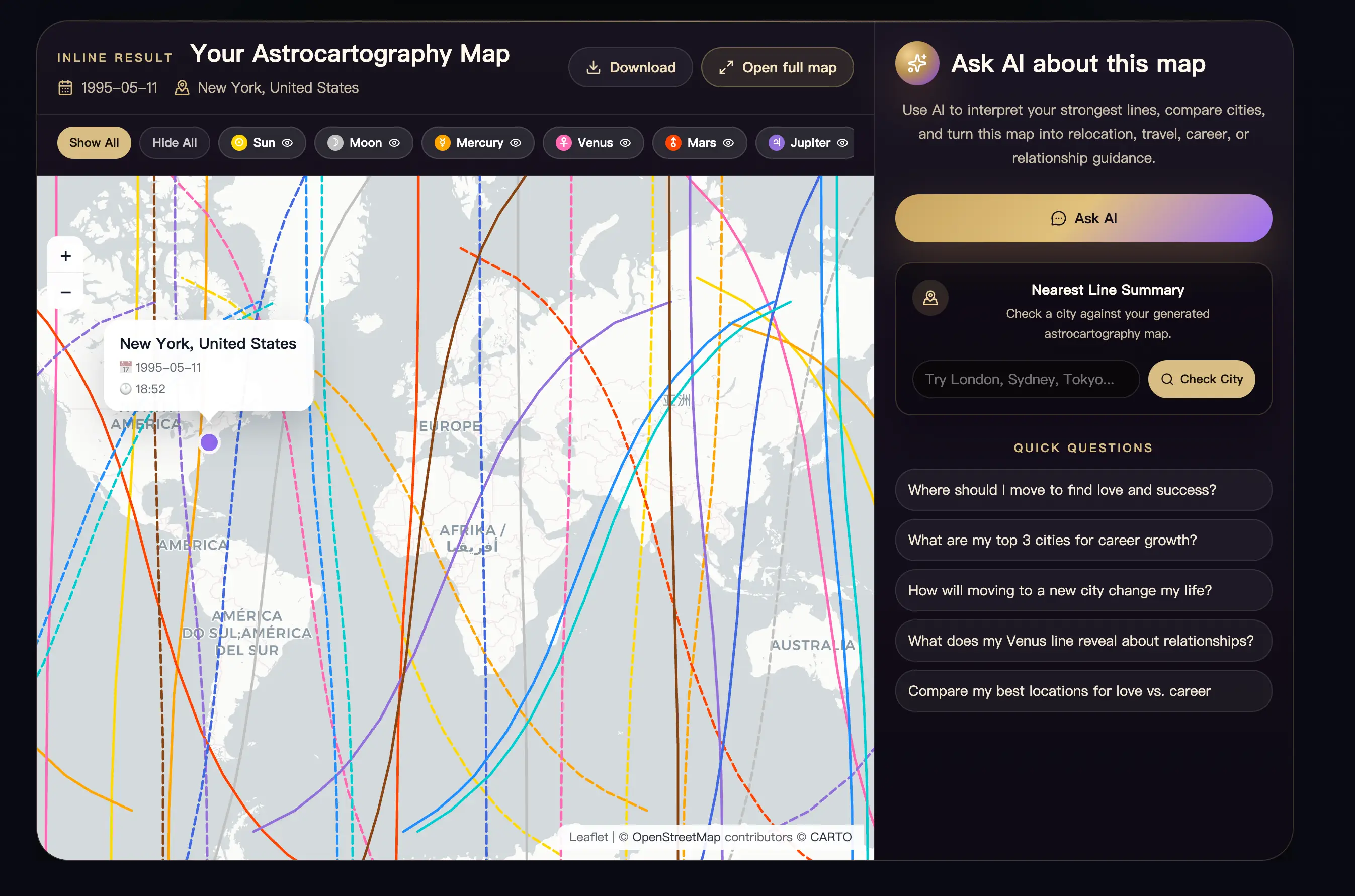
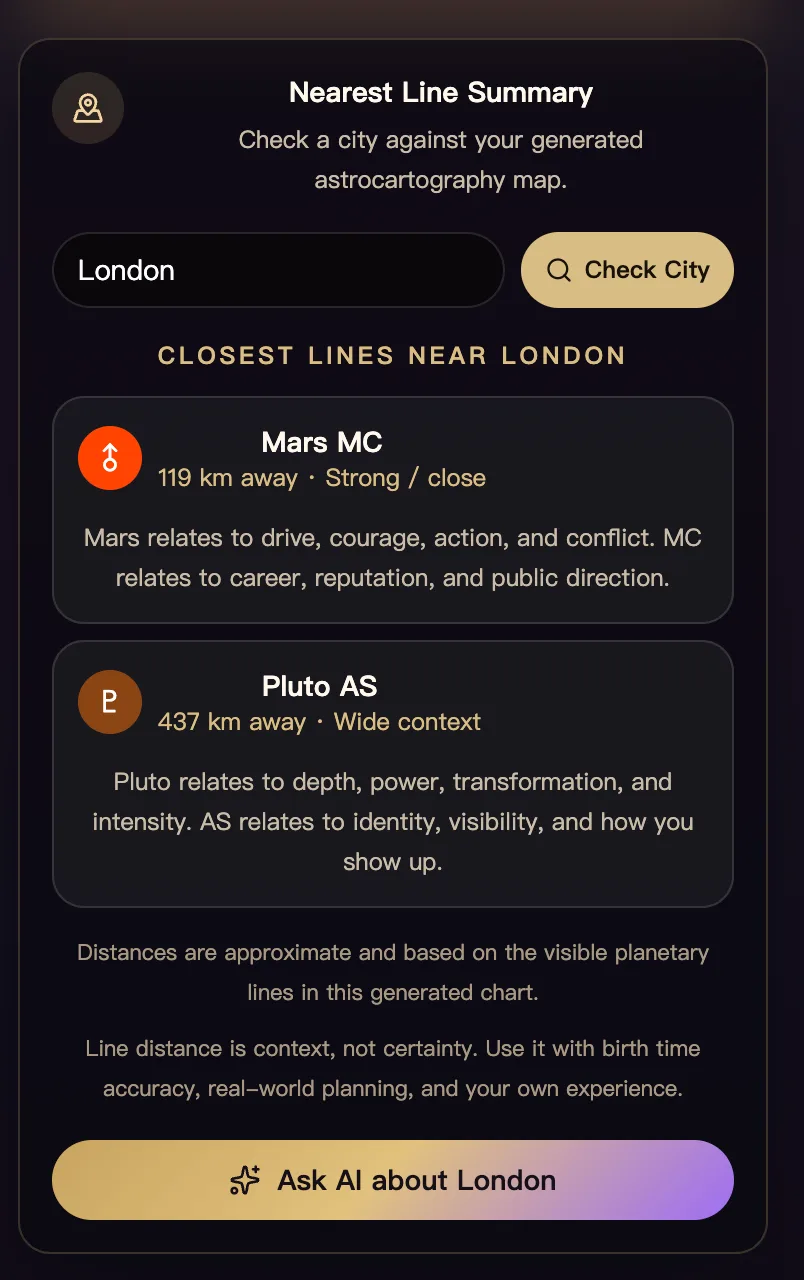
Check a city against your lines
Map Evidence Near Your City
The city check returns up to four closest visible astrocartography lines. Each result identifies the exact planet-angle combination, approximate distance, proximity strength, and combined theme to investigate. Once you have a city in mind, choose a goal in Best Time to Move to find your best times to move there over the next 12 months.
- Planet + angle
- The exact signal
- Distance
- Approximate kilometres
- Strength
- Strong to weak context
- Meaning
- The combined theme
Strength guide
Strong ≤ 120 kmNearby ≤ 250 kmBroad ≤ 400 kmWide ≤ 644 kmWeak > 644 kmIf no visible astrocartography lines are within 644 km, the result shows the two closest signals; it does not label the city ‘bad.’ AI can explain this attached evidence, but cannot invent uncalculated signals.
Check a City on My MapMap → evidence → decision
Your Map Identifies the Lines. Your Report Compares the Evidence.
Start with the free map and line meanings. The full Personal Astrocartography Report cross-checks more evidence to identify priority places, life-theme verdicts, trade-offs, cautions, confidence, and next checks.
The line meaning formula
What Do Astrocartography Lines Mean?
An astrocartography line does not have one fixed meaning. The planet describes the theme, the angle shows the life area, and distance plus context decide how useful that signal is for a real place.
Map colors are not universal. Identify a line by its planet glyph and ASC, DSC, MC, or IC label; use the Symbols Guide when you need the map key.
- 01
Planet
The planet supplies the subject: visibility, emotion, communication, connection, action, growth, responsibility, change, imagination, or transformation.
- 02
Angle
ASC brings the theme to identity, DSC to relationships, MC to career and public direction, and IC to home and private foundations.
- 03
Distance
A closer line may be more noticeable, but distance is context rather than a promise that an event will happen.
- 04
Question
The same line can be useful for one question and difficult for another, so name the career, relationship, home, or travel goal first.
- 05
Context
Nearby lines, natal modifiers, relocated charts, practical constraints, and birth-time sensitivity can change the final interpretation.
Ten planets × four angles
Astrocartography Planet and Angle Line Meanings
Use this 40-combination matrix as a quick reference. Each cell combines one planetary line with ASC, DSC, MC, or IC; distance and the rest of the map still matter.
Select a planet name to open its complete line guide with deeper ASC, DSC, MC, and IC interpretations.
| Planet | ASC · Identity & Beginnings | DSC · Relationships & Others | MC · Career & Public Life | IC · Home & Inner Life |
|---|---|---|---|---|
| Sun | Amplifies self-expression, confidence, visibility, and the urge to lead with your identity. | Highlights defining partnerships, strong personalities, recognition through others, and relationship dynamics around pride. | Emphasizes public visibility, leadership, recognition, career direction, and pressure to be seen. | Strengthens private confidence, belonging, family identity, and the need for a centered home base. |
| Moon | Heightens emotional expression, intuition, sensitivity, changing moods, and the need to feel personally safe. | Draws attention to nurturing bonds, emotional needs, family-like relationships, and dependence or care. | Connects public life with care, receptivity, community response, and an emotionally visible reputation. | Deepens themes of home, family, roots, memory, privacy, and the search for belonging. |
| Mercury | Encourages a curious, mobile identity shaped by learning, conversation, networking, and frequent movement. | Makes dialogue, negotiation, clients, teaching, and mentally stimulating partnerships more central. | Supports communication, writing, media, commerce, teaching, and a career built around ideas. | Brings study, writing, conversation, visitors, or mental activity into home and family life. |
| Venus | Emphasizes charm, style, sociability, pleasure, self-worth, and how you attract rather than pursue. | Highlights attraction, partnership, cooperation, social opportunity, and the risk of idealizing harmony. | Supports diplomacy, creative visibility, public appeal, relationship-based work, and an attractive reputation. | Favors comfort, beauty, hospitality, domestic harmony, and attachment to a pleasant private life. |
| Mars | Increases drive, courage, physical energy, directness, competitiveness, and the need to manage impatience. | Intensifies attraction, assertion, rivalry, confrontation, and the negotiation of anger in partnerships. | Pushes ambition, competition, leadership through action, and conflict with authority or professional rivals. | Brings activity, construction, independence, heat, or friction into home and family dynamics. |
| Jupiter | Expands confidence, exploration, learning, generosity, and possibility while sometimes encouraging excess. | Attracts mentors, teachers, generous partners, international ties, and expectations that can grow too large. | Supports career growth, recognition, teaching, publishing, leadership, and the risk of professional overreach. | Encourages a larger home base, family growth, hospitality, study, and restlessness with existing roots. |
| Saturn | Strengthens discipline, seriousness, endurance, boundaries, and self-command while potentially feeling isolating. | Tests commitment, responsibility, age or authority differences, loyalty, limits, and emotional distance. | Builds duty, authority, mastery, and durable achievement through slow progress and sustained pressure. | Emphasizes family responsibility, ancestry, property, foundations, and private burdens that require maturity. |
| Uranus | Accelerates reinvention, independence, experimentation, sudden changes, and freedom from an old identity. | Brings unconventional bonds, surprising encounters, unstable agreements, and a stronger need for space. | Stimulates innovation, independence, public change, technology, and an unpredictable professional direction. | Disrupts familiar roots through a private reset, unusual living arrangements, or frequent changes at home. |
| Neptune | Heightens sensitivity, imagination, intuition, compassion, and the risk of blurred identity or boundaries. | Encourages idealization, spiritual connection, projection, rescue dynamics, and compassionate but unclear bonds. | Supports creative or spiritual callings while making reputation, ambition, and professional direction less definite. | Favors retreat, imagination, and sanctuary but can blur domestic expectations or practical foundations. |
| Pluto | Intensifies personal transformation, presence, survival instincts, self-examination, and questions of control. | Deepens bonds, trust, intimacy, power struggles, endings, and relationships that demand psychological honesty. | Concentrates ambition, influence, public power, strategic reinvention, and encounters with institutional control. | Exposes ancestral patterns, family power, privacy, emotional excavation, and profound changes to inner foundations. |
These astrocartography line meanings are themes, not verdicts. Venus DSC does not guarantee a relationship, and Saturn MC can describe pressure as well as long-term mastery. Check the actual location and the rest of your map.
Generate My Map and Find These LinesImportance depends on the question
Which Astrocartography Lines Are Most Important?
There is no universally most important or best astrocartography line. Start with the life area you are evaluating, read the planet that carries the theme, and compare every relevant line near the place. Strongest means emphasized—not automatically easiest or most supportive.
Start With the Life Area
ASC is usually most relevant to identity and beginnings, DSC to relationships, MC to career and visibility, and IC to home and roots.
Find My Angle LinesThen Read the Planet
Sun, Venus, Jupiter, Mars, or Saturn cannot be ranked as universally good or bad. Each planet changes the kind of experience being emphasized.
Show My Planet LinesCompare Every Nearby Signal
The closest line may be important, but another nearby line can reinforce it, contradict it, or affect a different life area. Use Check City before choosing one meaning.
Check a City on My MapRead beyond one symbol
When One Astrocartography Line Meaning Is Not Enough
Astrocartography lines can overlap, pass offshore, sit far from a city, or shift when the recorded birth time changes. These situations do not make the map wrong; they mean one label is not enough context.
Several Lines Near One City
A city can sit near several astrocartography lines. Separate support, caution, and the affected life area. Strength means emphasis, not ease.
Crossings and Layered Regions
Crossings add layers, not automatic benefit. Ask whether signals reinforce the goal or compete.
Lines Over the Ocean
Astrocartography lines follow global geometry, not borders. Calculate coastal-city distance instead of dismissing an offshore line.
No Close Line
A quieter location is not negative; it may be less dominated by one angular theme. Check the closest signals for context.
Uncertain Birth Time
ASC, DSC, MC, and IC depend on birth time. If it is unknown, avoid treating close rankings as precise. The report can test a five-minute shift.
A synthetic walkthrough
Astrocartography Line Meaning Example: Venus MC Near Lisbon
This example explains the method; it is not a prediction about Lisbon.
Suppose Lisbon is 85 km from Venus MC, inside the strong band. Venus concerns connection, diplomacy, aesthetics, and value; MC brings them into public direction. For a career goal, Lisbon may merit research for collaborative or creative work.
That is not a relocation verdict. Other signals may add support or pressure, while Venus can highlight approval-seeking. Compare real options, then consider work, visas, cost, safety, health, family, and lived experience.
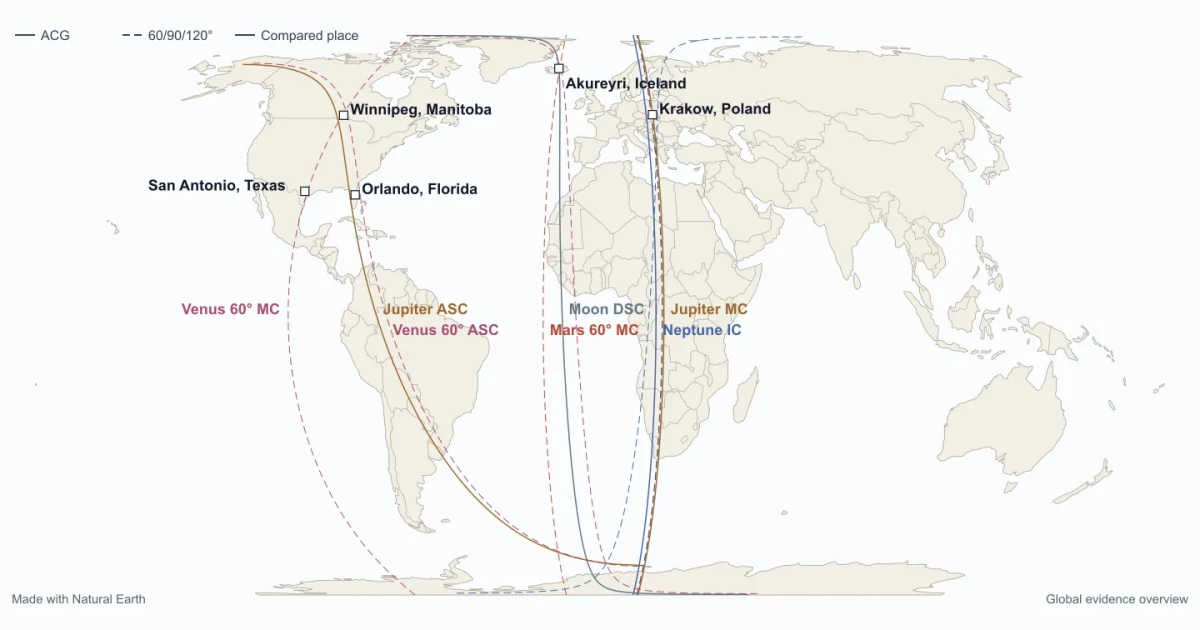
From signals to a personal report
From Astrocartography Lines to a Personal Report
The free overview gives an initial reading. The full report cross-checks your astrocartography lines through:
- ordinary ASC, DSC, MC, and IC lines
- major 60°, 90°, and 120° angle-aspect lines
- planetary Parans
- relocated Placidus and Whole Sign charts
- natal modifiers
- birth-time sensitivity within plus or minus five minutes
The result organizes evidence into priority places and five themes: career and money; home, family, and community; love and partnership; travel and exploration; wellbeing and growth. It adds a map verdict, caution places, trade-offs, confidence, next steps, evidence map, saved access, PDF, and report-aware AI.
Report-aware AI explains attached evidence and limits; it cannot create lines or override rankings.
Quick reference
Astrocartography Line Meanings FAQ
Use these short answers to identify the line, angle, and context before treating any location as a decision.
What do astrocartography lines mean?
Astrocartography lines show where a planet occupied an angle at your birth moment. The planet gives the theme, while ASC, DSC, MC, or IC identifies the life area. Distance, nearby lines, your goal, and chart context refine the meaning.
What are the four main lines in astrocartography?
The four angular line types are ASC, DSC, MC, and IC. ASC relates to identity and beginnings, DSC to relationships and other people, MC to career and public life, and IC to home, family, and inner foundations.
Which astrocartography line is most important?
No single line is most important for everyone. The relevant line is the one that matches your question, is close enough to the location being considered, and still makes sense when compared with the other nearby signals.
How do I find my astrocartography lines?
Enter your birth date, accurate birth time, and birthplace in the map generator. The calculated map shows each planet's ASC, DSC, MC, and IC lines. Use the planet filters or Check City to identify the lines relevant to a location.
How close should a city be to a line?
No cutoff guarantees an outcome. AstroCarto labels proximity strong within 120 km, nearby within 250 km, broad within 400 km, wide within 644 km, and weak beyond. Compare; do not predict.
Are some lines always good or bad?
No. Venus and Jupiter can involve excess; Mars and Saturn can support courage or durable achievement. Read the full combination.
What if two lines are near the same city?
Read both. Ask whether they support one goal, create a trade-off, or affect different life areas. Comparison makes the tension explicit.
What if there are no astrocartography lines near me?
A place without a close angular line is not automatically negative. It may feel less dominated by one planetary theme. Check the closest calculated signals and compare the location with places that have stronger line emphasis.
Can astrocartography tell me exactly where to move?
No. It organizes astrological evidence and cautions. Visas, work, safety, cost, health, family, and first-hand experience remain essential.
Your map is the starting point
Find Your Astrocartography Lines, Then Read What They Mean
Generate your personal map, then click any place or planetary line for a place reading, check a city, find your best time to move there, compare known options, or build a Personal Astrocartography Report from the calculated evidence.