Personal location guidance built from your birth chart
Free Astrocartography Where to Live Calculator & Map
Generate your personal astrocartography map, then discover places worth considering for relocation, career, love, home, or a more balanced life. See the planetary lines, distance, goal-based support, cautions, and trade-offs behind each candidate before deciding what to research further.
Three ways into the decision
Use Your Personal Astrocartography Map to Decide Where to Live
A generic astrocartography guide can explain what a Venus or Jupiter line means. AstroCarto lets you apply your own calculated astrocartography map to a real location decision. The map shows where ten planets were rising, setting, overhead, or below at birth; the next step depends on what you already know. For a move involving two people, add the other person's birth details in Find the Best Places for Two People to see where you both benefit and where your results differ.
I Don’t Know Where to Start
Choose a goal and region, then use Find My Best Places to create a candidate-city preview. Instead of assuming one Venus or Jupiter line is automatically best, the astrocartography result evaluates support, caution, fit, and confidence for relocation, career, love, home, balanced living, or a move-versus-stay question. Search worldwide or focus on North America, Europe, Asia, or Oceania.
Find My Best PlacesI Already Have One City in Mind
Use Check City when you know the place you want to investigate. This astrocartography city check identifies up to four closest visible planetary lines and shows the exact planet and angle, approximate distance in kilometres, proximity strength, combined planet-angle meaning, and the evidence you can ask AI to explain. If no line is close, AstroCarto shows the nearest signals instead of labelling the city bad. Once you have a city in mind, open Best Time to Move, choose your goal, and sign in for a personalized preview covering the next 12 months.
Check a CityI Have Two to Four Candidate Cities
Use Compare Cities when the question is which option fits your goal more clearly. Select two to four cities and one goal. The astrocartography comparison uses every calculated planetary line, including lines hidden on the map, to organize the leading city, support and caution signals, distance and strength, ranking reasons, meaningful trade-offs, and evidence that is too weak or mixed to overstate.
Compare My CitiesThe information gain
What You Get Beyond a Generic Astrocartography Guide
This page does not stop at general line meanings. The same birth data used to draw your astrocartography map continues into city-level evidence, goal-based comparisons, and a shortlist you can revisit. That makes the article and the tool one continuous decision workflow.
Explains planets and angles in general
Applies your birth date, time, place, and timezone to a calculated personal astrocartography map
Leaves you to guess which cities matter
Finds candidate cities from your selected goal and region
Describes one line at a time
Combines planet-angle meaning, distance, strength, support, caution, and nearby signals
Offers broad inspiration
Lets you check one city, compare 2–4 places, save the decision, and continue into a complete astrocartography report
A transparent decision method
How Astrocartography Evidence Helps Evaluate Where You Could Live
An astrocartography where-to-live decision requires more than finding the closest colourful line. AstroCarto reads each location through a sequence of evidence so that a strong signal is not automatically treated as an easy or guaranteed outcome.
- 01
Your birth data creates the astrocartography map
Date, time, birthplace, coordinates, and timezone determine where the planetary lines appear. Birth-time accuracy matters most when a comparison depends on an angle line or a small distance difference.
- 02
Your goal defines relevance
Career, love, home, relocation, and balanced living do not ask the same question of a city. A place can be compelling for public visibility while feeling less aligned with belonging or stability.
- 03
Planet and angle describe the theme
The planet describes the subject; ASC, DSC, MC, or IC shows how that subject may enter life through identity, relationships, public direction, or home and roots.
- 04
Distance adds context
Closer signals may feel more noticeable, but distance is not a promise of benefit or difficulty. Broad and weak signals stay visible as context rather than being forced into a confident verdict.
- 05
Support and caution work together
Several lines can reinforce a goal, pull in different directions, or create a worthwhile trade-off. A useful ranking keeps the supportive and difficult evidence visible at the same time.
- 06
Confidence keeps the result honest
An uncertain birth time, mixed evidence, or a quiet region should reduce certainty rather than strengthen a claim. Confidence tells you how carefully to treat the order of candidates.
Astrocartography can organize a location question; it cannot make the final decision. Visas, employment, housing, cost, safety, health, climate, family, and first-hand experience remain essential.
No universal lucky line
What Is the Best Astrocartography Line to Live On?
There is no single best line for everyone. Even traditionally supportive planets need to be read through their angle, distance, nearby signals, and your goal. The best candidate may be the place with the clearest combination of support, caution, and practical fit—not the strongest single line.
Learn what each astrocartography line meansExamine belonging, family, stability, emotional context, and what the location asks of your private life.
Examine visibility, growth, responsibility, public direction, and whether opportunity comes with pressure.
Examine attraction, partnership, social ease, boundaries, and the difference between chemistry and durability.
Look for a workable mix of energy, caution, daily rhythm, and practical fit instead of chasing the loudest line.
Lisbon
- Selected goal
- Relocation
- Selected region
- Europe
- Main support
- Venus MC · 85 km · Strong
- Fit
- Good Candidate
- Confidence
- Moderate
What a personalized result looks like
From “Venus Is Good” to a Better Location Question
This synthetic example explains the astrocartography result format; it is not a prediction about Lisbon.
Venus MC may make Lisbon worth researching for collaborative, creative, or public-facing goals. The distance makes the signal relevant, but it is not a relocation verdict. Another nearby line, a caution signal, or comparison with your current city may change the priority.
A useful astrocartography result continues beyond a planet label. It explains why a city entered the shortlist, what supports the selected goal, what deserves caution, how confident the evidence is, and what to check next. You can compare Lisbon with places you already know, save it to My Places, or continue into a complete Best Places Report.
Generate My Own Result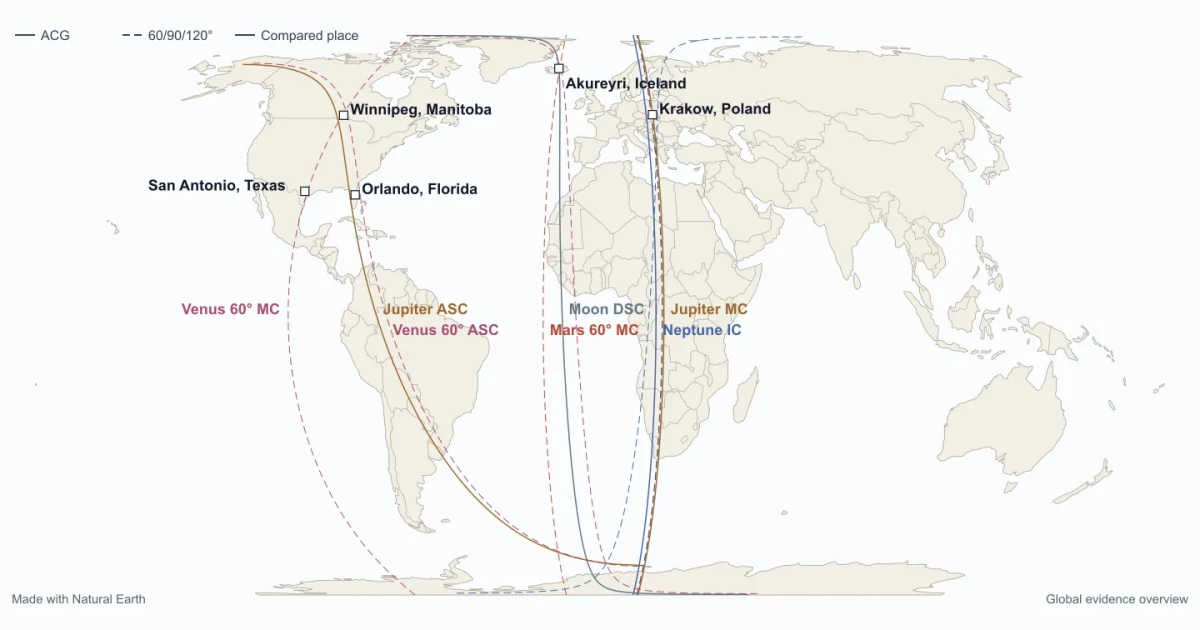
From free preview to complete evidence
Build a Complete Astrocartography Best Places Report
The free preview lets you test the workflow before deciding whether you need deeper analysis. Choose a goal and region, review candidate evidence, and see support, caution, fit, and confidence separately. The complete report expands that preview into a decision record you can save and revisit.
- a ranked ten-city shortlist for the selected goal
- a goal trade-off matrix
- comparison with your current city
- planetary-line, angle, distance, support, and caution evidence
- saved access and a downloadable PDF
- report-aware AI follow-up questions
Report-aware AI explains the evidence attached to the completed report. It cannot create new lines, hide limitations, or override the calculated ranking without support.
Choose your depth
Choose the Right Plan for Your Location Research
Start with the free core astrocartography map and Best Places preview. Upgrade when you want the complete shortlist, trade-off evidence, current-city comparison, saved reports, PDF, unlimited city tools, or grounded AI follow-up. Pro and Ultimate also include Best Time to Move, with complete dates and unlimited searches for any city and goal. Both plans also include full access to Find the Best Places for Two People, with unlimited searches and comparisons and no AI credits required. Plans are one-time purchases, not subscriptions.
Before you make the move
Frequently Asked Questions
Use the astrocartography map to improve your questions and comparisons—not to replace practical research or promise a result.
Can astrocartography tell me exactly where I should live?
No. It organizes calculated location evidence, identifies candidates, and clarifies comparisons. It cannot replace practical research or guarantee what happens after a move.
How do I use astrocartography to find where to live?
Generate your map, choose a goal, then check one city, compare known options, or discover candidates. Review support, caution, distance, trade-offs, and confidence together.
What is the best astrocartography line to live on?
There is no universal best line. Relevance depends on your goal, the planet-angle combination, distance, nearby lines, and broader chart context.
Can I compare my current city with somewhere new?
Yes. Compare Cities evaluates two to four places for one selected goal. The complete Best Places Report can also place your current city beside stronger candidates. For two people, Find the Best Places for Two People compares up to six cities, showing shared benefits and individual challenges.
What if I do not know which cities to compare?
Use Find My Best Places. Select a goal and region to receive a candidate preview before building or unlocking a complete shortlist.
How accurate is the result without an exact birth time?
You can explore with an estimate, but ASC, DSC, MC, and IC lines depend on birth time. Treat close rankings and distance-sensitive conclusions cautiously. Best Time to Move requires an exact birth time.
Does a Venus or Jupiter line guarantee a good place to live?
No. Venus and Jupiter can support some contexts but may also involve excess, idealization, or priorities that do not match your goal. Read the full combination.
What if no planetary line is close to a city?
A quieter location is not automatically negative. AstroCarto identifies the closest signals and labels broad or weak evidence without forcing a positive or negative verdict.
What is included in the complete Best Places Report?
It includes ten ranked candidates, goal trade-offs, current-city comparison, full location evidence, saved access, PDF download, and report-aware AI follow-up.
Your map is the starting point
Begin With Your Map, Your Goal, and Real Places
Generate your personal astrocartography map, then check one city, compare several options, or discover candidate places worth researching next. The useful answer is not a generic lucky city; it is a clearer, evidence-backed shortlist built from your own map.
Generate My Personal Map