
You can do your own astrocartography by generating a map from your birth details, choosing a city, and reading its planetary lines in context. If you are searching for “do my astrocartography,” AstroCarto lets you start here with a personal map, city checks, and explanations you can trace back to the visible evidence.
Do My Astrocartography
Complete your first reading
What should I finish with when I do my astrocartography?
A useful first session ends with more than a screenshot. You should know which birth record produced the chart, which place you examined, what the nearby lines actually say, and what remains uncertain. One city and one question are enough to begin.
Think of the work in three parts. The calculator places planetary lines on a world map. You interpret the named planet and angle in relation to a question. Then you investigate whether the real place offers what you need. These parts inform each other, but a symbolic interpretation does not establish a city’s housing, teaching quality, or opportunities.
For this walkthrough, the question is whether a short language course in Lisbon could offer more conversation and connection than studying alone at home. The end product is a brief personal reading, with the calculation separated from the interpretation and the practical checks. You can use the same method for a different place and purpose.
You are not trying to read every line, choose the best country in the world, or settle a permanent move today. A small, finished inquiry is more useful than collecting interpretations without knowing which ones apply.
Prepare your birth record and one place to examine
Enter your birth date, the local time recorded for the birth, and the birthplace in the form above. Choose the matching location from the suggestions. The birthplace identifies where you were born; it is not the city you want to visit. You will examine that destination after generating the map.
Use the most reliable time available. If it is unknown, select the form’s unknown-time option rather than inventing a precise minute. That produces an estimated-time chart for exploration. Keep that uncertainty in your notes: a precise-looking line on a screen does not make an estimated birth time precise.
Generate once, then inspect the result on this page. You do not need a second birth record for each destination. If you correct an input later, generate again and replace the earlier reading instead of combining observations from two different charts. For input problems, the separate guide to finding your astrocartography chart covers birthplace search and coordinate entry.
Before exploring, write one sentence about your purpose. “I want to practice a language through daily conversation during a six-week course” gives you something to investigate. “Tell me everything about my future” leaves no clear way to decide which result is relevant.
Read the city evidence before choosing a favorite line
Open Check City, search for your destination, and confirm the matching city and country. The result identifies nearby visible planetary lines and provides the planet, angle, approximate distance, and strength band. Record those fields together. “Mercury” alone leaves out which part of life the angle describes.
The distance helps replace a visual guess with a measurement. A path that appears to touch a city at one zoom level may not pass through it. The strength wording describes proximity in the summary; it is not a guarantee that a theme will be pleasant or that the city will suit your plans.
Start with the current visible selection and keep it noted. Hiding a planet changes the lines available to this summary. It does not remove that planet from the birth calculation. If you isolate Mercury to follow its paths, label the observation as Mercury-only; restore the planets you can access before writing a broader conclusion.
If there are no close lines, the tool can show the nearest visible signals as wider context. That is still a result you can describe. If all planets are hidden, restore a visible layer before trying to interpret the blank view. A restricted layer or an exhausted allowance is an access condition, not evidence that the location has no planetary lines.
Connect the explanation to the place you selected
Select the location on the map and look for Start with the answer in the place preview. This gives a plain-language starting point: the life area emphasized by the visible evidence, a planetary theme, and a suggested next step. The result can also indicate that the available signal is broad or neutral.
Open See why we reached this answer to inspect the visible lines, distances, and any available crossing evidence behind that preview. Confirm that the answer belongs to the place you selected. Check City and a clicked map point can describe different coordinates, even when you think of both as the same city.
Use the planet and angle as two distinct pieces of information. Mercury introduces communication, learning, and exchanging information as symbolic themes. DS directs attention toward relationships and one-to-one encounters. MC concerns public life and achievement. The letters matter: a Mercury DS label should not become Mercury MC because a career interpretation sounds more appealing.
The explanation helps you frame a question; it does not verify the course you are considering. If a preview emphasizes relationships while your purpose is language learning, ask whether the course actually creates conversations with other people. That connection needs both the map context and facts about the program.
Check and correct a first reading for Lisbon
This is an author-written teaching exercise, not a calculated Lisbon reading or a customer’s experience. For the exercise only, assume a city-check row reads Mercury DS and Broad. No numeric distance is supplied. Use your own displayed label, distance, and strength when doing this yourself; the drafts below are not AI responses.
A first draft that goes too far
You want regular conversation during a six-week language course and write:
Mercury means learning, so Lisbon will help my career. The line looks close on the map, which means the course is a good fit. I should pay the deposit.
Keep this draft long enough to check it. It jumps from a learning theme to a career claim, then from visual proximity to a judgment about the school. The purpose of the next step is to identify exactly which sentences the available evidence supports.
Check the wording against your result
Return to Check City and compare each claim with the complete row. If you also use Start with the answer, expand See why we reached this answer and confirm which location and lines support that preview.
| Claim in the draft | What to check | How the reading changes |
|---|---|---|
| This is a career-learning line. | The row says Mercury DS, not Mercury MC. DS concerns direct encounters; MC concerns public life and achievement. | Explore communication through interaction. This row does not establish a career outcome. |
| The line looks close, so it strongly supports my choice. | Copy the displayed distance and strength. The assumed band here is Broad. | Give the theme background weight in this exercise instead of treating a visual impression as a strong finding. |
| The course is a good fit. | The result describes map evidence, not the school’s lessons or teaching quality. | Ask for the timetable and amount of paired speaking practice before deciding. |
If your actual band is Wide context, keep the interpretation similarly modest. With Strong / close or Nearby, the interaction theme can deserve more attention within the reading, but proximity still does not rate the course. Review the other visible city lines before treating Mercury DS as the complete answer.
A corrected reading you can keep
For the assumed Mercury DS and Broad combination, an author-written revision could be:
For a six-week language course, the Mercury DS row gives me a communication-and-interaction theme to explore. The Broad band in this exercise keeps it in the background. This row does not establish a career benefit or rate the course. I will check the other visible city evidence and ask the school how much paired speaking practice the timetable includes before paying a deposit.
Compared with the first draft, this paragraph preserves the angle, uses the strength band, and leaves the school question open. Add your own distance beside the line label and replace the assumed band before keeping a version for your personal result.
Let new course information determine the next action
Suppose the school replies that teaching is mainly recorded and students work independently. The course may then miss your goal of regular conversation. Revise the booking plan: investigate a different format or a separate conversation group, while leaving the city itself open for further exploration. The planetary label does not need to change to explain that decision.
If the reply instead describes small-group lessons and regular paired practice, you have a practical reason to investigate the course further. Keep that reason beside the map interpretation in your notes. The timetable supplies information about the school; it does not prove the symbolism or guarantee a successful stay.
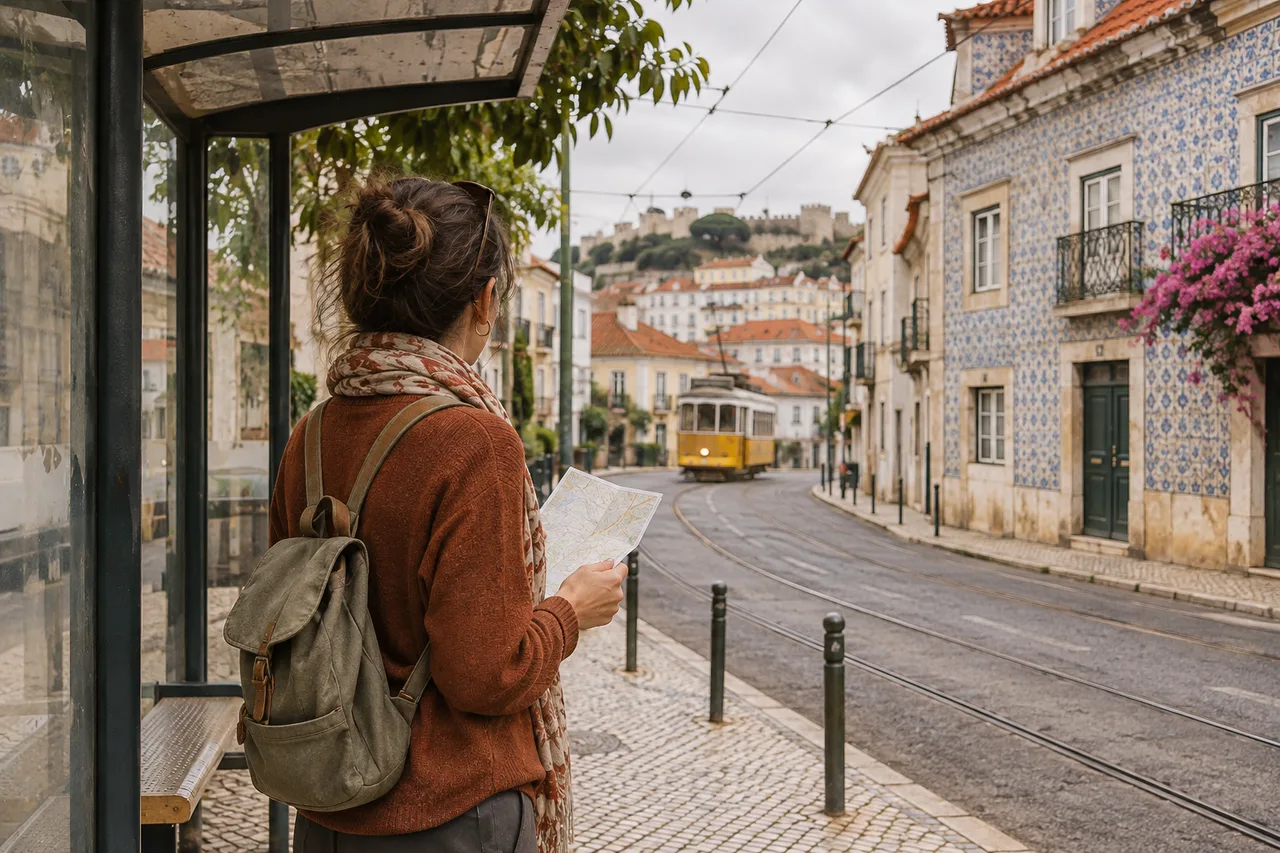
AI-generated scene illustration. A short visit can help you investigate daily life; this image is not a product result or a customer case.
Ask a follow-up that keeps the original evidence intact
When Ask AI about this city evidence is available in Check City, start there. That action attaches the current city and its line evidence, including planet, angle, distance, and strength. It reduces the need to retype the calculation, while leaving you responsible for explaining what you want to understand.
For the hypothetical course example, you could ask:
I am considering a six-week language course in this city, with regular conversation as my goal. Here is my first reading: [paste your draft]. Check whether my wording preserves the attached planet, angle, distance, and strength. Identify where I have turned proximity into a recommendation or assumed facts about the school. Help me revise the paragraph and identify what I still need to ask the school.
This is a suggested question, not an actual AI response. Paste the draft yourself; the city action does not automatically attach it, the school’s timetable, your budget, handwritten notes, or evidence for another destination. Add relevant background yourself. If you want to discuss a second place, make its evidence available rather than assuming the assistant can see both checks.
Read the reply beside the original result. Does it keep the same angle? Does it distinguish a symbolic theme from a factual claim about the city? If it introduces a distance or another planet, ask where that information came from before adding it to your reading.
AI can help express a subtle distinction or propose questions you had not considered. You can also complete this first pass without it. Keep the calculated fields, write a limited interpretation in your own words, and identify the practical information you still need.
Keep a record you can revise instead of a prediction to defend
Keep a short record of what you observed, how you interpreted it, and what you still need to check. Copy the template below into your own notes so you can revisit the reasoning later. It is a manual worksheet, not a separate save or export feature on this page.
| Field | Your own entry |
|---|---|
| My question | The experience I want to explore and the length of the proposed stay. |
| Birth record | Date, time, birthplace, and whether any detail is estimated. |
| Place and display | Selected city or coordinate and the planets visible during this check. |
| Calculated evidence | Planet, angle, approximate distance, and strength exactly as displayed. |
| My interpretation | What these labels might mean for the question, using conditional language. |
| Draft correction | A claim I kept, removed, or narrowed, and the evidence I used to check it. |
| What I cannot conclude | Claims about outcomes or local conditions that the map has not established. |
| Next step | One question, conversation, or visit that could clarify the choice. |
Keep the first draft beside the corrected version. In the Lisbon exercise, DS corrects the career claim, Broad reduces the theme’s weight, and the timetable informs the booking decision. Naming the source of each correction makes the revision easier to check later, even if you eventually choose a different course or city.
Write down what would change your mind. A timetable built around independent study, an unaffordable stay, or a corrected birth time can all matter, for different reasons. Keeping those reasons visible helps you revise the interpretation instead of treating every new fact as confirmation.
If the birth data changes, recalculate the chart. If the place changes, inspect the new place. If only the practical circumstances change, revise the plan without pretending the planetary lines moved. These are different reasons to revisit a reading.
Should I do my astrocartography myself or get help?
You have completed a useful self-guided first pass when you can identify the input, point to a specific result, explain a planet-and-angle combination without changing its label, and name the next question. You do not need certainty or a decision to move to count the session as useful.
The core map is free to generate. Check City displays its available allowance, currently 5 free checks. Location previews, AI follow-ups, additional layers, and deeper tools have their own access conditions. A displayed limit should guide your next action; it does not change the underlying meaning of a line. Review the access message before assuming another result is included.
For a broader place decision, you may eventually want comparisons or a fuller report, but those are separate tasks. Finish the current question first. If your difficulty is recognizing a mark, use the symbol reference. If you need an example of weighing competing themes, the astrocartography reading walkthrough takes that further.
Professional interpretation may be useful when the question requires more astrological context than you can confidently explain. This page supplies automated tools and a self-guided process, not a booked human consultation. State that distinction when deciding what kind of help you want.
Questions before I do my astrocartography
Can I do my astrocartography without knowing astrology?
Yes. Begin with one city, read the named planet and angle, and inspect the evidence behind the explanation. You can learn enough for a limited first pass without memorizing every symbol. Keep the interpretation modest when the terminology is still unfamiliar.
Can someone do my astrocartography from my zodiac sign alone?
Your Sun sign is not enough to calculate a personal map. Use the birth date, time, and birthplace requested by the form. People with the same Sun sign can have different birth moments and planetary line locations. Another person’s map is not a substitute for yours.
What if I do not know my birth time?
Use the unknown-time option and keep the estimated status in your record. You can explore the interface and learn the reading process, but narrow line placements should not be treated as precise. If a reliable birth time becomes available, generate a fresh result before using earlier notes.
Does generating a map include a personal reading?
Generation provides the map. Place previews can explain visible evidence within the available allowance, and AI offers a separate follow-up path when accessible. A complete human consultation is not included by filling in this form. The walkthrough helps you build an initial interpretation yourself.
Should I search only for Venus or Jupiter?
Start with the available evidence for your question, rather than choosing a favorable planet name in advance. The angle, distance, other visible signals, and purpose all affect what you can reasonably discuss. An appealing label is not a finding that a course, relationship, or job will work out.
Can I use this method before a short trip?
Yes, as an exploratory reading alongside normal travel planning. Choose a concrete question and use the result to decide what to investigate during the visit. A map does not verify accommodation, safety, transport, or course quality. Keep those checks distinct from the symbolic interpretation.
Start your own reading, one place at a time
Start with your own map and a place you want to understand. Leave with a clearer question, a reading you can check, and a practical next step.
Generate My Map