
Get an astrocartography reading for a place you are considering with AstroCarto. Generate your map and select a location for an available basic answer and evidence. Then follow the worked example below to understand how a nearby supportive line can coexist with a mixed conclusion—and what that means for your next decision. For structured analysis, choose Create Personal Report in your results; sign-in and report access requirements apply.
ONE CITY · SUPPORT AND TRADE-OFFS · YOUR NEXT DECISION
Your Astrocartography Reading
Start your astrocartography reading with your birth details
Generate your map, then select a city for an available place answer. For deeper analysis, use Create Personal Report in the results and follow its sign-in and access steps.
Explore the worked reading
See an astrocartography reading with support and caution
A useful astrocartography reading can be encouraging and qualified at the same time. Consider someone exploring a job opportunity in another city. They notice a nearby Jupiter–MC line and wonder whether it means the move would help their career. The next useful step is to inspect the wider answer, not stop at the attractive label.
Our saved fictional sample gives Krakow, Poland, a mixed assessment for career and money. Its explanation identifies a Jupiter–MC line as primary support, a Neptune aspect line as the main trade-off, and a Pluto aspect line as a conflict to watch. Support remains part of this astrocartography reading; it does not erase the other evidence.
This astrocartography reading example uses a saved personal-report sample based on fictional birth details: June 15, 1990, at 08:15 in New York. The job opportunity is a teaching scenario, not a customer story. The sample is not a live calculation for you, and its complete report evidence is not a promise of what a free map preview includes.
Read the example as a demonstration of reasoning: identify the goal, inspect the answer, then separate its support from its qualifications. Your own birth details, selected location, visible signals, and available access determine the result you can examine.
The evidence behind a mixed astrocartography reading
The saved explanation contains three named signals. Keep their full labels when interpreting this astrocartography reading. An ordinary Jupiter–MC line and a 90° or 120° aspect to an angle are different features, even when they involve familiar planets.
| Role in the saved career explanation | Evidence label | Distance | Exact residual |
|---|---|---|---|
| Primary support | Jupiter–MC line | 3.9 km | Not specified here |
| Main trade-off | Neptune 90° to ASC | 135.3 km | 1.37° |
| Conflict to watch | Pluto 120° to MC | 35.4 km | 0.46° |
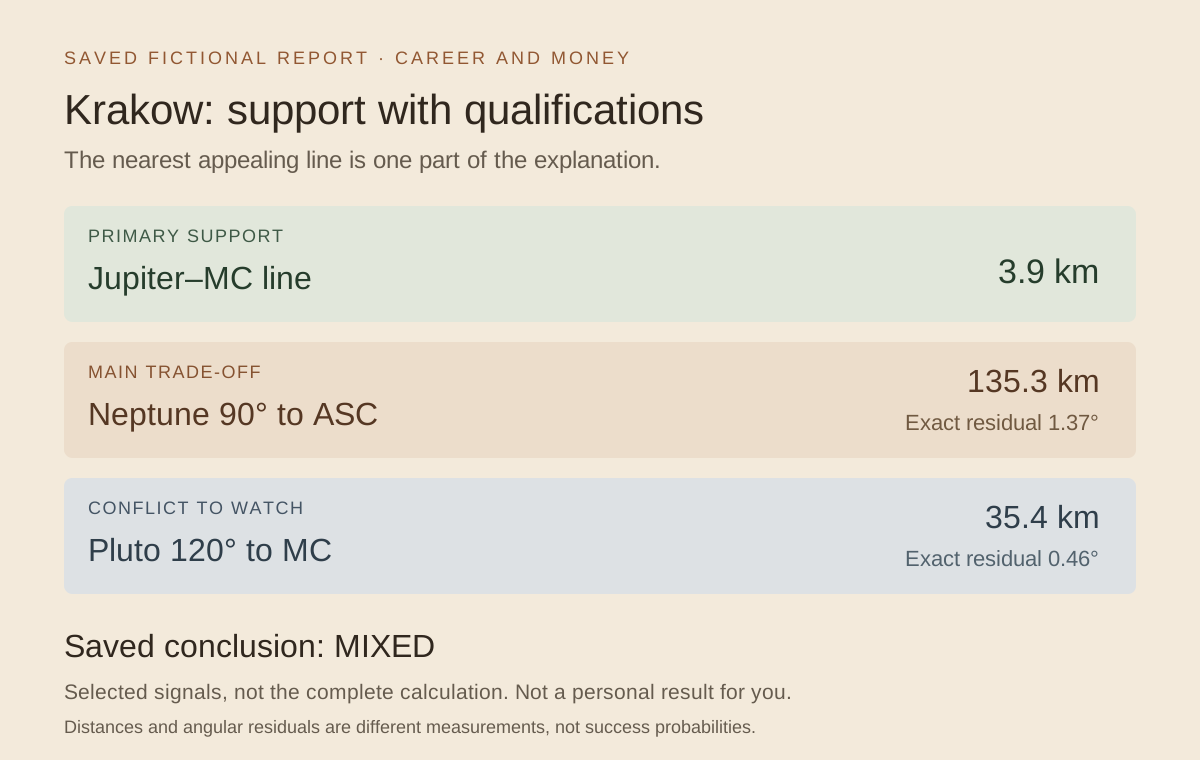
Saved fictional astrocartography reading from a personal report. These are the signals named in its career explanation, not an exhaustive list, a live result, or a screenshot of the free preview.
Distance describes geographic proximity to the calculated feature. Exact residual is an angular quantity recorded for the aspect evidence. Kilometers and degrees answer different geometric questions; they should not be combined into a personal success score. This table does not reproduce the full assessment method.
For this astrocartography reading, the saved result is already mixed. We are explaining that result rather than attempting to reconstruct it by averaging three distances. Other context exists in the report. A short explanation selects relevant evidence so that a reader can inspect the conclusion without mistaking the summary for the entire calculation.
Why the nearest appealing line is not the final answer
What the support contributes
AstroCarto’s general interpretation glossary associates Jupiter with growth and opportunity, and MC with career, reputation, and public direction. Together, Jupiter MC supplies a theme of professional expansion and visibility. In the saved astrocartography reading, that line is explicitly identified as support for the career goal.
Read “primary support” as the role this signal plays in the saved explanation. Its 3.9 km distance describes proximity; it is not a probability of promotion or a numerical vote that defeats every other signal. You can preserve the favorable theme while accepting that the overall assessment includes qualifications.
What the qualification adds
The same astrocartography reading names Neptune 90° to ASC as its main trade-off. Neptune’s general vocabulary includes imagination and ambiguity; ASC concerns identity, presence, and how someone enters an environment. Those broad meanings help explain the labels. The specific caution role comes from the saved assessment, not from treating every Neptune placement as unfavorable.
Keep the 90° in the label. The sample identifies an aspect to ASC, not an ordinary Neptune–ASC line. It also concerns a different angle from the Jupiter support. Reading both labels prevents you from treating the result as two interchangeable career scores. The saved explanation retains this qualification despite the closer Jupiter line.
How to read the Pluto conflict in this example
Pluto 120° to MC is named as a conflict to watch. The glossary links Pluto and MC with intensity, ambition, pressure, and power dynamics in public life. Those themes give vocabulary for reflection, but they do not independently establish why the complete assessment classifies this signal as a conflict.
Do not rewrite this astrocartography reading by assuming a 120° label must cancel every caution. Preserve both the aspect label and its role in the saved explanation. The useful distinction is between a geometric description, its broad symbolic vocabulary, and the role assigned in this particular assessment. None is a substitute for the other two.
Apply your astrocartography reading to a possible job move
The person in this scenario has one potential destination and an unresolved decision about work. To make an astrocartography reading useful, they first define what would make the move worthwhile: learning opportunities, responsibilities they want, and a working arrangement they can sustain. These criteria belong to the person, not the map.

AI-generated conceptual illustration of an imagined city. It is not a photograph of Krakow, a customer experience, or a calculated outcome.
Turn support into a question you can verify
The Jupiter–MC support gives the person a reason to examine what “growth” means in the proposed role. Would they gain a skill, lead a project, meet collaborators, or become more publicly accountable? Those possibilities are different. Someone seeking mentorship may not benefit from a title that adds visibility without support.
After an astrocartography reading, they could ask the hiring manager to describe an ordinary week and the first project’s responsibilities. A concrete description lets them compare their own goal with the opportunity. It does not confirm the astrology; it supplies information the map cannot provide.
Investigate the gap between an attractive story and a clear role
The Neptune caution invites attention to ambiguity. The person could separate what they have been told from what they have inferred. “There may be room to develop the team” is different from a defined responsibility with agreed resources. Writing down that difference can reveal the question they still need to ask.
An astrocartography reading does not prove the role is unsuitable. If the organization can clarify expectations and the person welcomes some uncertainty, the unresolved point may become manageable. If essential questions remain unanswered, collecting more favorable map signals will not supply the missing information.
Examine the responsibility that comes with influence
The Pluto conflict raises a different issue: how the person would experience responsibility, pressure, or decision-making authority. They might want to know who can change priorities, how disagreement is handled, and what support exists when a project becomes difficult. These are the guide’s suggested questions, not sentences generated by the report.
The value of this astrocartography reading is that it holds an appealing possibility and difficult questions together. It does not reduce the city to “yes” or “no.” The person can remain interested while examining whether the actual working arrangement fits their preferences and circumstances.
What a completed astrocartography reading looks like
A complete takeaway from this example needs more than “Jupiter is nearby.” It should preserve the goal, the reported conclusion, and the limits of the evidence. The following note demonstrates how someone could summarize an astrocartography reading without turning it into a guarantee.
For career and money, the saved Krakow astrocartography reading is mixed. Jupiter–MC is named as support, while Neptune and Pluto aspect evidence qualify the picture. For a possible job move, I would examine the growth opportunity, clarify responsibilities, and ask how authority and pressure are handled. The map cannot tell me whether this particular role will meet those needs.
The first two sentences summarize this saved astrocartography reading. The remaining sentences are an author-written application to the fictional work scenario. They are not an additional personalized forecast or a claim that the report inspected an employer.
| Part of the completed note | Where it comes from | How to use it |
|---|---|---|
| “For career and money … mixed” | The saved goal-specific assessment | Keep the goal beside the verdict; do not apply it to every part of life |
| “Jupiter–MC … Neptune and Pluto” | The named support, trade-off, and conflict | Keep all three roles when summarizing; do not retain only the appealing line |
| “I would examine … clarify … ask” | The author’s application to a possible job move | Treat these as questions to investigate, not additional report predictions |
When you summarize your own astrocartography reading, keep this separation between the result and your response to it. A reader should be able to tell which statements came from the tool and which you added. The note is complete enough to act on when it preserves the conclusion, names its evidence, and identifies an unresolved question.
Revisit your astrocartography reading after a real conversation
The next development in this scenario would come from the employer, not another planetary label. Suppose the person takes the questions from their astrocartography reading into a discussion about the proposed role. The following are alternative fictional continuations, not events that happened or outcomes predicted by the sample.
If the employer makes the role concrete
Imagine the employer names a mentor, describes the first project, and explains which decisions the person would own. The candidate now has information against which to assess their interest. They might write: “I understand the initial responsibilities and support. I still need to decide whether I want this level of public accountability.”
That is progress in the practical decision. It does not remove Neptune or Pluto from the map, turn the saved mixed label into supportive, or prove the Jupiter interpretation. The astrocartography reading stays on record while the candidate’s understanding of the opportunity becomes more specific.
If the employer leaves essential questions unanswered
Alternatively, imagine the conversation produces an impressive title but no agreed remit, resources, or reporting relationship. The candidate could keep the move undecided until those terms are clearer. They have identified an ordinary information gap; they have not established that Neptune caused the uncertainty.
In this branch, the attractive Jupiter support offers no answer to the missing job details. Another map preview would not resolve who sets priorities. The useful next action is to request the missing information, then decide whether the uncertainty is acceptable to this person.
If the input or the question changes
A corrected birth time calls for recalculation before reusing location-sensitive evidence. A different destination calls for inspecting that place. A changed goal, such as family life instead of career, calls for the relevant explanation rather than relabeling the career conclusion.
These are different from learning more about the same job. Keep a dated note of what changed: source data, selected place, personal goal, or external circumstances. Your astrocartography reading then remains traceable, while your practical decision can evolve without inventing a new calculated verdict.
Get an astrocartography reading for your own place
Start your astrocartography reading in the form above with your birth date, birth time, and birthplace. Your birthplace is where you were born, not the city you are considering. Generate the personal map first, then choose the destination in the results.
Continue your astrocartography reading from the map
- Read the selected place. Click your city or coordinate. In an available preview, begin with Start with the answer, then expand See why we reached this answer. Note the visible planet-and-angle labels and distances. This is the place-specific starting answer, not the complete report shown in the worked example.
- Open the report when you want structured depth. Choose Create Personal Report in the map results. Sign in when prompted. Use an exact recorded birth time for the personal report; if your time is unknown or estimated, keep the map exploratory instead of inventing precision to continue.
- Follow the access shown for your account. The report flow may open an existing report, offer an available overview, or request additional access. Follow the displayed steps before expecting a complete report. A free overview, when offered, is not the full set of evidence illustrated in this example.
- Read the report’s actual scope. When available, examine its listed places and life-theme assessments. Clicking a city on the map does not guarantee that it will appear in the report. If your destination is absent, return to its map evidence; absence is not a negative assessment of that city.
Keep these two routes distinct in your astrocartography reading: the location panel addresses the place you selected, while the report organizes the locations and themes within its supported scope. Use the Krakow example to understand an explanation’s structure, not to expect identical evidence or a mixed verdict in your own result.
For map controls, use the interactive reader guide. For the starting preview allowance, see the free reading guide. Both explain the corresponding step; you can begin from the form on this page.
Continue only when you can name the missing question
Your astrocartography reading may already help you identify what to ask about a proposed move. A practical gap, such as unclear responsibilities, needs direct investigation. Additional astrological detail cannot replace that conversation.
If the missing information concerns the map, inspect the accessible nearby evidence. If you want help explaining a selected result, Astrocartography AI describes how to ask with calculated context attached. For an organized assessment across places and life themes, choose Create Personal Report in your results. The personal report guide explains its scope and format before you continue.
An astrocartography reading becomes useful when you can explain what informed it and what remains undecided. You do not need a perfectly reassuring conclusion to take a sensible next step. You need a question specific enough to investigate and a clear distinction between the map’s interpretation and the realities of your choice.
Questions about your astrocartography reading
What do I receive from an astrocartography reading?
You begin with a personal map and the location information available through your current access. A place answer connects visible signals with a life theme. A fuller report can organize goal-specific conclusions and supporting or cautionary evidence. The available depth depends on the action you choose; this page’s report example does not describe every free preview.
Can I get an astrocartography reading without a human consultation?
Yes. AstroCarto provides automated map and interpretation features. This page explains a saved example and helps you apply the method to your result. It does not book a human astrologer or promise personal advice from a practitioner. Optional AI follow-up is also separate from a live consultation.
Does a mixed astrocartography reading mean a city is bad?
No. In the worked example, mixed retains support while identifying qualifications. Read the explanation for the selected goal and inspect its evidence. Whether the practical trade-offs are acceptable depends on your circumstances; the label is not a universal judgment of the city or a probability that the move will fail.
Why can a nearby Jupiter line appear in a mixed result?
An astrocartography reading can include other relevant signals and context. In this saved example, Jupiter–MC is support, while Neptune and Pluto aspect evidence add qualifications. The nearest appealing line is one part of the explanation. You cannot reconstruct the full conclusion from distance alone.
Do I need an exact birth time for an astrocartography reading?
Use your most reliable recorded time. When it is unknown, use the tool’s unknown-time option instead of inventing precision, and keep location-sensitive interpretations provisional. Some deeper actions require exact information. Check the requirement shown for that action before treating a small geographic difference as meaningful.
Can this astrocartography reading tell me to accept a job?
It can help frame questions about a place, but it cannot assess an employer, verify working conditions, or decide what matters most to you. In the fictional scenario, the practical outcome is a set of questions to investigate. The decision requires direct information about the role and your own circumstances.
What does the evidence say about your city?
Start your astrocartography reading with your own birth details. Choose one place, examine the available answer and evidence, and identify the question you still need to resolve.
Generate My Map