
Cyclocartography combines transits and progressions with location astrology to explore a place over time. Create your birth map in AstroCarto, then open Best Time to Move to explore one city’s timing over the next twelve months for your chosen goal. Compare the periods you could realistically use. The tool provides city timing windows, rather than a classical cyclocartography map overlay.
Cyclocartography: Understand Place and Timing
Explore cyclocartography and your timing question
How cyclocartography adds time to a birth map
Your birth map records a particular moment. If your birth details stay the same, its planetary lines do not move because you have a birthday, visit another country, or begin a new job. Cyclocartography introduces a separate time-dependent layer. It asks how later planetary positions relate to your personal location picture.
Cyclocartography can be relevant when a familiar city feels different during different chapters of life. A natal Venus line does not disappear when a relationship ends. Nor does a difficult month prove that a previously interesting destination was calculated incorrectly. Cyclocartography offers an astrological framework for discussing timing alongside the underlying place; it does not establish the cause of an experience.
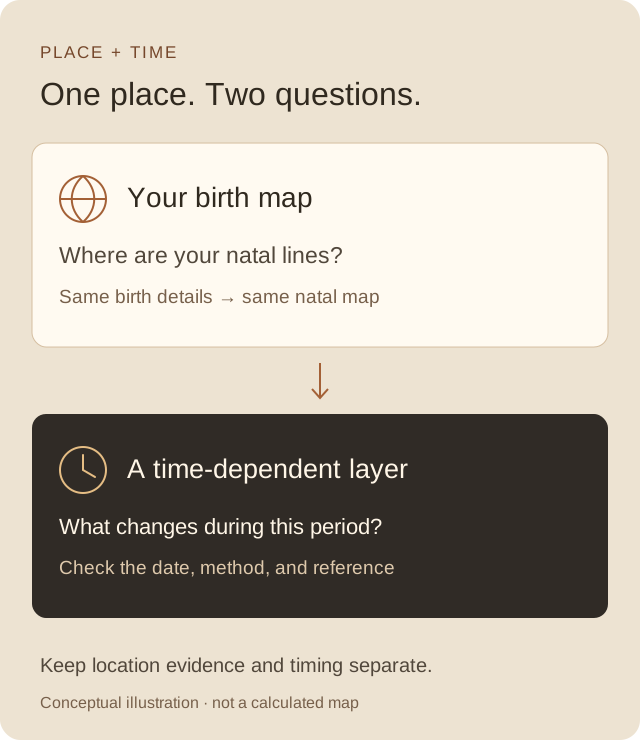
Conceptual illustration: these layers explain the distinction, not calculated lines for a person or city.
Keep two questions in your cyclocartography notes: “What does my birth map show near this place?” and “What timing question am I asking about it?” The first can be explored on the map above. The second needs a time-based method. A cyclocartography reading keeps those questions connected without treating them as interchangeable.
To evaluate a cyclocartography reading, ask which date and calculation support a changing influence. A general planet description does not establish when that influence applies.
What a cyclocartography calculation includes
Cyclocartography is associated with Jim Lewis’s development of location astrology. In the classic combination, the Sun, Moon, Mercury, Venus, and Mars use secondary progressed positions, while Jupiter through Pluto use transiting positions. Those positions are interpreted geographically in relation to the birth chart. The abbreviation CCG refers to this method, rather than a particular city or planetary line.
For a cyclocartography beginner, the useful distinction is how those two kinds of position are obtained. Transits describe planetary positions at the time being examined. Secondary progressions use a symbolic day-for-a-year relationship to the birth chart. They are not observations that a person literally lives another day of their infancy. In cyclocartography, the astrological interpretation remains a different layer from the position calculation.
Before comparing cyclocartography maps from different tools, check these details:
| Check | Why it changes what you are comparing |
|---|---|
| Birth date, confirmed time, and birthplace | They establish the personal chart used as the reference. |
| Target date and stated method | A current transit snapshot and a combined progressed/transit calculation need not represent the same thing. |
| Which planets are progressed or transiting | A label saying “dynamic” does not explain the calculation by itself. |
| Relationship to the natal map | You need to know whether you are seeing birth lines, a separate overlay, or contacts to a relocated chart. |
Cyclocartography is therefore more specific than drawing today’s sky on a world map. A transit-only display can be useful, but its label and instructions should explain its scope. Compare cyclocartography settings before comparing colors or concluding that a shifted line means one calculation is wrong.
Identify the line before interpreting its timing
Suppose a cyclocartography map identifies a progressed Sun MC line near a destination. “Sun” names the body, “MC” identifies the angular relationship, and “progressed” identifies the time method. Without that third label, you could mistake the line for a natal Sun MC path. A cyclocartography interpretation begins by keeping all three parts together.
Next, check what any crossing actually represents. A dated line crossing a natal line is not automatically a Paran, and a nearby line does not by itself give you the beginning and end of a timing window. Cyclocartography needs the date and method behind the geometry. If those details are absent, record the question rather than supplying a date from a generic planet meaning.
This is also why a cyclocartography line distance cannot be substituted for an AstroCarto timing score. They describe different measurements. Use the available result to answer its own question, and keep any separate cyclocartography map clearly identified in your notes.
AstroCarto’s Best Time to Move has a related purpose with a different implementation: it evaluates a city and goal, then returns timing windows. Transits establish the city windows, while additional methods can contribute background. This guide uses that existing workflow to explore a practical timing question; it does not present the output as a classical cyclocartography overlay. For the broader distinction between location methods, see locational astrology.
Give cyclocartography a specific timing question
Start with a decision you can describe. “Will Lisbon make me happy?” has no clear date, goal, or outcome to inspect. “I have two possible periods for moving to Lisbon, and I want to compare their relocation context” gives cyclocartography a specific job.
Separate the actions inside that decision. Signing a lease, arriving for a trial stay, starting work, and moving permanently may happen on different dates. Cyclocartography does not make those events equivalent. Choose the action you want to examine before interpreting a timing window, especially when your job or housing already fixes part of the schedule.
Use the map or Check City to establish the destination first. Read the planet, angle, approximate distance, and other available location evidence. Record that as the place context. This prevents a common cyclocartography mix-up: calling a line near your city a new transit when it actually belongs to your unchanged birth map.
Then choose one goal for the timing search: Relocation, Career, Relationships, Study, or Travel. Keep that goal the same when examining two possible periods. Changing both the city and the goal makes it harder to understand why the results differ. A useful cyclocartography question isolates the decision before expanding the search.
You can compare other destinations later. First finish one city-and-goal reading well enough to explain what you learned and what remains unresolved.
Use the map and timing results together
The birth map gives cyclocartography its personal reference. Enter your birth date, confirmed time, and birthplace above. Best Time to Move also requires a confirmed birth time; unknown or estimated times cannot be used for its city timing results.
Select your destination on the map and read its location explanation and available evidence. Check the name and coordinates. In cyclocartography, comparing periods only makes sense when you know which place each reading concerns.
Open Best Time to Move, select the city from the suggestions, choose a goal, and select Find My Best Time. It reuses your birth chart. Keep your birthday unchanged: entering a travel date there creates a different birth chart, not a cyclocartography reading.
The signed-in free preview shows the window count, overall outlook, and overall strength, or a quiet result when no window is found. It does not show exact date ranges or Strongest Dates. Those dates and supporting details require full-result access.
The search covers the next twelve months from the current date. To investigate a historical cyclocartography date, you need a calculation for that date. For future plans, compare the returned windows with your available dates.
Read timing evidence alongside cyclocartography
Cyclocartography can lead to two different questions: which time-dependent lines are near a destination, and which periods deserve attention there? A classical map addresses the first; the city timing results below address the second. Keep the method attached to each answer when combining them in a cyclocartography reading.
| Visible city timing result | Question from your cyclocartography reading | How to use the answer |
|---|---|---|
| Date range | Does this period overlap the action I am considering? | Match the window to arrival, a visit, or another specific action. |
| Favorable, Mixed, or Challenging | What balance of support and caution needs interpretation? | Read it for the selected goal; it is not a universal city rating. |
| Signal strength | How prominent is the evidence in this method? | Keep strength separate from whether the tendency is favorable. |
| Strongest Dates | Where is the emphasis within the period? | Check which dates fit your schedule; they are not mandatory arrival dates. |
| Why this time matters | What supports the interpretation? | Inspect the available alignment counts, events, and additional methods. |
Inside Why this time matters, Overall Timing Score expresses signal strength out of 100. It cannot be converted into a cyclocartography line distance or a success probability. Read the tendency first, then the strength; the London example shows why.
A Mixed result calls for examining support and caution together. Cyclocartography interpretation still needs your circumstances: the label alone cannot identify a housing problem or explain a relationship.
With No Strong Time in This Range, review the Month-by-Month Outlook instead of inventing an exact date. In your cyclocartography notes, record that this city method found no strong window. That does not erase a line on a separate cyclocartography map. Locked dates mean access is restricted; a calculation error provides no timing conclusion.
A saved city timing example for cyclocartography readers
The comparison below illustrates a useful distinction for cyclocartography interpretation: a prominent period is not necessarily favorable. It uses fictional birth details: 1 January 2000, 12:00 UTC, Greenwich. The saved AstroCarto calculation is for London / Relationships, starting 4 September 2026. This is a dated teaching example, not a live personal forecast.
Read the two saved windows
Two of the four saved windows appear below, in London local time. These dates belong to full results. A new search starts today and will examine a different period.
| Result field | January window | June window |
|---|---|---|
| Date range | 4 January–3 February 2027 | 18–30 June 2027 |
| Tendency | Mixed | Favorable |
| Signal strength | Medium | Low |
| Overall Timing Score | 71 / 100 | 57 / 100 |
| Strongest Dates | 9, 22, and 26 January | 24 and 28 June |
| Exact Planetary Alignments | 2 | 1 |
The city and goal remain fixed, as they should when comparing timing within one cyclocartography question. This excerpt contains no individual planetary explanations; it cannot identify a particular line or planet behind either tendency.
Compare tendency before score
January is stronger but Mixed; June is weaker but Favorable. 71 does not mean a better time for relationships than 57. For cyclocartography, this illustrates a useful distinction between how prominent an influence is and how you interpret it for a particular purpose. These numbers remain city timing scores, not cyclocartography measurements.
Likewise, three Strongest Dates do not promise three positive events. Cyclocartography interpretation needs context beyond a count; the table does not predict meetings, reconciliations, or relationship outcomes.
Turn the comparison into a next step
In this author-created planning scenario, you can visit London on 10–25 January or 20–28 June to reconnect with important people. Both visits overlap a window. The first includes 22 January, not 9 or 26 January; the second includes both 24 and 28 June.
If both visits are practical, inspect June first for its favorable tendency. Then check when those people are available. Their calendars can change the choice; neither the timing result nor a cyclocartography reading supplies that information.
Keep the evidence and your choice separate in a cyclocartography record: “January: Mixed, 71; June: Favorable, 57” describes the output. “Ask about June before booking” is the author’s suggested action. Generate your birth map and check your own city and goal before using these steps for yourself.
A short trip with fixed dates
A second cyclocartography scenario starts with a booked trip rather than an open-ended move. Suppose your leave is approved and your travel dates cannot change. Cyclocartography then serves a question about understanding the period and setting expectations, not finding a new country or pretending the schedule is flexible.
Inspect the destination, then choose Travel in Best Time to Move. If your dates fall within the available result range, read the window and monthly context around them. Keep the Travel goal when comparing periods; a Career result answers a different question. This is how a cyclocartography interest can lead to a focused use of the existing tool.
A challenging label does not forecast an accident or instruct you to cancel. A favorable label does not promise easy travel. Keep bookings, local conditions, health needs, and budget in the decision. Cyclocartography is an interpretive practice; it does not replace practical travel information.
For a short stay, choose one modest observation to revisit afterward: did the pace suit you, did you have space to rest, or would you want a longer visit? Write your cyclocartography expectations before leaving and experiences afterward. Avoid crediting cyclocartography for every positive event while ignoring the ordinary circumstances that shaped the trip. For planning the experience itself, the separate astro travel guide covers that task.
Keep a cyclocartography record you can revisit
A cyclocartography record should preserve the date, place, method, evidence, and decision. Label a classical cyclocartography map separately from an AstroCarto city timing result. Keeping that distinction lets you revisit a conclusion without confusing a mapped line with a scored window.
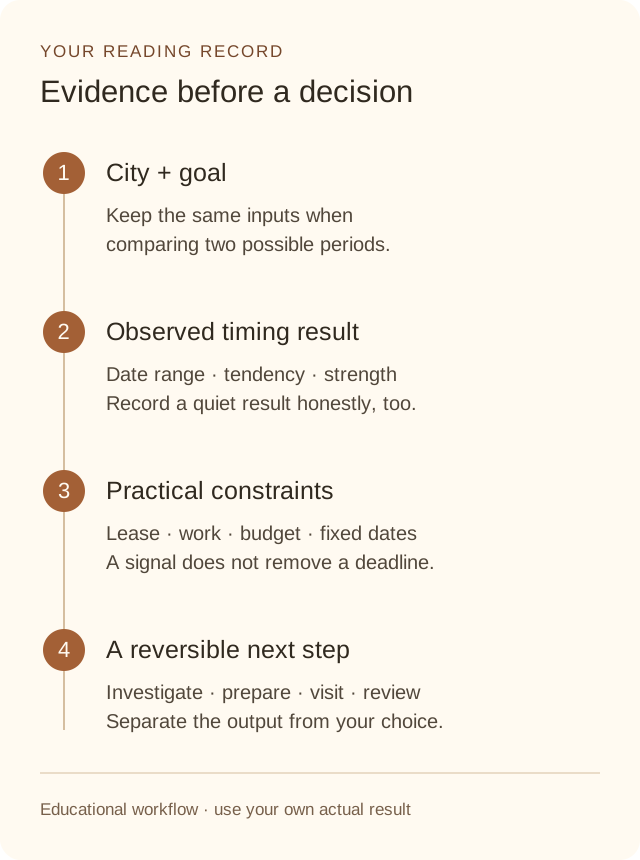
Reading workflow, not a product screenshot or a forecast. Fill it with your own result.
For city timing, note the goal, searched period, accessible dates, tendency, and strength. For a cyclocartography map, note the target date and whether a line is natal, progressed, or transiting. Add your response separately, as in the London example.
When discussing cyclocartography with an astrologer, bring those notes. Ask which conclusion comes from the natal map, which depends on the time layer, and what a corrected birth time would change. This is a conversation you prepare yourself, not an automatic import into AstroCarto.
Later, add what happened without rewriting your original cyclocartography interpretation. Include ordinary factors such as who could join you. Preserve a quiet result, too; it remains part of the record even if nothing noteworthy happened.
Cyclocartography questions
Is cyclocartography the same as astrocartography?
They are related, but answer different parts of a location question. The natal map shows the angular geography associated with your birth moment. Cyclocartography adds transits and progressions to examine timing in relation to that personal reference. Changing the date in an ordinary birth form does not create a cyclocartography reading.
Can I calculate a classical cyclocartography overlay here?
No. The shared tool creates your natal map and provides city timing analysis through Best Time to Move. To reproduce a particular cyclocartography overlay, use a service that explicitly supports that calculation and check its date and method settings.
Can I explore cyclocartography for free?
You can read this cyclocartography guide and create the basic birth map for free. The signed-in Best Time to Move preview shows the window count, overall outlook, and overall strength. Exact date ranges, Strongest Dates, and full window details require full-result access.
Does cyclocartography work without an exact birth time?
A personal cyclocartography map needs reliable birth information. Small changes can affect the reference used in the interpretation. For the timing workflow on this page, a confirmed birth time is required; unknown and estimated times are not accepted. Resolve that input before drawing precise timing conclusions.
Does a stronger result mean a better time to move?
No. Strength and tendency describe different things. Read whether the window is Favorable, Mixed, or Challenging alongside its strength and your practical circumstances. A cyclocartography reading is not a scientific probability model, and a score should never be presented as the chance of a successful move.
What if cyclocartography and my practical plans disagree?
Keep the practical facts visible: work, housing, finances, family responsibilities, and travel arrangements. Treat cyclocartography as a prompt for reflection rather than a requirement to override them. You can choose a smaller next step, gather missing information, or proceed without a strong timing signal.
Bring your timing question to your own map
Start with your birth details, check one destination, then open Best Time to Move in your results. Keep the city, goal, and practical decision together.
Create My Personal Map