
Astro travel uses your personal astrocartography map to explore places through the purpose of a trip. Generate your map with AstroCarto, select a destination, and inspect its available planetary evidence. Use your own result to identify a theme worth exploring and a question to resolve before booking. The six-night example shows how those questions inform an activity choice, independent time, and an optional excursion.
YOUR MAP · YOUR BASE · YOUR DAYS AWAY
Astro Travel: From a Map to a Trip
Start your astro travel map
Enter your birth details, generate your map, then select a destination to inspect its available answer and evidence. Access conditions apply to additional tools and reports.
Explore the six-night trip plan
Begin with one place and one purpose
A line across the world is an invitation to investigate a region. A trip needs somewhere to sleep, activities you can actually reach, and enough time to enjoy them. The useful move in astro travel is from an interesting map pattern to a place that fits your days away.
Imagine a solo traveler considering six nights in Winnipeg. Their aim is to learn something new, explore at their own pace, and return with ideas rather than an exhausted checklist. They are curious about their map, but they do not want to spend half the break changing accommodation. That preference becomes a planning constraint before any line is interpreted.
This astro travel scenario has a concrete brief: one base for six nights, one organized learning activity, time for independent exploration, and a day that can remain open. The traveler has not yet confirmed accommodation, activities, or transportation. Those are research tasks, not facts inferred from a birth chart.
If you already have several destinations and need a comparison method, use the travel destination comparison guide. Here, the task is narrower: take one place that interests you and decide how a visit could work. A useful outcome might be a simpler itinerary, a question to ask a host, or a decision that a detour adds too little value.
What the Winnipeg sample actually shows
Our astro travel example draws on a saved fictional personal-report sample. It uses a synthetic birth profile dated June 15, 1990, at 08:15 in New York. The sample’s Winnipeg travel and exploration assessment is mixed. The six-night holiday is an author-created teaching scenario, not a trip taken by a customer.
| Role in the saved explanation | Recorded evidence | Measurement |
|---|---|---|
| Primary support | Jupiter–ASC line | 151 km away |
| Main trade-off | Neptune–DSC line | 223.9 km away |
| Conflict to watch | Jupiter–DSC / Pluto–MC Paran | 0.501° residual |
These are the signals named in the saved explanation, not its complete calculation. The residual in degrees is not a distance in kilometers. This astro travel example uses report evidence; it does not promise that an available free location preview displays every field above.
The product glossary associates Jupiter–ASC with exploration, confidence, openness, and personal growth through place. For this astro travel brief, that turns a general wish to “do something different” into a question about which unfamiliar experience the traveler actually wants to try.
Neptune–DSC introduces idealization and unclear relationship boundaries into the symbolic vocabulary. The traveler can examine how much of the imagined group experience comes from a provider’s description and how much they have supplied themselves. This gives their astro travel research a specific question to investigate.
The saved Paran is also part of the cautionary picture. Preserve its exact label rather than turning it into a second Jupiter line or calculating a travel score from the residual. A full explanation would require the wider assessment. For this astro travel plan, the available conclusion remains mixed, with room for interest and unresolved questions together.
What line distance means for astro travel
The 151 km in the saved sample describes distance between a selected location and the calculated Jupiter–ASC line. It does not describe the drive from a hotel, a train journey, or the location of a sightseeing stop. That distinction matters before an astro travel idea turns into a reservation.
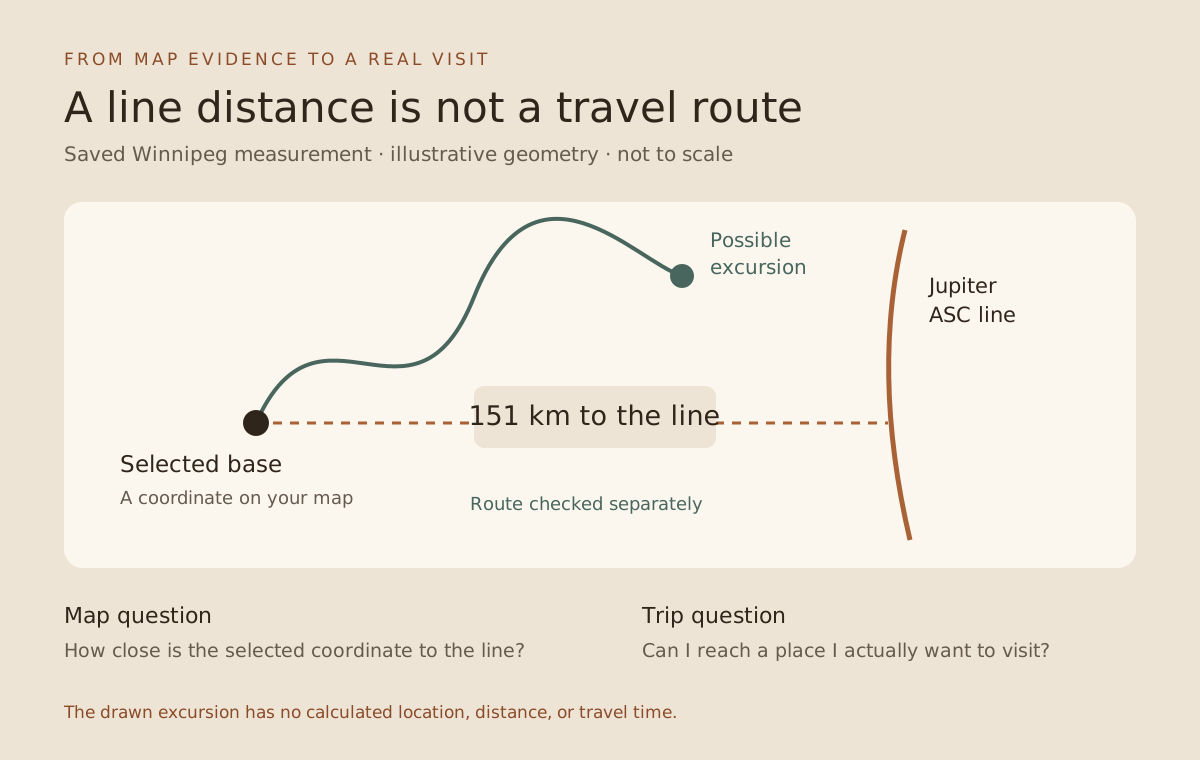
Conceptual diagram, not a geographic map. The 151 km label comes from the saved Winnipeg sample; the excursion and transport path are illustrative and have no measured length.
A tempting mistake is to draw an imaginary journey toward the line and assume that being closer makes the holiday better. The nearest point might not be a practical destination at all. Even when a reachable place exists, map proximity alone does not establish that it offers the experience you want.
Before adding an astro travel excursion, name the actual place you would visit and why you would enjoy it. Check transport, access, opening times, and the return journey independently. Then inspect that location’s own available map evidence. A city’s reading does not automatically describe every stop around it.
A hotel is another coordinate, but avoid making a room choice depend on tiny apparent differences without reliable birth data and appropriately precise evidence. Accommodation should meet the traveler’s ordinary needs. There is no reason to trade a workable base for an impractical one merely to make a line appear nearer on screen.
For more on interpreting proximity, read the line-distance guide. Keep two questions separate in your astro travel notes: “How far is this coordinate from a calculated feature?” and “What would it take to visit this actual place?” Only the second is a transportation question.
A completed six-night astro travel itinerary
The fictional traveler keeps one accommodation base and builds variety into the days. Their budget and available time establish the six-night structure. The astro travel evidence helps them choose what to investigate within it. These connections are the author’s application of the sample, not activities or bookings generated by the tool.
| Evidence in the sample | Question for this traveler | How it informs the plan |
|---|---|---|
| Jupiter–ASC is named as support | Which unfamiliar subject would I enjoy exploring? | Research one learning activity for day two instead of filling every day with generic sightseeing |
| Neptune–DSC is named as a trade-off | Am I assuming a group will provide the connection I want? | Check interaction expectations before committing; keep day three independent |
| The overall travel assessment is mixed | Which hopes still lack evidence? | Leave the excursion optional until the place itself and its logistics justify the visit |
This astro travel plan preserves choice. If the person dislikes organized learning, the Jupiter theme could instead prompt independent exploration of an unfamiliar interest. The chart supplies a subject for reflection; their preferences determine the activity. Arrival, sleep, meals, and departure remain ordinary travel arrangements.
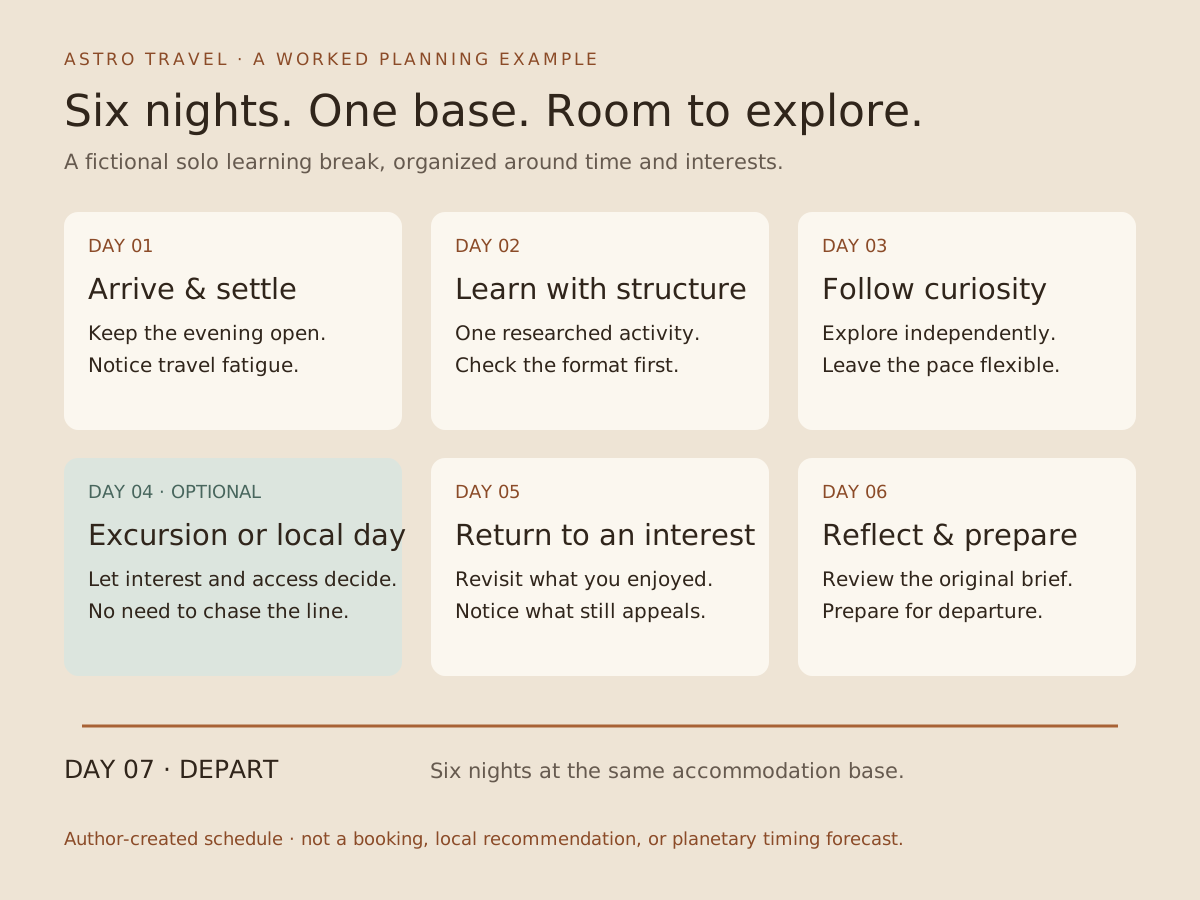
Author-created six-night plan. Activities, availability, transport, and accommodation must be researched separately. The sequence does not represent favorable planetary dates.
Arrive without making the first evening a test
Day one is for arrival, settling in, and finding a comfortable local routine. The traveler leaves the evening open instead of scheduling an experience to prove that the Jupiter theme is working. Fatigue, food, unfamiliar surroundings, and the journey itself can shape a first impression.
An astro travel note from that evening can be simple: what felt unfamiliar, what was easy to navigate, and what needs arranging tomorrow. There is no need to pronounce the destination right or wrong before the stay has begun.
Pair one learning commitment with independent time
For day two, the traveler researches a class, guided cultural visit, or another interest-led experience. Applying the Neptune question means checking whether the session involves paired exercises, continuous group discussion, or mostly independent participation. They can then choose a format they actually want, rather than relying on an appealing description of the atmosphere.
Day three remains largely self-directed. This gives the astro travel plan two different experiences of novelty: learning within a structure and following curiosity independently. The traveler can notice which suits them without interpreting a preference as a permanent personality diagnosis.
Keep the fourth day optional
Day four is reserved for an excursion only if it is appealing and feasible. If the transport would consume the day or the activity adds little to the brief, the traveler stays at the base and explores something nearby. The alternative is a complete day, not a failed version of the holiday.
In this astro travel example, the decision is not “closest line wins.” The candidate stop must justify the time it takes away from the rest of the visit. Changing accommodation solely to pursue a line would also add packing, check-in, and unfamiliar routines that the traveler originally wanted to avoid.
Return to an interest before leaving
Day five revisits something the traveler enjoyed or leaves space for a newly discovered interest. Day six has a slower rhythm: unfinished exploration, practical preparations, and a short review of the stay. Departure is on day seven, after six nights at the base.
The repeat visit matters. One exciting encounter may reflect novelty; returning can reveal whether the interest persists. An astro travel plan with some repetition provides a different kind of observation from moving on every morning. It also gives the traveler permission to enjoy a place without continually searching for a more dramatic signal.
Decide what to keep, change, or leave open
A plan becomes useful when it tells you which choices remain open. The following decisions belong to this fictional astro travel brief. They are not new predictions derived from the sample or universal instructions for visiting Winnipeg.
| What the traveler learns | What changes in the plan | What does not change |
|---|---|---|
| A suitable learning activity is available near the base | Reserve one activity and keep independent time around it | The saved map evidence does not verify its quality |
| An excursion requires more travel than the traveler wants | Keep the base and replace the excursion with a local day | A farther line does not make the remaining stay a failure |
| The activity involves more group time than expected | Choose another format or reduce other commitments | The map cannot determine whether the group will be compatible |
| A friend wants to join | Revisit the shared schedule, privacy, and budget | One person’s chart does not become a joint reading |
Keep two sources of information in your astro travel decision: the personal interpretation and the practical facts you have checked. The map does not verify providers, accommodation, transport, accessibility, or activity availability. If those requirements fail, change the plan regardless of how appealing a symbolic theme feels.
Apply astro travel evidence to your own plan
Begin your astro travel map with your birth date, most reliable birth time, and birthplace in the form above. Birthplace means where you were born. The destination comes later, when you select a place in the generated map; changing your birthplace to the holiday city would change the input incorrectly.
After generation, click a location you could realistically visit. In an available preview, read Start with the answer, then expand See why we reached this answer. Record the labels and distances actually shown. Your evidence may differ completely from the saved example, and some signals or further actions may require additional access.
A filled note you can adapt
Here is a completed astro travel note for the fictional sample, written by the author:
Place and result: Winnipeg; the saved travel assessment is mixed. Evidence to explore: Jupiter–ASC support alongside a Neptune–DSC trade-off. Meaning for my trip: I want to try an unfamiliar interest while checking my expectations of a group. Plan to investigate: one learning activity, followed by independent time. Still unanswered: what participation involves and whether the excursion is worth the journey.
For your astro travel record, replace each field with your actual place, accessible evidence, and question. The worked note draws on a report; an available location preview may offer a narrower answer. Write down what you can see, keep restricted information marked as unavailable, and connect only that evidence to your plans.
When your result differs from the example
Personal inputs matter because the available theme and evidence may change. An astro travel plan should respond to the answer you received, rather than borrow Jupiter simply because the six-night schedule looks appealing.
| Your astro travel result | How to adapt your planning question |
|---|---|
| An exploration theme is relevant to your goal | Name an unfamiliar interest and investigate a suitable way to try it |
| A relationship theme is more prominent | Ask how much shared and independent time you want; do not assume a learning activity is the priority |
| The answer feels unrelated to the trip you want | Reconsider whether this theme helps your question; keep activities based on your interests rather than force a fit |
| The evidence is sparse, unclear, or restricted | Record the gap and continue practical research; do not invent a favorable conclusion |
These are conditional ways to use an astro travel answer, not additional calculated outcomes for Winnipeg. Your basic schedule may stay the same while the question you investigate changes. That is a useful result too: personal interpretation should clarify a choice, not manufacture a reason to rearrange every day.
If your astro travel shortlist contains two destinations, inspect each before using Compare Cities. If you want a structured assessment across places and life themes, choose Create Personal Report in your results and follow the sign-in and access steps. The report guide explains its scope. Selecting a city does not guarantee that it will appear in that report.
Before adding another tool to your astro travel research, name the missing information. A question about a visible signal can lead back to its evidence; a question about an activity needs an answer from the provider. Continue through the route that can actually supply what you need.
Bring home observations, not a verdict on your future
During the stay, keep observations short and specific. “I enjoyed a small group more than an unstructured evening” gives you something to use later. “This whole city is my destiny” combines too many assumptions. Good astro travel notes leave room for ordinary explanations and experiences that do not fit the anticipated theme.
A useful entry has three parts: what happened, the circumstances, and what you might change next time. Note poor sleep, an unusually busy day, the company you kept, or an activity you already loved. A positive afternoon does not establish that a planetary line caused it; a difficult one does not invalidate every reason for visiting.
After your astro travel break, compare the experience with the original brief. Did the one-base arrangement leave enough room for curiosity? Did the optional day reduce pressure? Would you want more structure, more independence, or a different length of stay? Those answers can improve a future itinerary even if the astrological interpretation remains uncertain.
A holiday also cannot settle whether you should move permanently. Six nights do not test employment, long-term housing, community, or everyday responsibilities. If the trip raises a serious relocation question, use the where-to-live guide as a separate investigation rather than extending the holiday verdict indefinitely.
Questions about astro travel
What does astro travel mean on this page?
It means exploring travel destinations using a personal astrocartography map. The map connects places with calculated planetary lines and related evidence; your trip purpose gives that information context. This page focuses on arranging a realistic visit from that starting point, with the actual form and result available above.
Is astro travel the same as stargazing?
No. Stargazing concerns observing the night sky at a place and time. This guide uses a birth-based astrological map to reflect on destinations. It does not identify dark-sky sites, forecast visibility, or provide an astronomical observing calendar.
Does astro travel require staying directly on a line?
No. A calculated line is not a booking address or a promise of a better trip. Inspect the evidence for a practical destination, including other nearby signals. In astro travel planning, the accommodation and itinerary still need to meet your actual needs.
Does a longer stay make the line stronger?
Do not treat nights away as a dosage. The line geometry does not become stronger because you book extra nights. A longer stay changes the routines and situations you experience, which may give you more observations. This astro travel guide does not claim a formula connecting duration with planetary effects.
Can I plan astro travel without an exact birth time?
Use the unknown-time option when appropriate instead of inventing a precise time. Keep location-sensitive conclusions provisional and avoid choosing between close coordinates on that basis. Deeper actions can have stricter input requirements. Paying for additional detail does not make uncertain birth information more accurate.
Is the example available as my free result?
No. The saved fictional report belongs to its own birth profile. Your astro travel map uses your inputs, and the visible depth depends on your current access. Generate the map and inspect an available place answer; do not expect the example’s city, measurements, or complete report evidence to be reproduced for you.
Turn Your Selected Destination into a Trip Plan
Begin your astro travel plan with your own map. Select a realistic destination, read the available evidence, and decide what belongs in the itinerary.
Generate My Travel Map