
If you are asking “what is my astrocartography,” start with the map calculated from your birth details. It contains many planetary lines; checking a city shows which ones are nearby. Enter your birth date, time, and birthplace to find your map and understand why different places can highlight different parts of it.
What Is My Astrocartography?
Understand your personal map
Your answer is a personal map, not a single label
Your astrocartography is the geographic expression of your birth chart: a set of planetary lines across the world, calculated for your birth moment. There is no single answer like “you are a Venus line.” Different places relate to different parts of the same map. A useful personal answer therefore names both the person whose data was used and the location being considered.
With AstroCarto, you can move from that whole map to a particular city or selected point. The result can show a planet, an angle, a distance, and an interpretation of the relevant life area. Those details explain why a place has a particular theme in your map. They do not describe everything about your personality or everything that can happen there.
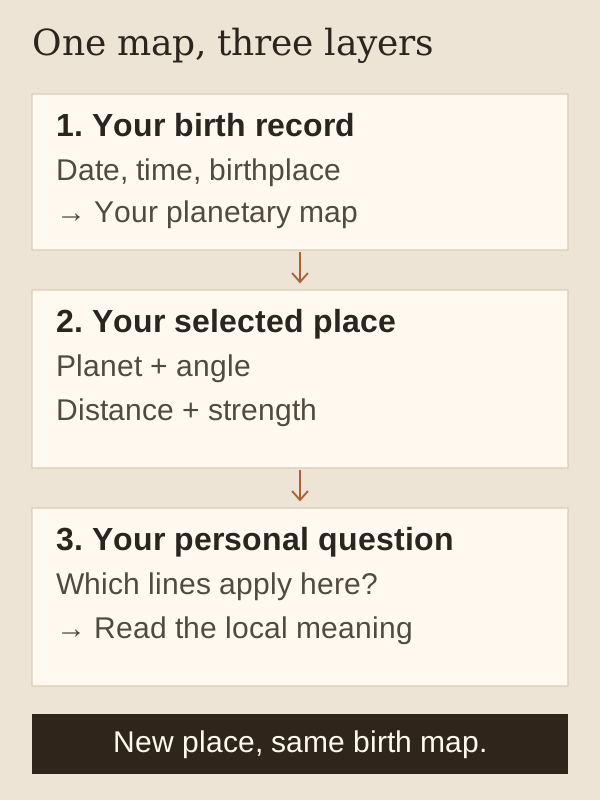
Three layers help keep the answer clear. Your birth record determines the map. Your selected place determines which nearby lines you inspect. Your question determines which parts of the interpretation matter to you. Checking another city changes the local evidence you are examining. Asking a new question changes your focus, while the underlying map still belongs to that original birth record.
That is why “what is my astrocartography” becomes more useful when followed by “at this place, for this part of my life.” You do not need a relocation plan to begin. Your current city, a familiar holiday destination, or a place you are curious about gives the question a concrete focus.
Make sure the map belongs to your birth record
Use your birth date, the local clock time recorded for your birth, and your birthplace. The city you want to explore comes later, after the map is generated. Putting a prospective destination into the birthplace field changes the input record; it does not ask the tool to explain your existing map at that destination.
For example, someone born in Montreal who now lives in Edinburgh still enters Montreal as the birthplace. Edinburgh is then a place to inspect. These cities illustrate the two roles, not a calculated example. The relevant distinction is between where the birth happened and where the person wants an answer now.
Sharing a Sun sign with a friend is not enough to share a map. The calculation uses more information than a zodiac sign, and the geographic lines depend on the birth moment. A screenshot that feels familiar may still belong to someone else. Begin with your own record rather than finding a picture that seems to match your experiences.
If you do not know your birth time, use the form’s unknown-time option and keep that uncertainty attached to any result. You can explore the interface and learn what the labels mean, but a precise-looking line cannot remove uncertainty in its input. An interpretation that resembles your life is not a way to verify a guessed time.
Check simple transcription details before interpreting: the date order, morning versus evening, and the correct birthplace when several places share a name. If you have two possible birth times, retain the source of each. A comparison between uncertain inputs is a question about the record, not evidence that one city is secretly better for you.
What is my astrocartography at a particular place?
After generating your map, use Check City to search for a place you know. Check the resolved city and country before reading a card. A result for another place with the same name will not answer your question, even when its interpretation sounds appealing.
The cards identify the planet and angle together, show the approximate distance to the line, and provide a strength description and theme. This gives you more than a colored line near a city name. You can tell which combination you are considering and how close it is to the city location used for that check. Keep those details together when taking notes.
You can also select a location on the map and read Start with the answer. It connects the visible evidence to a life area and planetary theme, so you have an initial explanation before interpreting every symbol. Open See why we reached this answer to inspect the supporting lines, distances, and any available additional signals.
Use that evidence to answer a simple question: why does this explanation mention home, relationships, public life, or personal initiative? Find the relevant angle and planet in the same selected result. If you cannot locate the evidence, leave that part unresolved rather than borrowing a label from another city card.
A city search and a manually selected point may use different coordinates. Treat them as separate results, even when both are within the same city. The distance from one cannot automatically support the interpretation from the other. Core map generation is free; previews and deeper tools have their own access conditions, so work with the information actually available to you.
Which of these lines is mine?
All the calculated lines on your personal map belong to that birth record. The nearest line at one place is a local relationship, not a permanent title for you. A prominent Venus line in one region does not remove your Moon, Sun, or other lines elsewhere. You are looking at different geographic expressions of one chart.
The complete label matters because the angle changes the focus of the planetary theme. A line labeled Moon IC combines a Moon theme with the private or home sphere. Venus DS connects a Venus theme with direct relationships. These are interpretive combinations, not personality categories or guarantees about what a destination will provide.
| Part of a line label | What it contributes | What it does not establish |
|---|---|---|
| Planet | A symbolic theme, such as belonging, communication, or connection | Your entire personality or a fixed outcome |
| AS / ASC / AC | Identity, initiative, and how you meet the world | A promise that starting over will be easy |
| DS / DSC / DC | Partnerships and direct encounters | A particular partner or an available friendship |
| MC | Public role, career, and recognition | A job offer or professional success |
| IC | Home, roots, and private foundations | Suitable housing or a guaranteed sense of safety |
| Distance and strength | Geographic proximity to the line in this result | A rating of how happy you will be |
When “what is my astrocartography” really means “which line should I follow,” first name the life area you care about. Then inspect the actual labels at a relevant place. Selecting a favorite planet before checking your result can make every explanation sound like an instruction to chase that planet.
You can consult planet and angle meanings for a label you do not recognize. Keep the full combination beside the city. A general meaning becomes relevant to your question through the specific result; a glossary alone cannot tell you which line is near your chosen point.
One birth map, two places: which result is yours?
You generate your map for the first time, check your current city, and notice a Sun MC card. Then you check another familiar place and notice Moon IC. Which one is your astrocartography? Did the second search replace the first result, or reveal a more accurate description of you?
These are hypothetical labels, not calculations for named cities. Both can belong to one birth map. The Sun MC card describes the first location’s relationship to a particular line; Moon IC describes another location’s relationship to another line. Neither becomes your single personal type. Follow the same process with whatever your accessible results actually show.
Keep the birth record, change only the city you inspect
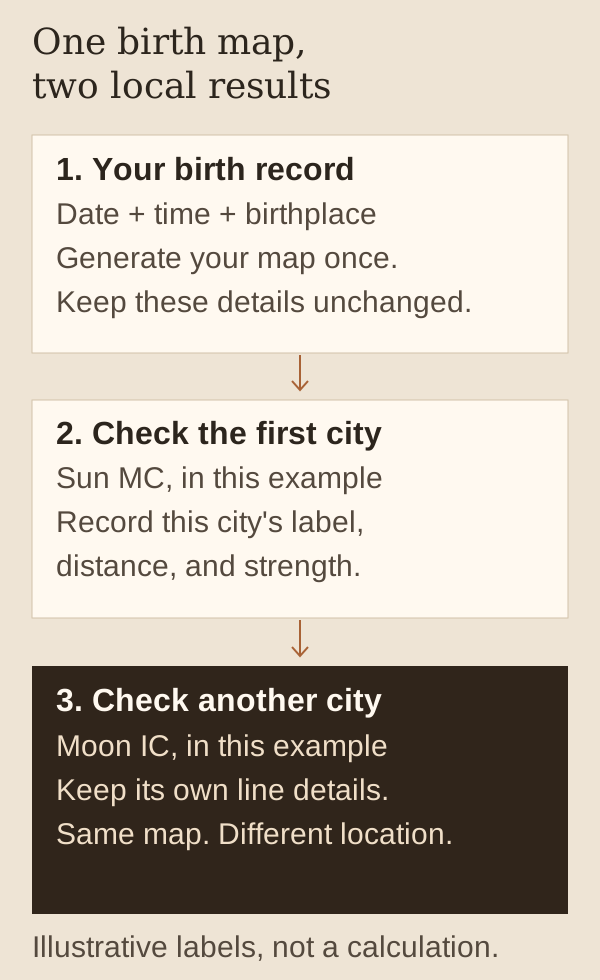
Generate the map once with your own details. In Check City, search for your current city and verify the resolved name and country. Note a complete planet–angle label, its approximate distance, and its strength. Keep the city name with those values before making another search; your note is a record you make, not an automatically saved comparison.
If your access allows another check, search for a second place you know. Leave the original birth date, time, and birthplace unchanged. Enter the second destination in Check City, not in the birth form. A destination is a point to inspect on your existing map. Replacing your birthplace would instead change the information used to generate it.
Read the second location’s own labels and distances. In this example, Sun MC draws attention to visibility and public life at the first place; Moon IC concerns belonging and private foundations at the second. Those themes describe different local relationships within one chart. They do not mean you became a different person when you changed the search.
| What you are checking | First place | Second place |
|---|---|---|
| Birth information | Your original date, time, and birthplace | Unchanged |
| Location being inspected | The first resolved city | A different resolved city |
| Illustrative line label | Sun MC | Moon IC |
| Distance and strength | Read from the first city’s card | Read separately from the second city’s card |
| What the result describes | A local part of your map | Another local part of the same map |
Your results may show the same planet at both places, different angles, or similar distances. That is still a useful check: the distinction is between the locations and their evidence, not a requirement to find contrasting planets. Keep additional cards with the city that produced them. One highlighted label is only part of what is available there.
The question you can now answer is “Which part of my map am I looking at?” A choice between destinations requires further interpretation and practical information. Here, you have established why two different local answers can both be yours without assigning either place a better score.
When two answers seem to contradict each other
Start with what each answer is about. A Sun MC interpretation for one city and a Moon IC interpretation for another can both describe your map. Reading the first as “I am a career person” and the second as “I am a home person” creates a conflict by turning local themes into fixed identities. Keep the city attached to each explanation.
If you expected to be viewing the same place, check its resolved location and the source of the result. A city search and a point selected on the map can refer to different coordinates. If the birth information also changed, you are no longer inspecting the same underlying calculation. Identify that change before trying to reconcile the wording.
A quieter result at the second place is not a missing personal identity. It can mean there is no strong nearby emphasis in the available visible evidence. No visible lines is a different state and calls for reviewing the map controls. A restricted detail remains unavailable; it does not establish that the corresponding line is absent from your map.
When you return to “what is my astrocartography,” keep the whole map and a local answer separate. The map is based on your birth record; each place reveals a particular geographic relationship to its lines. You do not have to select the most flattering local interpretation as the one that defines you.
Ask about the city you are actually viewing
Use Ask AI from Check City when a local result still feels confusing. This entry can carry the current city name, coordinates, and the displayed lines’ planets, angles, distances, and strengths into the conversation. Those fields give the explanation a specific place to address instead of requiring you to reconstruct the evidence from memory.
If you have checked two places, this entry supplies the currently selected city. It does not automatically attach the earlier city’s card as a second location. Begin with the result you want explained. If you later refer to another place, supply its actual recorded details and identify them clearly rather than expecting the conversation to retrieve an earlier search.
For the second place in the example, you could ask: “Explain the planet–angle labels attached to this city and what their distances add. How does this local result fit within my wider birth map? I have seen a different label elsewhere, but I have not supplied that other city’s evidence, so please explain this location without guessing the other result.” This is a suggested question, not an AI response.
Check that the reply discusses the selected city and the labels you can see. A claim about your dominant planet everywhere would need more than one local card. A useful explanation helps you understand this place’s part of your map and identifies what additional information a wider question would need.
Describe your map without reducing yourself to one line
A useful response to “what is my astrocartography” can now distinguish the full map from the place you checked. For the hypothetical two-place example, a personal note could read:
“My birth details produce one map containing many planetary lines. At the first place, I examined a Sun MC result; at the second, I examined Moon IC. These are different local parts of my map, not competing descriptions of who I am. I will keep each city’s labels and distances together and ask about the location I want to understand next.”
Add your actual cities and displayed values beside that note. If you have checked only one place, describe that result alone; you do not need another city check to understand the principle. Leave missing details unresolved. A note made from your own accessible evidence is more useful than copying the example’s planets into a chart that does not show them.
A life question comes after this distinction. A Moon IC theme may help you reflect on feeling settled at home, while a question about making friends still needs relevant relationship evidence and ordinary knowledge of the place. Keep that as an application of a local theme, rather than a definition of your whole map or personality.
Use planet and angle meanings when a label is unfamiliar. For a systematic reading method, continue with how to read an astrocartography map; for introductory concepts and exercises, use astrocartography basics. Return to your map with one concrete uncertainty, such as what a displayed angle contributes or why its distance matters at the selected city.
Questions about your personal map
What is my astrocartography if I only know my zodiac sign?
Your zodiac sign alone cannot identify your personal map. You need the birth date, time, and birthplace used to calculate the geographic lines. Start with those details and note any uncertainty. Someone with the same Sun sign may have different lines and different relationships to a particular city.
Is my astrocartography one main planet or line?
No. Your map contains multiple planetary lines. A nearby or emphasized line belongs to the selected location’s result; it does not become your permanent identity. Keep its planet and angle together, and avoid extending one city’s interpretation to every place on your map.
Does my map change when I move or have a birthday?
The natal map uses the original birth moment. Moving changes the place you inspect, and a birthday does not replace your birth data with today’s date. Timing and current-transit questions require additional methods; a natal location map alone is not a forecast for a particular travel date.
Can someone else’s map explain the same city for me?
Their map reflects their birth record, so it cannot substitute for yours. Even a shared destination needs separate personal calculations. You can discuss your experiences together, but do not transfer their nearest line, distance, or interpretation into your own result.
What if there are no close lines where I live?
Check that lines are visible, then read the actual location message. Distant visible lines can produce a neutral explanation rather than a strong theme. That does not invalidate your life there or imply you should leave. Use the evidence available and let practical circumstances inform your choices.
Can I find my map without paying for a full reading?
Core map generation is free. Place previews, additional signals, AI follow-ups, and deeper tools have their own access requirements or limits. Start with the available map and one place; decide whether you need more only after identifying a question the accessible result has not answered.
Find the answer on your own map
Generate your personal map, check a familiar city, and see how its local lines belong to the wider picture.
Explore My Map