
Learn astrocartography basics with your own map: what planetary lines mean, how the four angles change their interpretation, and where birth details fit. Create your map with AstroCarto, choose a familiar place, and work toward one result you can explain. Finish with a learning record you can check against actual evidence.
YOUR FIRST MAP · A CLEAR START
Astrocartography Basics
Practise astrocartography basics with your map
Create your map, then explore a place you know. Core map generation is free; place previews and deeper tools have separate access limits.
Your first lesson and practice questions
What astrocartography basics help you understand
Astrocartography maps places where planets were rising, setting, crossing the upper meridian, or crossing the lower meridian at your birth moment. Each line combines a planet with one of those four angles. Astrological interpretation connects that combination to themes such as identity, relationships, public life, or home.
In astrocartography basics, personal birth data comes before destination research. Different birth moments produce different maps of the same city. Your friend’s memorable trip cannot identify the combinations on your map.
Three questions organize a first lesson in astrocartography basics: whose birth data produced this map, which place am I examining, and what complete label am I reading? Start there before memorizing every symbol.
Astrocartography basics include both calculation and interpretation. Planetary positions and line geometry are calculated; their life meanings are astrological interpretations. Keep those sources distinct: accurate geometry does not establish that a place causes an experience.
You understand astrocartography basics when you can identify evidence, explain a combination, and recognize an unanswered question. Choosing where to live is a later task that also needs practical information.
Prepare your first map
To practise astrocartography basics, enter your birth date, recorded local birth time, and birthplace. Explore destinations after generating the map; the birth-location field is not a travel search.
Check the date format and morning or evening time against your original record. A precise-looking map cannot correct an input mistake.
You can study astrocartography basics with uncertain birth timing. Use the unknown-time option and learn the controls, while keeping personal conclusions tentative. A familiar-sounding explanation cannot verify an approximate time.
Choose a familiar city for your astrocartography basics practice. Existing knowledge of daily life helps you separate map statements from personal experience. Save destination comparisons for later.
Start a note outside the tool with your birth-time source, selected location, and one question. You will add evidence and an explanation below. This is your own learning record, not an automatically generated notebook.
Astrocartography basics: planets and angles
In astrocartography basics, the planet supplies a symbolic theme and the angle identifies its life area. Reading the pair together is essential: the same planet can have different interpretations at different angles.
Use this reference to identify the angle in your result:
| Angle | Astronomical relationship | Usual interpretive focus |
|---|---|---|
| AS / ASC / AC | Rising | Identity, initiative, how you meet the world |
| DS / DSC / DC | Setting | Partnerships and direct encounters |
| MC | Upper meridian | Public role, career, recognition |
| IC | Lower meridian | Home, roots, private foundations |
One distinction matters early in astrocartography basics: “Venus ASC” identifies places where Venus was rising at your birth moment. It does not mean your natal rising sign has become Venus. A planetary line and a zodiac sign answer different questions.
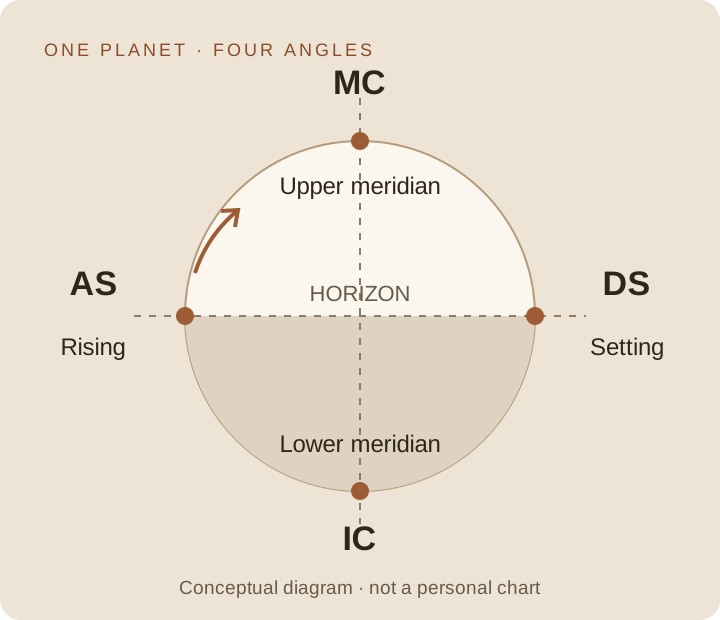
Conceptual angle diagram for learning; it is not a personal chart or a geographic map.
Begin the planetary vocabulary of astrocartography basics with five themes: Sun—visibility and self-expression; Moon—feelings and belonging; Mercury—communication and learning; Venus—connection and pleasure; Mars—initiative and friction. Read each theme alongside its angle.
The remaining five themes are Jupiter—expansion; Saturn—responsibility; Uranus—change; Neptune—imagination; and Pluto—power and transformation. These themes are not inherently good or bad. Expansion can involve overcommitment; responsibility can support sustained work.
Try an astrocartography basics contrast: Mercury MC places communication or learning in public or professional life. Mercury DS shifts attention toward one-to-one exchange. Comparing those labels tests whether you understand the angle; the planet stays the same. Neither predicts a publishing contract or a particular relationship.
Use the planet and angle meanings for unfamiliar labels. The combinations above are astrocartography basics teaching examples, not calculations for a supplied city. Practise with labels your own result includes.
Practise astrocartography basics on a familiar place
Use Check City to find a familiar place on your generated map. Verify its city and country. For hands-on astrocartography basics, the line labels, approximate distances, and strength descriptions provide measurable location context that a glance at the drawing cannot supply.
Choose an accessible card and copy its complete label, displayed distance, and strength. Write the city beside those values so you can return to the same result when checking your interpretation.
Select a map location and read Start with the answer. Identify the life-area words and planetary theme in its explanation. Applying astrocartography basics this way connects the vocabulary to your own result instead of requiring you to assemble an interpretation from symbols alone.
Open See why we reached this answer. Find the supporting planet and angle, distances, and available additional signals. If the explanation concerns public life, locate the angle behind it and add that label to your note. You can then show which result supports your understanding.
City search and manual selection may use different coordinates. Give each result its own entry. A city-check distance cannot automatically support an explanation from another point, even within the same city.
For this astrocartography basics exercise, locate evidence for one explanation. If a detail is unavailable, record that limit and practise with an accessible result. You do not need every planetary layer to explain one complete label.
Turn one result into a learning record
A useful astrocartography basics record shows how your understanding changed. Start with “I recognize Mercury, but what does MC add?” Separate the observed result, your interpretation, and independent knowledge of the place.
| Part of your record | What to write | How to check it |
|---|---|---|
| Selected place and source | City name or selected point; Check City or map location answer | Keep the note attached to the result you are viewing |
| Calculated evidence | Complete line label, displayed distance, and strength when available | Copy the result; do not estimate values from the illustration |
| Interpretation | Planetary theme plus the life area identified by its angle | Compare the label with the reference above and the available explanation |
| Independent fact | Something you know or have checked about that place | Name its source outside the map |
| Remaining question | One point you cannot yet explain or one practical fact still needed | Choose a relevant follow-up instead of treating the gap as a conclusion |
The example below is conditional on an accessible Mercury MC result. Fill the evidence row with your own values and change the interpretation if your label differs. No city distance or AI response is supplied.
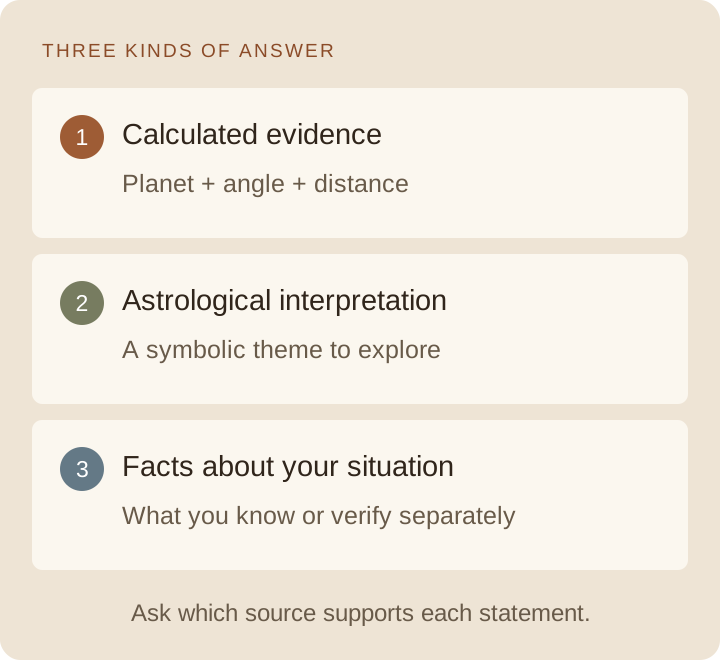
Before: I saw Mercury and assumed the label only meant communication.
Evidence to record: I keep the selected city, Mercury MC label, displayed distance, and strength together, copying only values available in my Check City result.
After checking the angle: Mercury supplies communication or learning; MC places it in public or professional life. Distance describes proximity to the line, not the chance of professional success.
What I know separately: I know a writing group in the city from my own research.
My next question: Would that group’s format help me practise presenting my work? I need its activities and schedule. If MC remains unclear, I can ask about the angle using this city result.
This author-written example demonstrates three astrocartography basics skills: explain the full combination, distinguish proximity from interpretation, and identify a practical question. It is a teaching note, not a generated reading.
Make a separate entry for another accessible label. Observe first, then explain. A remembered good or difficult stay adds personal context, but cannot establish that a line caused the experience.
Handle different result states
Treating a close line as a good score
In astrocartography basics, proximity and meaning answer different questions. Check City’s “Strong / close” describes distance context, not happiness. Keep it in the evidence row, then explain the planet and angle separately.
Name the life area and your purpose together. A career theme may interest someone seeking visibility but contribute little to a quiet-holiday question.
Treating an empty or quiet result as failure
A quiet result gives you something to record: no strong nearby signal is available. That describes the evidence, not the number of opportunities in your life.
Read the message before proceeding. No visible lines calls for turning on an available line; loading calls for waiting; restricted access leaves a detail unresolved. Respond to the stated condition before deciding whether there is enough information to interpret.
Treating the first explanation as the whole story
Practising astrocartography basics starts with one combination, but several lines may contribute themes. Return to the evidence and record another label separately before combining interpretations.
After astrocartography basics, use how to read an astrocartography map for detailed reading and place comparisons. First identify the evidence behind one explanation.
Ask a question about your result
Ask about the part of your result you cannot explain: “What does MC change in this Mercury result?” Naming the uncertainty gives the next explanation a useful scope.
Ask AI in Check City can carry the city name, coordinates, and displayed lines’ planet, angle, distance, and strength. This keeps your question attached to the selected city’s evidence without retyping those details. Your purpose and experiences still need to come from you.
Try: “I am learning astrocartography basics. Explain the angle in this result separately from the distance. Which part concerns public life, and what must I still find out about joining a writing group?” This is a suggested follow-up, not a quoted AI answer.
Check the response against the planet–angle reference above: does it explain the actual angle and separate a theme from a prediction? Clarify any unsupplied personal assumptions before adding the explanation to your record.
Core map generation is free; previews have limits and deeper tools have separate access requirements. Work through the reference and learning record with the results available to you, then decide whether a remaining question needs further interpretation.
Five exercises to check your astrocartography basics
Keep your result open while you work through these five exercises. Each produces something you can check. These are self-guided activities, not a quiz or score generated by the tool.
1. Copy a result you can find again
Choose an accessible Check City card. Record the city, full label, distance, strength, and your birth-time source. Check: find the same card again and match each copied field. Mark missing values unavailable; do not estimate them.
2. Explain the two halves of the label
Cover the card’s interpretation and write a sentence combining the planet theme with its angle’s life area. Compare it with the reference. Check: Mercury MC needs both communication or learning and public or professional life. “Communication” alone omits the angle. Use your actual combination.
3. Trace one place answer to its evidence
Read Start with the answer, then open See why we reached this answer. Find the label supporting the life-area statement. Check: both must belong to the same selection. If neutral or unavailable, record that state. A clear account of what you found completes this exercise, even without a prominent line.
4. Repair an unsupported conclusion
Apply astrocartography basics to this claim: “The line is close, so the city will be good for my career.” Keep the actual proximity, add the planet–angle meaning, and separate practical claims. Check: explain the combination without predicting an outcome, then name a fact still needed, such as what a local opportunity involves.
5. Choose your next learning step
Review your learning record and highlight one unresolved item. Consult the meaning reference for a label, prepare an AI follow-up for city evidence, or investigate a local fact separately. Check: name both the question and a source that could answer it. Sending an AI request is optional.
You have applied astrocartography basics when you can explain an observation, identify its source, and choose a next step. Repeat the difficult exercise before adding another place. Progress means understanding the result you already have.
Questions about astrocartography basics
Can I learn astrocartography basics without knowing astrology?
Yes. Start with one personal map, a familiar place, and the planet–angle reference. You can consult unfamiliar meanings as needed. Astrocartography basics provide a foundation for understanding individual results; a broader astrological reading can involve much more than this map.
What should I learn first in astrocartography basics?
Learn the input, a complete planet–angle label, and the selected location’s proximity to lines. Then separate calculation from interpretation. That sequence makes astrocartography basics practical: you can state what you observed before deciding what it might mean.
Can I practise astrocartography basics without my exact birth time?
You can study astrocartography basics and learn the controls, but uncertain timing limits personal conclusions. Use the unknown-time option and note that limitation. A familiar-sounding interpretation cannot verify a guessed time.
Do astrocartography basics tell me where to move?
Astrocartography basics help you understand location readings. Housing, visa options, finances, and personal wellbeing need separate investigation. Use your learning record to prepare questions about places, rather than treating an introductory lesson as a relocation shortlist.
Are map lines predictions of future events?
No. These lines describe angular relationships at birth, interpreted within an astrological tradition, not dates for future events. When learning astrocartography basics, distinguish a geographic relationship from a prediction in your notes.
Do I need a paid report to learn astrocartography basics?
No. Practise astrocartography basics with the free core map and place information available within your access. A report or AI follow-up can address a later question. First explain one complete label, its location context, and the evidence supporting your interpretation.
Put astrocartography basics into practice
Find one complete line label, explain its angle, and finish your first learning record with evidence from your own map.
Create My Map