
Get a free astrocartography chart with explanation from AstroCarto: your personal map plus a basic reading of a selected place, within the free preview allowance. Understand what each sentence says about your chart, which visible details support it, and what your first explanation leaves unanswered.
YOUR CHART · ITS LABELS · A CLEAR FIRST EXPLANATION
Free Astrocartography Chart With Explanation
Generate your personal chart
Enter your birth details to create the map, then select a place for its available basic explanation. Location previews have a free allowance; deeper tools have separate access requirements.
Read your first explanation, one sentence at a time
Suppose you have generated your first map and selected your current town. You recognize some labels, but the paragraph underneath is still hard to interpret. Does it describe your whole birth chart, this particular place, or something that will happen? Start by keeping the selected place and its explanation together.
Here is a conditional example of a free astrocartography chart with explanation: an available preview identifies Sun MC as the closest visible primary line in the strong category. These are the tool’s actual words under those conditions, not a calculated result for a named town.
Start with the answer can show:
This place may strongly affect career direction, public image, and achievement
The accompanying explanation can read:
The closest visible line is ruled by Sun. In practical terms, you may feel more visible, confident, and motivated to earn recognition, while becoming more conscious of your performance.
The first sentence names a life area and an intensity. The second identifies a planet and develops its theme. Together they give you a starting interpretation for the selected point. They do not describe every part of your chart. Open See why we reached this answer to connect the words to the available evidence; the annotated example below shows how to preserve the meaning without turning it into a prediction.
Understand your chart and its explanation
What does a free astrocartography chart with explanation include?
A useful chart should give you more than a colorful picture. It should let you identify what belongs to your birth data, inspect a place, and understand why the accompanying words describe that place in a particular way. The map above provides the starting point; selecting a location connects it to an available basic explanation.
With a free astrocartography chart with explanation, the first useful outcome is modest and specific: you can name a visible planetary line, recognize its angle, and connect that combination to the theme in your location preview. You do not need to understand every planet before trying this with a place you already know.
| Part of the experience | What you can learn | What it does not automatically include |
|---|---|---|
| Personal world map | Where the available planetary angle lines fall for your birth details | A verdict about every city on Earth |
| Basic location preview | A starting interpretation and the available evidence for the selected point | Unlimited location previews or every restricted signal |
| This illustrated guide | How to connect chart labels to the words in an explanation | A private consultation or a generated personal report |
The current basic allowance is 5 location previews. Visiting this page does not create a separate allowance from the shared map tool. Reopening a location can use another preview; the allowance is not described as a daily reset. Choose one place deliberately, then spend time understanding the evidence already displayed.
The standard unlocked planetary lines are Sun, Moon, Mercury, Mars, Uranus, Neptune. Venus, Jupiter, Saturn, Pluto have separate access requirements. Those boundaries matter when reading a partial view: a restricted line has not disappeared from your birth map simply because its detail is unavailable. A personal report, AI follow-up, or other deeper tool may also require additional access. The basic map is the place to begin, without committing to those next steps.
Give each mark on the chart a job
When you first open a free astrocartography chart with explanation, the most useful question is not “Which color is lucky?” It is “What does each part of this picture identify?” A line, a label, and a location marker do different jobs. Reading them separately makes the explanation much easier to follow.
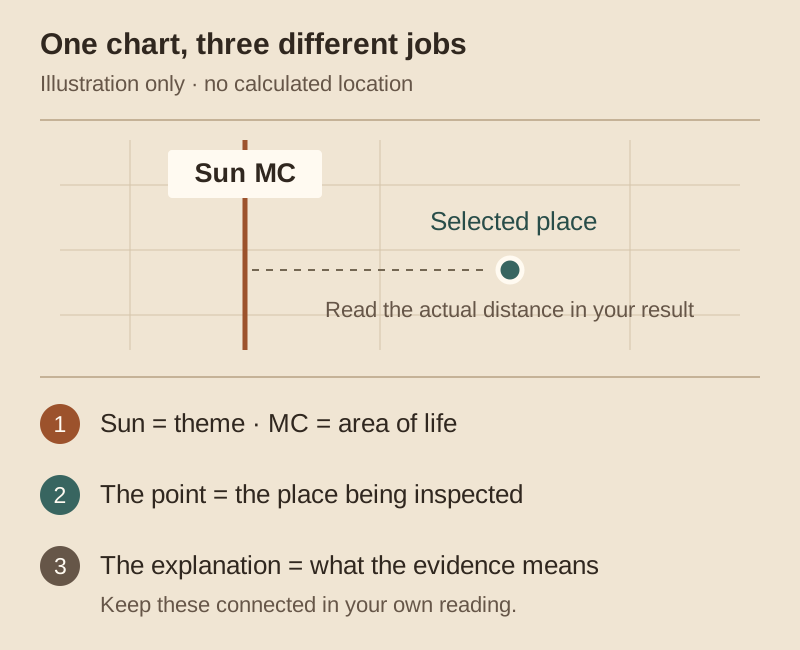
Reading diagram, not a calculated chart. The marked place and line have no real geographic coordinates. Your map supplies the actual labels and distances.
The planet name identifies the symbolic theme. In AstroCarto’s interpretations, the Sun concerns visibility and self-expression, while Mercury concerns communication and learning. A color can help you follow a line across the map, but the text label is the reliable way to identify it. Do not carry a color rule from another website into this chart.
The angle identifies the part of life through which that theme is interpreted. For a first pass, keep four compact distinctions in mind:
| Angle labels you may encounter | Geographic relationship at birth | Theme used in the reading |
|---|---|---|
| AC, ASC, or AS | Rising | Identity, presence, and beginnings |
| DC, DSC, or DS | Setting | Partnerships and one-to-one connections |
| MC | Upper meridian crossing | Career direction and public life |
| IC | Lower meridian crossing | Home, roots, and private life |
These are symbolic associations used for interpretation. The map calculates geographic relationships; it does not establish that moving to a line will cause a particular life event. In particular, MC does not mean that a planet must be directly overhead. Read the angle name instead of guessing from a line’s shape.
The selected point identifies the place currently being inspected. A nearby line is evidence about that point, while the distance describes their geographic separation. Finally, the explanation translates the available evidence into a theme you can consider. Keeping those roles distinct is what turns a free astrocartography chart with explanation into something you can actually read.
Match the words to the evidence
Return to the first explanation with one question: which part of the chart accounts for each part of this paragraph? You can make useful progress with the available preview before learning every line on the map. Treat the wording as a set of claims with different scopes, rather than one general verdict about your life.
In the conditional free astrocartography chart with explanation above, the following phrases come directly from the two displayed sentences. The interpretations in the last two columns are reading notes, not extra product results.
| Words in the explanation | What to check | What the words support | What they do not establish |
|---|---|---|---|
| “This place” | The location name or coordinates currently selected | The sentence concerns this inspected point | A description of every place on your map |
| “may strongly affect” | The primary line’s strong category; keep “may” when paraphrasing | A strong symbolic emphasis in this reading | A probability, deadline, or guaranteed event |
| “career direction, public image, and achievement” | MC in the complete Sun MC label | The life area being interpreted | Your profession, job prospects, or a predicted promotion |
| “The closest visible line is ruled by Sun” | The primary visible line named in the evidence | The source of this paragraph’s Sun theme | A complete inventory of every line or restricted detail |
| “while becoming more conscious of your performance” | The Sun interpretation accompanying the visibility theme | The explanation includes a possible pressure alongside confidence | A diagnosis of how you currently feel |
Notice how “visible” limits the claim about the closest line. The sentence does not say that every possible influence has been inspected. Likewise, “strongly” belongs to the tool’s strength wording; it does not cancel “may.” Keeping those small words gives you a more accurate summary than copying only the attractive themes.
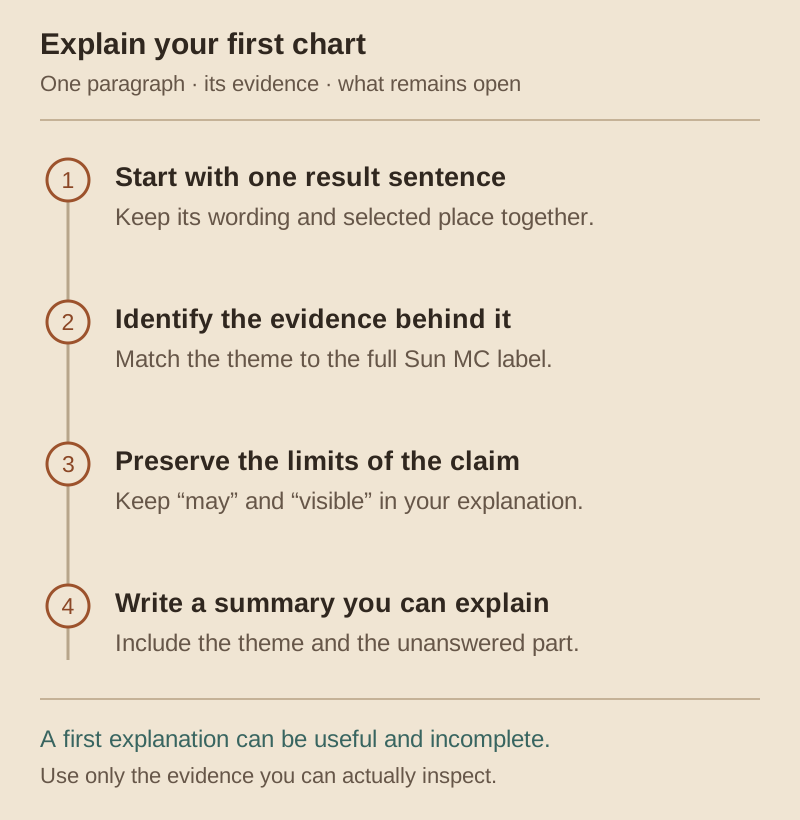
An annotation guide for the conditional Sun MC example. Use the words and evidence in your own preview; this is not a calculated city result.
Separate the map fact from the interpretation
“The panel names Sun MC” records what the tool displays. “Visibility is a theme to reflect on here” summarizes its interpretation. “This city will make me successful” adds a forecast that neither sentence supplied. When explaining your chart to someone else, keep the first two kinds of statement distinct. That makes it possible to revisit the interpretation without losing the underlying label.
For a free astrocartography chart with explanation, a good paraphrase should also preserve any tension in the original. In this example, confidence and recognition appear alongside performance awareness. Writing only “a good place for success” drops that second part and makes the result broader than it was. A short explanation can be readable without becoming one-sided.
If the marker is beside the line
A selected point can receive a nearby-line reading without sitting directly on the drawn line. Check its displayed distance and category instead of judging the screen gap. For thresholds and measurement details, use the line-distance guide. Here, distance is one supporting detail in understanding the paragraph, rather than a separate lesson.
If a term still blocks your reading, the map-reading guide provides the broader method. You have completed this first annotation when you can identify the sentence’s subject, point to its evidence, and name something it leaves open. A restriction or unfamiliar label becomes a specific question to investigate, rather than a reason to guess at the rest of the chart.
When the explanation is incomplete
An incomplete result is still useful if you know what is missing. A free astrocartography chart with explanation can show a clear basic theme, a relatively neutral location, or an access boundary. Those are different situations and should produce different notes.
Distant visible lines: the preview may explain that it does not have enough nearby evidence to emphasize a strong theme. Record that limited finding. It does not mean the location is bad, empty, or unsuitable for you; it means this particular map view offers less material for a strong line-based interpretation.
Restricted detail: you may be able to see that additional information exists without being able to inspect it. Keep the visible interpretation and identify the gap. Do not fill it with a remembered description of a planet, and do not write “no other influences” when the honest statement is “other detail is unavailable.” If your first chart has both a readable paragraph and a locked detail, record those separately: you have an explanation for the inspected evidence and an unanswered question about the rest.
No visible lines: an empty view cannot support the same explanation as a view with readable lines. Restore an available planetary line before attempting another location reading. If changing settings is the part you want to understand, the calculator and explanation guide examines that process in detail.
Uncertain birth time: generating an approximate map does not make its line positions exact. Keep the uncertainty attached to the interpretation. If you later obtain a reliable time, regenerate the chart before comparing the old and new explanations. A polished paragraph cannot repair uncertain input data.
For any free astrocartography chart with explanation, your stopping point should be the evidence you can actually inspect. If the next useful question requires unavailable detail, leave that question open. There is no need to purchase a deeper tool just to make an introductory note look finished.
Build a chart you can explain back
Start with your own birth date, recorded local birth time if available, and birthplace. The birthplace field refers to the birth event, not the destination you would like to explore. If you do not know the time, use the form’s unknown-time option and treat the resulting map accordingly instead of inventing a precise time.
Then generate your free astrocartography chart with explanation and select a familiar town. Keep the first available paragraph open while you inspect its evidence. Familiarity helps you separate what you already know about the place from what the chart actually adds. Do not rewrite a label to make it agree with a memory of living there.
Before requesting several more previews, complete this sequence with the first available one:
- Save the sentence you are explaining. Copy its wording into your own notes with the selected place. Keep qualifiers such as “may” and “visible.”
- Attach its evidence. Record the full planetary label and any displayed distance or strength. A natal Sun sign cannot substitute for a Sun line on this map.
- Paraphrase one claim at a time. Describe the life area, the planetary theme, and any tension in ordinary language. Do not add an outcome that the paragraph never mentioned.
- Mark the unfinished part. Write down any detail you cannot inspect or term you still do not understand. A complete first note can contain an unanswered question.
- Read the note back against the result. Check that your version describes the same place, evidence, and limits. Correct an overstatement before exploring another location.
A free astrocartography chart with explanation becomes easier to revisit when you preserve those connections. You now have both the original sentence and your interpretation of it. If someone asks why you mentioned a particular theme, you can point to the matching label rather than answering that the whole map “felt positive.” If a label remains unclear, leave that part unexpanded until you can identify it.
A completed example of the note
This is an author-written note completing the conditional example above. It demonstrates how to explain the available paragraph without claiming to have read the entire chart. It is not a saved customer result or a generated report.
| What I am recording | Completed note |
|---|---|
| What I am explaining | The basic paragraph for one selected place, not the whole birth map |
| Evidence in this example | The closest visible primary line is Sun MC, in the strong category |
| My plain-language version | The reading emphasizes public life and visibility; it also mentions greater awareness of performance |
| Limits I have kept | This is a possible symbolic theme, not a forecast of success; visible evidence is not necessarily the whole picture |
| What remains open | Any further lines or details I have not inspected, and how this theme relates to actual experience |
| What I would check next | Whether each sentence in my own preview has a label or other available evidence I can identify |
Read the middle two rows together. The note retains the useful theme and the limits that give it context. That is enough to explain this part of a first chart to another person. You do not need to invent a distance, a second planetary influence, or a personal story to make the explanation sound complete.
For your own free astrocartography chart with explanation, replace the evidence and interpretation, not just the location name. If your panel shows Mercury DSC, the example’s public-career emphasis is no longer the right explanation. If it shows a neutral result, retain that result instead of borrowing the strong Sun wording. This makes your record useful even when it differs completely from the example.
The finished note answers a practical beginner question: “What have I actually learned from this free chart?” You can name the subject, trace the wording to evidence, and identify the unfinished part. If that leaves you with a question across several places, the personal report guide explains that separate workflow. Bring the question you have identified; you already have a useful explanation to build on.
Questions about your free chart and explanation
Is the chart free, or only a picture preview?
The core interactive map is free to generate. A free astrocartography chart with explanation also offers basic location previews within the current allowance of 5. Restricted planetary lines, deeper features, and personal reports have their own access requirements. You can begin with the map and available explanation without purchasing a report.
Do I need an account to generate it?
You can generate the core map without signing in. Other actions may ask you to sign in or obtain additional access. Creating an account should not be assumed to remove every limit; follow the conditions shown for the particular feature you want to use.
Is this the same as a round birth chart?
No. A round natal chart organizes planetary placements and houses around the birth event. This map places planetary angle relationships onto geography. Your birth details connect the two, but a zodiac placement and a line passing near a city answer different questions. Here, “chart” refers to the geographic map.
Can I use it when I do not know my birth time?
The form includes an unknown-time option. Use it honestly and treat the output as approximate, especially when discussing whether a specific line passes close to a place. Knowing the calendar date alone does not justify a precise location interpretation. Revisit the chart if better birth information becomes available.
Does the explanation come from a human astrologer?
The basic explanation is automated. It translates the available map evidence into themes using the tool’s interpretation rules. It is separate from a live consultation, an AI conversation, or a personal report. Those formats should not be treated as interchangeable just because each can contain explanatory text.
Can a free astrocartography chart with explanation tell me where to move?
It can introduce themes to explore around a location, but it does not select a home for you or predict the outcome of a move. First learn what your own chart actually says. If you later compare destinations, consider the map alongside work, housing, relationships, and direct experience rather than treating one line as the decision.
Make sense of your own chart
Create a free astrocartography chart with explanation, choose one familiar place, and connect the words in its basic reading to the lines you can see.
Generate My Chart