
Astrology cartography maps the places where planets were rising, setting, or crossing the upper or lower meridian at your birth moment. Usually called astrocartography, it connects a birth chart to geography. Use AstroCarto with your birth details to explore a city you know. Identify the planetary lines and angle labels around that place, and learn how these geographic relationships differ from your Sun sign.
ONE BIRTH MOMENT · MANY PLACES ON EARTH
Astrology Cartography: Your Birth Moment on a World Map
Explore astrology cartography with your birth details
Enter your birth details, then select a familiar place on the map to inspect its available planetary lines and angle labels. The core map is free; place previews and deeper tools have separate limits and access requirements.
From your birth moment to a world map
One moment can look different from different places
Imagine a call with three friends around the world. For one person, the Sun is rising. Another sees it near its daily culmination, while someone else is approaching sunset. You are sharing one instant, even though your clocks and local skies differ. Astrology cartography begins with that distinction: keep the moment fixed and change the place from which it is observed.
To understand astrology cartography, replace the moment of the call with the moment of your birth. The calculation asks where a particular planet was at a particular angle relative to the local horizon or meridian. It repeats that question across Earth. A set of locations satisfying the same condition becomes a planetary line on your map.
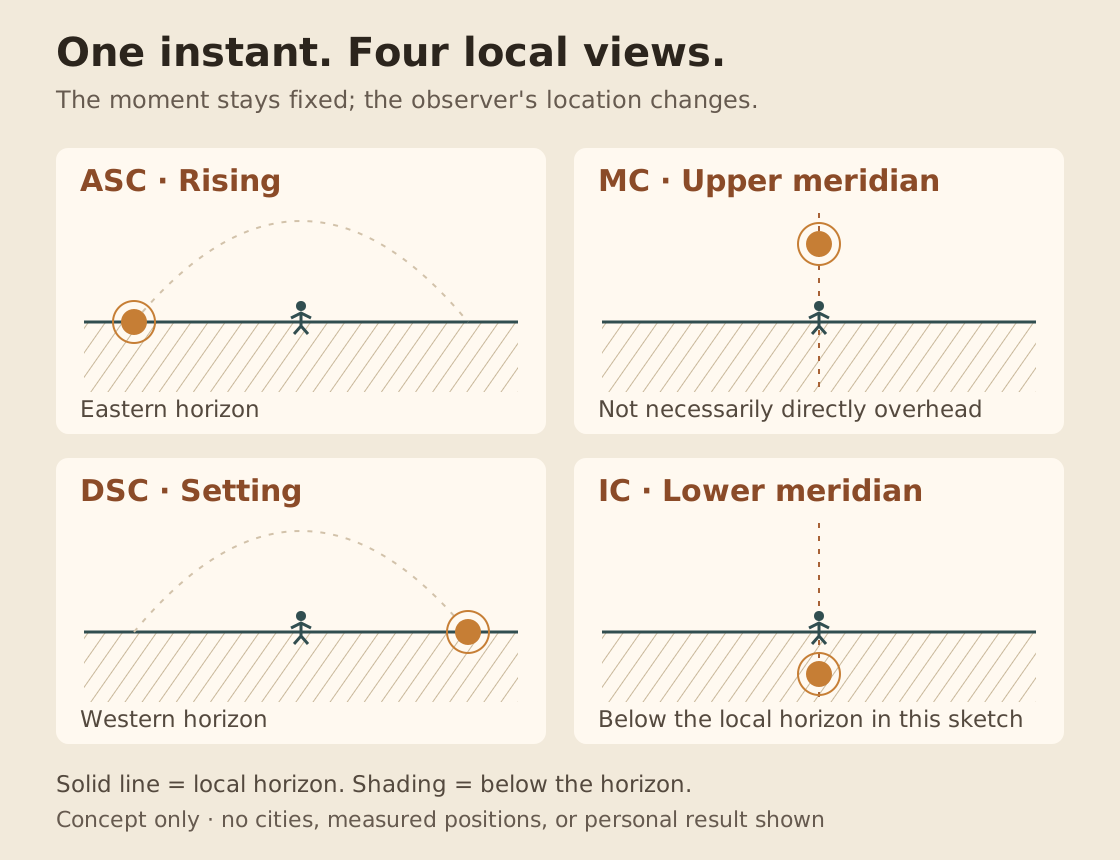
Conceptual local views, not a calculated chart or a sequence through time. The Sun illustrates four angular conditions; positions and spacing are schematic.
The Sun makes the idea familiar, but astrology cartography applies angular calculations to other planets too. You do not need to see a planet with your eyes for its position to be calculated. Cloud cover, daylight, and the view from your window are different questions from the geometric condition represented by the line.
This also explains why astrology cartography can cover countries you have never visited. The calculation does not depend on your travel history. It describes how the sky of that one moment relates to locations around the globe. Your birthplace is part of establishing your birth information; it is not the only place that can appear on the resulting map.
In astrology cartography, the interpretation comes afterward. Astrology assigns symbolic themes to the planet and angle. The calculation establishes where the angular condition occurs; it does not establish that a particular experience must happen there.
How an observation becomes a line in astrology cartography
Start with one planet and one condition: Jupiter rising on the eastern horizon. There can be many geographic positions where that condition holds at the chosen instant. Connecting those positions creates the Jupiter ASC line. The line is a collection of observing locations, not a trail left by Jupiter moving across the surface of Earth.
Four labels organize ordinary planetary lines in astrology cartography:
| Label | Geographic condition at the birth moment | Common symbolic area |
|---|---|---|
| ASC or AC | The planet is rising on the local eastern horizon | Identity and how you meet experience |
| DSC or DC | The planet is setting on the local western horizon | Relationships and encounters with others |
| MC | The planet is crossing the local upper meridian | Public direction and visibility |
| IC | The planet is crossing the local lower meridian | Private life, roots, and belonging |
The middle column describes the calculation. The right column describes an astrological interpretation. Keeping them separate makes astrology cartography easier to understand without turning symbolism into a geographic fact. A Jupiter MC line can prompt questions about growth in public life; it cannot confirm that an employer is hiring.
For MC, “upper meridian” is more precise than “directly overhead.” A planet crossing the meridian need not be at the zenith above your head. Likewise, an IC line does not require a planet to be exactly beneath your feet. These labels refer to angular relationships, not four physical destinations in space.
One planet can therefore have several differently labeled lines. Finding Jupiter ASC in one region and Jupiter MC in another does not mean Jupiter has changed identity. Astrology cartography is showing two different relationships between that planet and the local frame of reference. Read the angle as part of the name, rather than treating every Jupiter line as interchangeable.
For your first look at astrology cartography, choose one planet and recognize its labels before adding interpretations. The line meanings overview can help with symbolism once the spatial idea is clear. You do not need to memorize every combination to understand what the map represents.
Birthplace sets the input; a destination is something you inspect
Consider someone born in Chicago who now lives in Lisbon and wants to explore Tokyo. These are three different roles for places. Chicago belongs in the birth-location field. Lisbon and Tokyo are places to inspect after generating the map. Moving today does not replace the birthplace recorded in the original input.
An astrology cartography calculation needs an instant, not just a clock reading. A recorded local birth time must be understood with its date and birthplace, including the applicable time-zone rules. Enter the birth time as recorded for that place. Do not convert it to the destination’s clock time and then enter it as though you were born there.
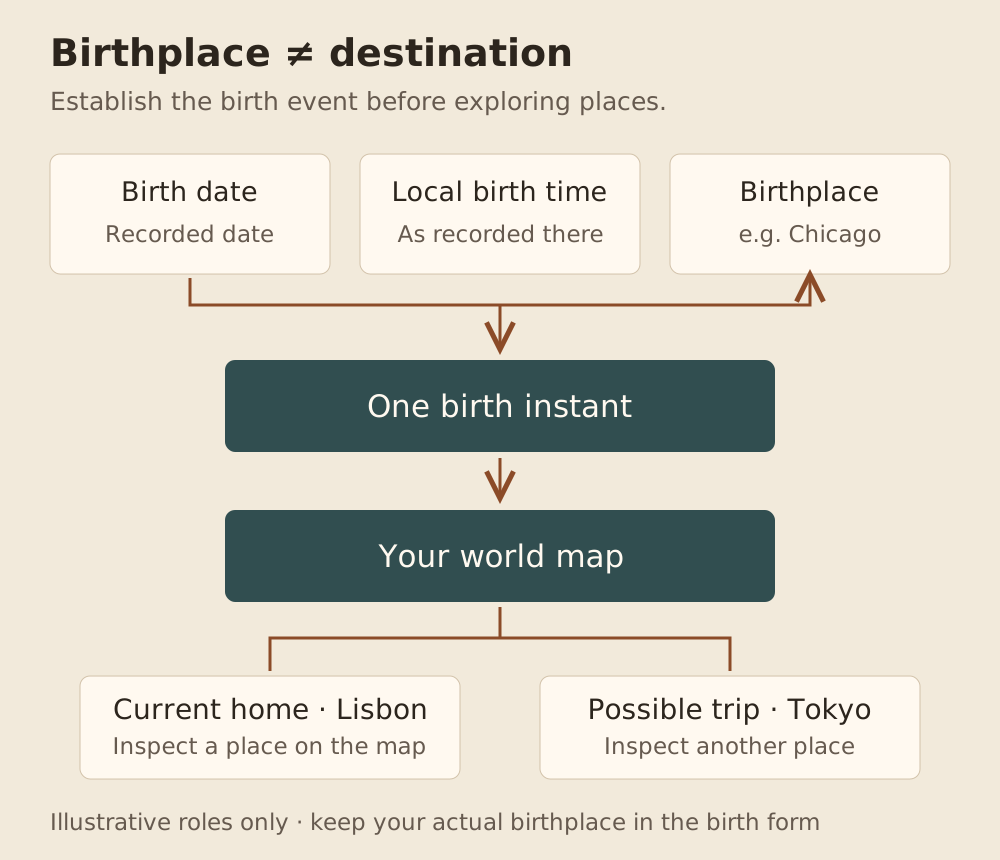
The diagram separates birth information from places you explore. Chicago, Lisbon, and Tokyo are illustrative roles, not calculated recommendations.
This is an important distinction in astrology cartography because the same clock reading in two cities usually describes different instants. Replacing Chicago with Tokyo while leaving the date and local time unchanged can change the event being calculated. It does not simply move a marker on the original map.
If you are uncertain about a recorded time, keep that uncertainty visible. The form offers an unknown-time option, but selecting it does not recover a missing birth time. Precise angle-line locations depend on time, so an uncertain input cannot support a confident statement that a particular street lies on your line.
Birthplace and destination serve different roles in astrology cartography, even when both involve searching for a city. A useful habit is to read the input back as a sentence before generating: “I was born on this date, at this local time, in this place.” Afterward, ask a separate question: “What does this map show near the place I want to explore?”
Generate your personal map with those roles kept separate. You can then examine a familiar place without changing the birth details that produced the lines.
A zodiac placement is not a geographic location
A birth chart and a world map describe different kinds of coordinates. A natal placement such as Sun in Gemini refers to the Sun’s position in the zodiac. A Sun MC line refers to geographic locations where the Sun was crossing the upper meridian at the birth instant. Astrology cartography connects the sky to Earth; it does not turn a zodiac sign into a country.
Suppose the Chicago-born traveler knows their Sun sign and expects it to identify Tokyo as a matching destination. That expectation leaves out the birth time and the relationship between the sky and local angles. People who share a Sun sign can have different maps. Even people born on the same date can have different lines when their birth instants differ.
The same distinction applies to a rising sign. Your natal ascendant belongs to the birth chart calculated for your birthplace and time. An ASC line in astrology cartography identifies places where a specified planet was rising. “My rising sign” and “my Venus ASC line” are related to the horizon, but they are not interchangeable answers.
| Statement | What it describes | What it does not establish |
|---|---|---|
| “My Sun is in Gemini.” | A natal zodiac placement | One country that is right for you |
| “This is my Sun MC line.” | A geographic angular condition at birth | A guaranteed career outcome |
| “This is my natal rising sign.” | The ascendant for the birth location and instant | The identity of every ASC line worldwide |
| “This city is near a Venus line.” | A place’s relationship to a particular line | The complete relocated birth chart |
Astrology cartography is most useful here as a translation between views. A globe view helps you scan geographic patterns. A relocated chart examines the same birth instant from one chosen location in more chart detail. They can complement each other, but a world map is not a full listing of relocated houses and placements.
If you are deciding between astrology cartography and a relocated chart, the locational astrology methods guide explains their different purposes. Stay with the map when your immediate question is where an angular condition occurs, rather than what every house in a relocated chart contains.
Why the drawing can be misleading at first
As the traveler moves the map view from Lisbon toward Tokyo, some lines look straight while others curve. In the ordinary geometry used for astrology cartography, MC and IC lines follow meridians; rising and setting conditions depend on latitude as well as longitude. The difference in shape describes geometry, not how favorable a destination is.
A flat world map also has an edge even though Earth does not. A line leaving one side can continue on the other. Panning or zooming the astrology cartography map changes the view, not the birth moment or the geographic relationship being examined. A line that looks close to Tokyo at a world scale still needs to be checked against the selected Tokyo point.
Read the complete label rather than carrying a color impression from Lisbon to Tokyo. In astrology cartography, Jupiter ASC identifies a relationship; “the yellow line” only identifies a display color. If a city has no prominent nearby ordinary line, record what is available instead of treating the blank space as a verdict about the trip.
Use the result’s available location evidence for proximity. The line distance guide covers that separate question. The aim here is to keep the traveler’s birth event, the map view, and the selected place distinct.
Try astrology cartography from Lisbon to Tokyo
Return to the traveler born in Chicago, living in Lisbon, and considering a trip to Tokyo. They want to understand how one personal map can describe both places. This astrology cartography exercise follows those three roles; it does not assign a planetary line to either city without a calculation. Use your own birthplace, current home, and place of interest when trying it.
Why does Chicago stay in the birth form?
The form describes the original birth event. The traveler enters the recorded birth date, local birth time, and Chicago as the birthplace, even while using the tool from Lisbon. Tokyo is the place they want to explore afterward. In astrology cartography, wanting to visit a city does not turn it into a new birthplace.
Before generating, they check that the form still describes the birth record. If the birth time is uncertain, that uncertainty follows the map into both city checks. Choosing a more familiar destination does not make the original input more precise. If they later correct the birth record, they regenerate the map and reconsider both locations using the corrected information.
Why use the same map for Lisbon and Tokyo?
First, the traveler selects a point in Lisbon and reads its available planet-angle labels. Next, they select the intended point in Tokyo on that same generated map. They keep each place attached to its own result, including any approximate distance shown. The astrology cartography comparison is between two observing locations for one birth instant.
If the labels differ, that does not mean a planet moved between the two clicks. The selected geography changed. If the available results share a planet-angle label, they should record that too: a useful exercise does not require inventing a contrast. Each place still has its own geographic context and available evidence.
The trip’s departure date is not entered as a new birth date. This natal astrology cartography map answers how the birth moment relates to Tokyo; it does not calculate the sky on the day of arrival. Exploring travel timing would be a separate question.
Why does one Sun sign not give both places the same answer?
The traveler’s natal Sun sign does not change when they select Tokyo instead of Lisbon. It describes a zodiac position at birth. A Sun line describes places where the Sun met an angular condition at that same instant. Astrology cartography makes this distinction visible: one natal placement can be examined against different geographic viewpoints.
The useful check is therefore not “Which city matches my sign?” It is “What planet and angle does the result actually identify at each selected point?” The result may emphasize a planet other than the Sun. The traveler should read that evidence rather than substitute a Sun line because they already know their Sun sign.
If a needed line or detail is restricted, leave that part unresolved and practice with the available evidence. An unavailable Tokyo detail cannot be filled in from the Lisbon result. That limit concerns access to the reading, not a change to the underlying birth event.
What should the traveler understand afterward?
A completed conceptual note for this astrology cartography exercise could read:
Chicago identifies my birthplace. Lisbon is where I live now; Tokyo is the place I am exploring. I used one birth event and inspected two locations on its map. My Sun sign stayed the same. I need each selected place’s own planet-angle labels and available distances to describe its relationship to the lines.
This is an author-written learning note, not a generated reading or a measured result for those cities. It demonstrates what the traveler has learned without pretending to know which lines their unknown birth details would produce.
Try the same astrology cartography exercise with your own locations. Keep the recorded birth information fixed, inspect each place separately, and check whether you can explain why the labels belong to the selected place rather than to an entire country. For the next step of interpreting those labels, use how to read your map.
What astrology cartography can help you ask
The traveler now has a more precise question about Tokyo: “Which planetary angles appear around the place I want to explore, and what do their themes invite me to notice?” Astrology cartography gives that curiosity a geographic starting point. It does not need to become a decision about permanently leaving Lisbon.
An accurate line calculation and a useful personal interpretation remain different things. The calculation establishes angular geography; it does not establish that Tokyo will feel welcoming or that the trip will be successful. A theme can suggest something to reflect on, while the traveler’s preferences and actual experience determine whether it feels relevant.
Start this astrology cartography exercise with the free core map and the place information available in your session. Previews have limits, and deeper tools have separate access requirements. You can learn the distinction between birthplace and destination without purchasing a complete report.
Once you understand that distinction, your next question can be about the place itself. Keep the actual label and location together when exploring its meaning. That is the practical foundation astrology cartography provides before any broader travel or relocation interpretation.
Questions about astrology cartography
Is astrology cartography the same as astrocartography?
In this context, yes. Astrology cartography is a descriptive phrase for mapping astrological relationships onto geography; astrocartography is the usual name for the planetary-angle mapping method discussed here. The wording does not require a different birth form or a separate kind of map. Broader locational astrology also includes methods with other purposes.
Why does the same planet have different lines?
Each ordinary line applies a different angular condition to the same birth instant. Astrology cartography can show where Venus was rising, setting, or crossing either meridian. Those are different observing locations, so read both the planet and its angle. They are not four different versions of Venus or a route between four destinations.
Will traveling change my original map?
Travel changes where you are, not the birth instant used for the map. Your natal astrology cartography lines therefore do not need to move because you take a trip. You examine another location against the same map. Techniques that introduce a new date or timing question are a different task from this fixed birth-moment view.
Can I use astrology cartography without an exact birth time?
You can explore the concept and use the form’s unknown-time option, but the missing information remains a limit. Precise angular positions depend on the birth instant. An approximate or unknown time should not be treated as enough evidence for a confident city-to-line or neighborhood-level conclusion. Better birth records can improve the input; interpretation cannot reconstruct them automatically.
Does a line show where a planet is now?
A natal astrology cartography map refers to the planet’s relationship to Earth at your birth moment. It does not show the planet’s current physical path or today’s sky. That is why your birth date matters even when you are investigating a future trip. Current planetary timing requires a separate calculation and interpretation.
Is a map enough to choose where to live?
No. Astrology cartography can offer questions and symbolic themes, but it cannot supply the practical conditions of living somewhere. Use a selected place’s evidence to clarify what you want to explore, then consider real opportunities and constraints. A closer line does not automatically make a city a better home for you.
Start your astrology cartography map with one place
Start with your actual birth details. Find one complete line label, then select a place you know and see how the two relate.
Generate My Map