
Use this where should I live astrology calculator to explore candidate cities when you do not yet have a destination in mind. AstroCarto connects your birth map with a Home goal and a region you could consider. See why a place appears, what deserves caution, and which candidate is worth checking more closely.
YOUR BIRTH DETAILS · YOUR HOME GOAL · YOUR FIRST SHORTLIST
Where Should I Live Astrology Calculator
Start with your birth details
Generate your map, then open Find My Best Places and choose Home and a region. Core map generation is free; candidate previews and complete results have separate access limits.
From your first search to a shortlist
Start with a goal, even without a city
You need your birth details and a reason for looking, even without a favorite destination. Perhaps your lease is ending and you want a settled base, but the possible cities feel overwhelming. The useful first result is a few places with understandable reasons to investigate them.
Generate your map using the form above. The location field is your birthplace, even if you now live somewhere else. Use the most accurate birth time you have; if it is unknown, use the existing unknown-time option. Do not invent a precise time to make a location recommendation appear more definite.
In the results, open Find My Best Places, choose Home, and select a region. Home is a useful starting point when domestic life and belonging are the question. If your actual priority is professional visibility, choose Career instead, but keep that separate from the Home exercise described here.
The available region choices are Worldwide, North America, Europe, Asia, and Oceania. Pick a scope you could realistically explore. The region selector does not check where you can legally live, find an affordable apartment, or verify your work arrangements. Those are questions you investigate separately.
A where should I live astrology calculator is most useful when it reduces an open question to an understandable first candidate. You can start exploring the map without committing to a complete report. Follow any access steps shown when opening candidate details or deeper results.
Understand what changes the shortlist
Your birth information establishes the map. Your goal changes how the location evidence is evaluated. Your region changes which candidate cities are considered. These are three different parts of the question, and changing one should not be mistaken for changing all three.
For example, selecting Europe instead of Worldwide narrows the search. A city that rises in the list has not acquired a new planetary line. It may simply face a different set of alternatives. Likewise, a place that looks more promising for Career than for Home answers a different question; it is not a contradiction that must be resolved by choosing the happier label.
| What you change | What the change means | What to keep in your notes |
|---|---|---|
| Birth details | You are recalculating the personal map | Which input was corrected and why |
| Home to another goal | You are asking for a different kind of fit | The selected goal beside the result |
| Worldwide to a region | You are narrowing the candidate search | The region used for this shortlist |
| Preview to deeper access | You can inspect more of the available result | Which evidence you have actually read |
This where should I live astrology calculator evaluates a supported city collection. Worldwide does not mean that every village, neighborhood, or address on Earth has been independently ranked. A missing place may be outside the searched collection or outside the portion of the result you can currently see.
Keep your birth details, Home goal, and region consistent while examining the first result. Record any deliberate setting change so you can distinguish the questions behind different rankings.
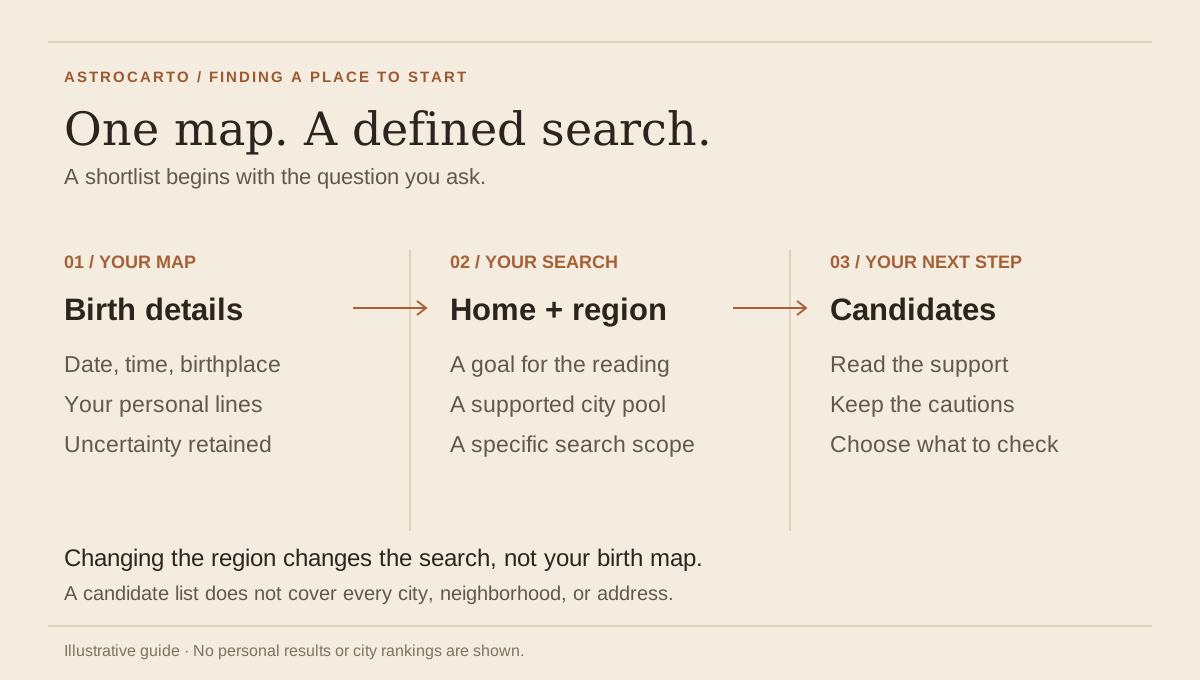
A guide to the search process, not a calculated result or a promise that every city is included.
Read the result beyond its rank
The first name is a starting point, not a complete explanation. Read its support level, fit label, available line summary, and any caution shown. The where should I live astrology calculator gives these fields different jobs; a high rank should not erase the qualifications beside it.
Support describes the strength of the calculated evidence for the selected goal. Caution identifies competing or demanding themes. Fit brings these together into labels such as Stronger Evidence, Good Candidate, Mixed Signal, Broad Context, or Weak Evidence. A Mixed Signal result can contain meaningful support and substantial caution at the same time.
Rank is relative to the candidates considered. Evidence strength describes something about the candidate itself. A place can lead a weak field without becoming a strong recommendation. Conversely, a second option can still have useful support even though another place ranked ahead of it. Do not translate either position into a percentage chance of happiness.
The short line explanation helps you understand why the candidate is worth opening. Keep both the planet and the angle: a Moon IC theme and a Moon MC theme do not describe the same area of life. Distance adds proximity context; it does not measure the quality of a neighborhood or how welcome you will feel there.
The complete Best Places Report also includes a confidence assessment and limitations. This is separate from a candidate’s support badge and may not appear on the basic preview card. Estimated birth time and mixed evidence can limit how firmly you read the result. Even High confidence is an internal assessment of the interpretation, not a scientifically established probability of a successful move.
If the preview is still loading, has failed, or a detail is locked, leave that information unknown. None of those states means weak support. Retry a failed request or follow the access option if you want more detail; do not fill the gap with an assumption about the city.
Build a first shortlist from different kinds of evidence
Consider a fictional reader, Sam, whose lease ends in six months. Sam can consider European cities and wants a steadier home base while keeping the same work. In this teaching scenario, Candidates A and B stand for two accessible discovery results; City C is a place Sam knows through a friend. These are invented examples, not calculations for named cities. Your initial preview may not expose all the evidence described here.
Sam enters birth details, opens Find My Best Places, and chooses Home and Europe. The where should I live astrology calculator now addresses a bounded question: which candidates deserve attention for this home goal within the selected search area? Each place will enter Sam’s notes for a different reason.
Candidate A: keep the support and the caution
Suppose Candidate A says Mixed Signal and its accessible evidence includes Moon IC support with a Saturn IC caution. Moon IC introduces home and emotional belonging; Saturn IC adds private responsibilities and the work of maintaining a base. Sam retains both: there is a home theme worth investigating, with a qualification that belongs beside it.
The concrete question is: “Would the home structure I want also involve responsibilities I cannot sustain?” The candidate explanation can clarify the symbolic tension. Checking who would handle chores and household decisions belongs in a later investigation of an actual living arrangement; the map cannot supply that information.
Sam retains A with the responsibility question open. This interpretation depends on the stated lines; a different Mixed Signal result would need its own explanation.
Candidate B: separate a high position from strong support
Candidate B appears near the top of the available list but carries a Weak Evidence label. Its position does not create missing support. In this fictional scenario, Sam has also seen a rental listing there worth investigating. That is a separate reason to retain B, not evidence that the calculator strongly favors it for Home.
Sam records B as a practical option with weak astrological support. Any later search in a wider region needs its own settings note; it does not rewrite B’s original evidence.
Keep unavailable information separate from weak evidence
Only record Weak Evidence when that label is actually available. A locked detail or failed request remains unread. If the birth time is uncertain, record the input limitation before expanding the search. If your account shows one candidate, begin with one record rather than borrowing this example’s second result.
The where should I live astrology calculator has now helped Sam separate a candidate supported by mixed evidence from one retained for a practical reason. Neither entry is a decision to move.
Check City C before treating absence as rejection
Sam also wants to investigate City C, where a friend lives. It is absent from the visible list. That absence alone says very little: the city may fall outside the selected region, be beyond the preview, not be in the candidate collection, or simply rank below the displayed candidates.
Before rejecting it, separate those possibilities. Check the selected region and what part of the result is visible. If you want to investigate the place itself, return to the map and use Check City. This asks about a named location instead of relying on whether it appeared in discovery.
Check City reports nearby visible planetary lines with their labels and approximate distances. Its scope can differ from the candidate-ranking calculation, which evaluates its own location evidence. A hidden line in the map view is not proof that the recommendation invented it. Check the displayed scope and available detail before treating the two outputs as contradictory.
The where should I live astrology calculator is therefore a starting point for discovery, not a rule that only listed places may be considered. You can add a personally relevant city to your own research list, investigate it, and later compare it with a discovered candidate.
Sam records C as unassessed and personally relevant. The friend’s presence explains why Sam wants to check it; it supplies no astrological verdict. After reading C’s own location evidence, Sam can update that entry. Until then, “not visible in my preview” must not become “rejected by the calculation.”
Turn the result into a shortlist you can explain
Sam’s first shortlist separates a candidate with mixed support, a practical option with weak support, and a familiar place awaiting assessment.
The entries below continue the same fictional Home/Europe exercise. A, B, and C are teaching labels, and the statuses are Sam’s notes, not additional product scores or an automatically generated export.
| Place | Evidence available | Reason to retain it | Next check |
|---|---|---|---|
| Candidate A | Mixed Signal: Moon IC support and Saturn IC caution | Investigate belonging while retaining the responsibility question | Read both signals in the candidate explanation; keep household duties as an unresolved practical question |
| Candidate B | Weak Evidence despite a high position | Investigate the rental possibility; do not claim strong Home support | Read the available explanation and check the listing separately |
| City C | No result read; absent from the visible discovery list | A friend lives there; astrological fit is still unassessed | Use Check City and record its own available planetary labels and distances |
This shortlist makes the where should I live astrology calculator result usable: Sam knows which places enter the next round and why. A has mixed support worth understanding, B remains for a practical reason, and C needs its own assessment. None has been selected as a future home.
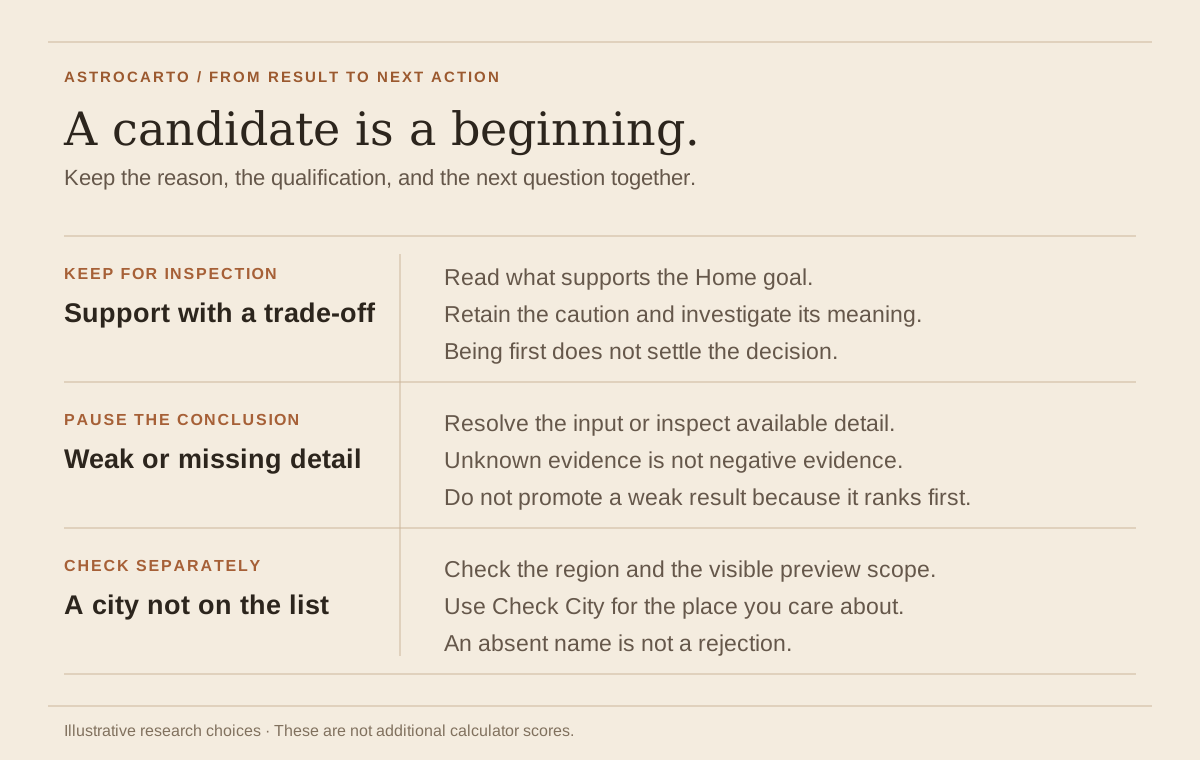
Illustrative next steps. These are your research decisions, not additional product scores.
Once you have two to four real options, Compare Cities can evaluate them together for the same goal. Keep Home selected for this exercise. Discovery rank and a comparison of your chosen cities answer different questions, so do not paste their positions into one combined league table. Read the comparison’s own support, cautions, and reasoning.
If you are ready to interpret two established candidates and plan further checks, continue with choosing where to live based on astrology. That guide takes over after the initial shortlist; here, the task is to create one with reasons you can explain.
Choose when a deeper result would help
A clear support summary may identify a place worth investigating. Deeper access helps when you need evidence beyond the preview: why one city ranked ahead, what a caution refers to, or how a candidate looks across different goals.
The complete Best Places Report provides candidate explanations, ranking rationale, support and caution evidence, a goal trade-off matrix, limitations, and next steps. Access follows the options shown in the tool. A free core map does not mean every ranked candidate or report is included without additional access.
When using the report’s Ask AI action, the report evidence accompanies the question. For example: “For my Home goal, explain why the first candidate ranks above the second. Identify the support and caution behind that difference, and tell me what the report leaves unresolved.” This asks AI to explain a result you have, rather than invent a new list from a broad prompt.
Keep the initial where should I live astrology calculator question visible as you go deeper. If your question was about a settled base, a promising Career section is useful context but should not silently replace the Home conclusion. Read the relevant trade-off and decide whether it matters to your priorities.
You can stop with one candidate and a clear next action, or open a complete report to answer a remaining question.
Questions before choosing a place
Is this where should I live astrology calculator free?
The core personal map is free to generate. Find My Best Places offers a limited candidate preview, while complete recommendations and deeper reports have separate access requirements. Check the options displayed for your account. The preview can help you decide whether a fuller explanation would be useful before proceeding.
Can I use it if I have no destinations in mind?
Yes. Start with Find My Best Places, choose Home and a region, and read the available candidates. If you already have places in mind, Check City and Compare Cities may be more direct. The where-to-live tool overview explains these different starting points.
Why did changing the region change the first city?
The set of candidates changed. A regional result is interpreted within that search, while Worldwide considers a broader supported collection. Your birth details did not change, and the city did not gain a different line simply because its position in the list changed.
Does the where should I live astrology calculator choose my home for me?
It provides astrological candidates and explanations, not a binding decision. Its ranking cannot confirm available housing, employment, personal safety, or how daily life will feel. Use the result to decide what deserves a closer look, then investigate the ordinary conditions relevant to your situation.
Can I use this where should I live astrology calculator without a birth time?
Use the unknown-time option rather than supplying a confident guess. You can explore, but precise line positions and the strength of location conclusions need more caution. Estimated time is one reason a report may be marked Sensitive. Do not read that label as a statement that a city is dangerous.
Is the first candidate necessarily better than my current city?
Not from the discovery rank alone. Your current city may not be among the visible candidates, and the ranking is not a direct move-versus-stay verdict. Add the places you actually want to compare to a separate city comparison and keep the same goal. An absent or lower position does not establish that your current home is wrong for you.
Find a place worth a closer look
Start with your own map. Choose Home and a region, read the available candidate explanation, and keep the reason that makes a place worth investigating.
Generate My Map