
Where should I live based on astrology? Explore potential places to live with AstroCarto’s personal map, understand their planetary themes for home, relationships, and career, and compare those themes with what you want from everyday life.
YOUR BIRTH MAP · YOUR SHORTLIST · YOUR EVERYDAY LIFE
Where Should I Live Based on Astrology?
Start with your personal map
Generate your free core map, then select a place to read its life-area theme and cautions. Location previews are limited; discovery and deeper tools follow the access steps shown.
Explore the home-choice guide
Turn a broad wish into a living question
A useful shortlist names places worth investigating, explains why they remain candidates, and identifies what could change your mind. Start with a personal map rather than a city assigned to everyone with your Sun sign. Your complete birth information supplies the individual context that a general sign description leaves out.
When you ask “where should I live based on astrology,” the decision may still be several steps away. You might be choosing between two job locations, looking for a more settled home routine, or considering whether to stay where you already live. Those situations need different comparisons even when they use the same birth information.
Write one sentence before opening a result: “For my next home, I want more of this, while keeping that.” For example, “I want a steadier sense of community while keeping a manageable journey to work.” That sentence gives the reading a purpose. It does not ask the map to calculate transport availability or identify welcoming neighbors.
Keep one primary goal throughout the comparison. If the first city’s result is about career and the second city’s result is about home, you have changed the question between candidates. A favorable career theme does not settle whether the daily living arrangement suits you. You can examine a second goal later, as a separate comparison with its own explanation.
Build a shortlist that could become a real home
Before asking the map to distinguish places, separate three kinds of information: a requirement, an unanswered question, and a preference. They should not all receive the same treatment. An appealing interpretation cannot satisfy a requirement, and an unanswered question should not silently become either a positive or a rejection.
| Kind of information | Example written by the reader | How it changes the shortlist |
|---|---|---|
| A requirement | I need an arrangement that permits me to live and work there | Keep the city provisional until the requirement is verified through the appropriate source |
| An unanswered question | I have not checked the journey from a realistic neighborhood to my workplace | Assign a specific research task; do not score the unknown as good or bad |
| A preference | I would like to reach a recurring activity without a long trip | Use it to compare otherwise feasible arrangements and plan a visit |
These are examples of questions you investigate yourself. AstroCarto does not verify immigration status, find housing, calculate your household budget, or research local services. Write your own limits and obtain the information relevant to your situation before treating a place as actionable.
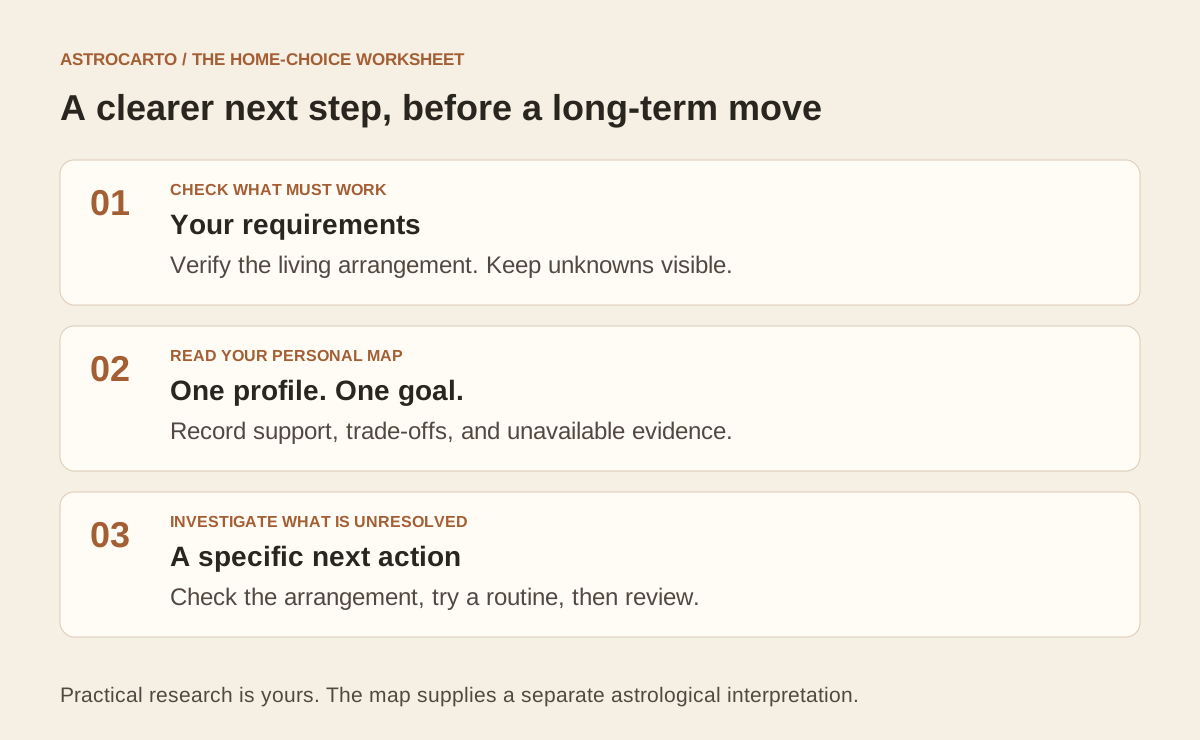
An editorial planning diagram. The practical checks are yours; the map provides a separate astrological interpretation.
A common mistake in answering “where should I live based on astrology” is to collect attractive line descriptions first and only later ask whether any of the locations are workable. Reversing that order makes the map more useful: it helps you explore actual options instead of generating an impossible wish list.
Start here if you have no city in mind
“Where should I live based on astrology” can begin with a blank shortlist. Generate your map using the form on this page, then open Find My Best Places in the results. Choose Home when belonging and domestic life are your priority, and select a region you could realistically consider. Read the candidate preview and follow any sign-in or access steps displayed; generating the core map does not unlock every discovery result.
Choose an available candidate to investigate, keeping its support, caution, and confidence together. If you already have a city, select it on the map and read the location answer. Both starting points lead to the same question: what deserves further investigation before you commit to living there? The where-to-live tool overview explains the wider discovery and comparison options; this guide continues with the decision after a candidate appears.
Read the answer before following a favorable line
The form above uses your birth date, birth time, and birthplace to generate your personal map. Enter where you were born in the birth-location field. Select a destination on the resulting map afterward. Replacing your birthplace with a prospective home changes the input instead of investigating a new location on the same map.
Once you select a place and a preview is available, look for Start with the answer. Read the life area and planetary theme described there, then expand See why we reached this answer to inspect the accessible labels and distances. The summary and the evidence belong together. A colorful line alone does not explain the full result.
This is where “where should I live based on astrology” becomes personal. Two people can inspect the same city and receive different map patterns because their birth information differs. Your next step is to examine your own available answer, not assume that an appealing example on this page applies to you.
The angle tells you which area of life the interpretation concerns. An MC theme relates to public direction and work; an IC theme relates to home and inner foundations. ASC and DSC themes concern the self and relationships respectively. These categories help you frame a question, but none is an automatic instruction to live somewhere.
Keep the complete label when taking notes. A Venus aspect to an angle, an ordinary Venus line, and a crossing or Paran are different kinds of evidence. Distance in kilometers and an angular residual in degrees are also different measurements. Do not combine them into a homemade score or assume that the smallest number always wins.
A basic location preview and a Personal Report have different scopes. The core map is free to generate without signing in; available previews are limited, and additional signals or deeper outputs have separate access requirements. The following example uses a saved full report. It demonstrates a way of reading evidence, not the contents promised by your first free preview.
Two cities can share a verdict and need different checks
Consider a fictional reader who plans to choose one long-term home and is comparing San Antonio and Orlando for settled home and community life. The saved product sample uses a birth on June 15, 1990, at 08:15 in New York. The two city results below come from that sample’s home, family, and community category. They are not a current recommendation for either city.
Both saved conclusions are mixed. That means the headline alone cannot choose a winner. The explanations name different supporting evidence, trade-offs, and conflicts. Keeping those differences visible is more informative than replacing the two mixed labels with a guessed ranking.
| Saved report field | San Antonio | Orlando |
|---|---|---|
| Goal conclusion | Home, family, and community: mixed | Home, family, and community: mixed |
| Primary support | Venus 60° to MC, 88.7 km; residual 0.99° | Moon 120° to ASC, 187.3 km; residual 1.84° |
| Main trade-off | Pluto 120° to MC, 214.8 km; residual 2.4° | Uranus 90° to MC, 156.9 km; residual 1.75° |
| Conflict to watch | Mars–ASC / Uranus–MC Paran; residual 0.588° | Moon–IC / Mercury–DSC Paran; residual 0.137° |
The support entries are angular aspects, not ordinary planetary lines. The final row contains Paran evidence rather than road distances. These are the roles assigned by the saved report explanation; this guide does not reconstruct its scoring or claim that a single aspect determines the city conclusion.
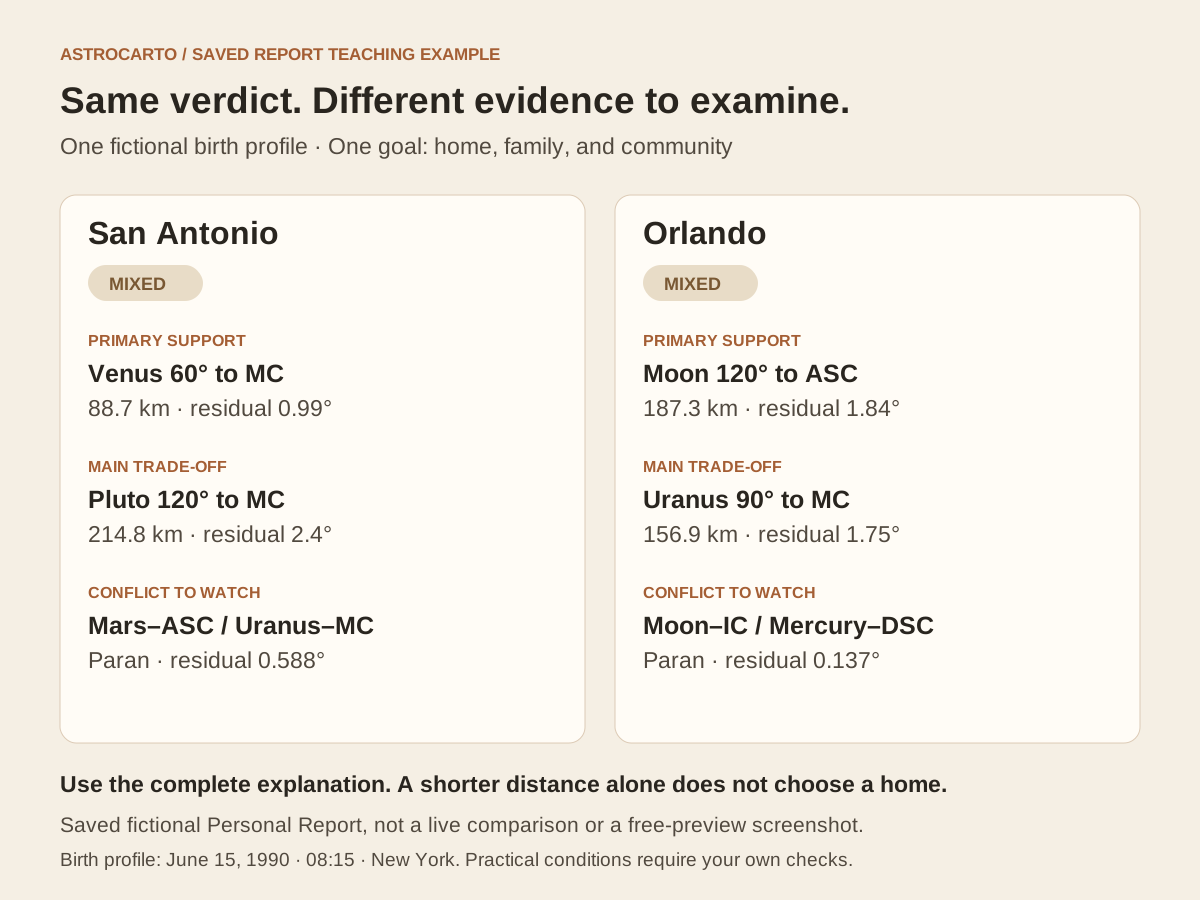
Saved fictional report evidence for one birth profile and one goal. This is a teaching diagram, not a live comparison or a free-preview screenshot.
If this reader asks “where should I live based on astrology,” the honest response is not “San Antonio, because Venus is closer.” The two support entries involve different planets and angles, and both explanations retain significant qualifications. Comparing just 88.7 km with 187.3 km would discard most of what the report says.
Turn the two explanations into one comparison plan
The reader’s question is the same for both places: can I build recurring community contact while keeping a settled home routine? They can retain the same remote job in either city. For this teaching exercise, they define two personal conditions before visiting: a recurring activity they can attend without taking an organizing role, and two quiet evenings at home each week. These are invented priorities for one person, not rules calculated by astrology.
The map helps identify topics to examine. Venus and MC bring connection and public participation into the San Antonio interpretation, with Pluto–MC adding a power or intensity theme to retain. Moon and ASC bring emotional belonging and personal comfort into the Orlando interpretation, while Uranus–MC raises questions about adaptation to change. Rather than write two unrelated city descriptions, translate those differences into tests of the same desired home life.
| Comparison step | San Antonio | Orlando |
|---|---|---|
| Question prompted by the saved support and trade-off | Can participation remain enjoyable without escalating into a demanding role? | Can a comfortable routine remain workable when plans change? |
| Observation arranged by the reader | Attend a recurring activity as a participant and clarify what continued attendance requires | Repeat the intended home routine, then check how a changed work appointment affects it |
| Additional question prompted by the saved Paran | Do new commitments grow faster than the reader intended? | Have household expectations been stated clearly rather than assumed? |
| Common standard for both places | Participant access and two quiet evenings must remain workable | The same two conditions; no easier standard for the favored city |
These are author-created applications of symbolic themes, not predictions or extra report findings. The saved report supplies the mixed verdict and its evidence. The reader defines the conditions and gathers observations. A disagreement between an expectation and a visit should stay in the notes; it should not be rewritten to make the map look correct.
For someone asking “where should I live based on astrology,” this shared comparison plan is more useful than counting favorable planet names. It tells them what to look for in each candidate while keeping the standard of success consistent. Both remain possible homes at this stage.
Watch the decision change as new information arrives
The following sequence is entirely a hypothetical teaching exercise. Housing checks, activity arrangements, conversations, and visit observations are invented to demonstrate how a decision changes. They are not actual findings about San Antonio or Orlando, customer experiences, or information generated by AstroCarto. The saved astrological evidence above remains unchanged throughout.
First checkpoint: one candidate is ready to investigate
Initially, the reader has checked a workable housing arrangement in San Antonio. In Orlando, they have only seen an advertisement. The sensible next actions differ: plan the San Antonio observation, and verify the Orlando arrangement. This is a difference in readiness, not an astrological ranking. An unknown listing does not make Orlando a bad city.
Suppose the Orlando arrangement is then verified as workable. Both places can now proceed to the same comparison stage. Record the update as “housing verified,” not “Orlando’s map improved.” No planet, angle, distance, or report verdict changed. Keeping that distinction visible prevents practical progress from being mistaken for stronger astrological evidence.
Second checkpoint: compare observations under the same conditions
The reader next makes comparable trial visits using the same work schedule and the two conditions they wrote in advance. They record both encouraging and difficult observations. A short stay is a limited sample, so an apparently workable arrangement still needs confirmation beyond the dates visited.
| Invented observation | What it supports | What it does not establish |
|---|---|---|
| In San Antonio, the activity they selected is enjoyable, but continued participation in this particular group requires an organizing commitment on one protected evening | The chosen activity arrangement conflicts with a stated condition | Every group in San Antonio requires that commitment, or Pluto caused it |
| In Orlando, the chosen activity permits attendance without organizing, and the tested routine keeps both quiet evenings available | This arrangement met the same conditions during the visit | The whole city is a better astrological match or the routine will always work |
| A changed work appointment in Orlando can be accommodated after discussing the shared evening schedule | One specific adjustment was manageable and expectations were clarified | Every future disruption will be easy, or the Uranus trade-off disappeared |
The first observation creates a concrete follow-up in San Antonio: ask whether participant-only attendance or another suitable activity is available. The Orlando observation creates a different follow-up: confirm that the arrangement remains available outside the trial dates. Neither place gets a new planetary score from these conversations.
Third checkpoint: make a provisional choice and name what could reverse it
In this exercise, continue investigating the Orlando arrangement and pause the current San Antonio arrangement. The reason is that one tested setup meets the reader’s stated conditions while the other has an unresolved conflict. The author is not declaring Orlando the best place to live or converting its mixed report into a positive verdict.
For this reader, “where should I live based on astrology” now has a qualified answer: Orlando is the next arrangement to examine closely; San Antonio stays available if its participation condition can be resolved. That answer has a reason and a revision rule, so it is more informative than either a city name or a warning that nobody can decide for you.
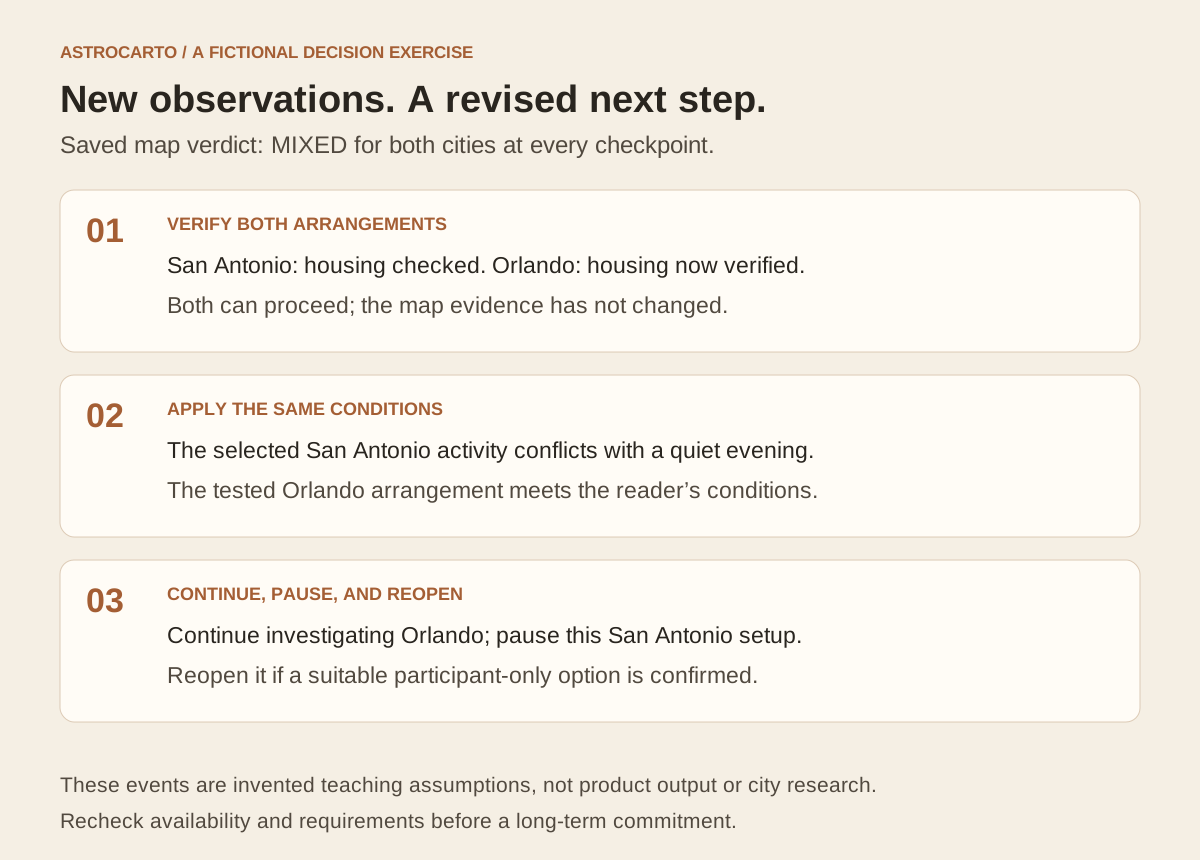
Author-created decision exercise. The saved home verdict stays mixed for both cities; new observations change the reader’s next action.
If participant-only attendance becomes possible in San Antonio, reopen that candidate under the original conditions. If the Orlando arrangement is unavailable for the intended move dates, pause it and investigate alternatives. If an essential requirement cannot be met, rule out that specific arrangement for now. Do not turn a failed arrangement into a blanket judgment about a city.
The interpretation helped the reader choose useful questions. The final provisional preference also depends on what they observed and what matters to them. Someone with different priorities or birth information could choose differently. A decision record should make those dependencies clear enough that the reader can change their mind without pretending the original map was different.
What to do when the result is not a clear yes
A neutral or qualified answer can still help you decide what to investigate. Your map is not obliged to produce a dramatic theme near every place, and the most intense-looking location is not automatically the best home. Sometimes practical fit should do most of the work of distinguishing candidates.
| Result or limitation | Useful response | Avoid this shortcut |
|---|---|---|
| A mixed answer | Read both support and caution for the same goal | Keep only the encouraging paragraph |
| A neutral answer | Give everyday requirements more weight and inspect the available evidence | Assume that a quiet map means a bad life |
| A restricted signal or exhausted preview | Record that the information is unavailable; decide whether you need further access | Treat the missing interpretation as positive or negative |
| Uncertain birth time | Keep angle-sensitive comparisons provisional and use the tool’s unknown-time option if needed | Change the time until a favorite city looks better |
If you are wondering “where should I live based on astrology” without a reliable birth time, a map can be an exploratory starting point, but a precise nearby-line claim deserves more caution. Do not manufacture certainty by entering a convenient time and forgetting the assumption. Keep the input limitation beside any interpretation you save.
A second person adds another question. One partner’s result does not represent the whole household. Explore each person’s information separately, then compare priorities and practical needs. A shared choice may involve compromise rather than a single city that maximizes every theme for everyone. Do not describe one person’s favorable career result as proof of another person’s comfort.
If you use Compare Cities, keep the same person’s data and the same goal across candidates, and follow the access steps shown in the tool. If you need broader analysis, Create Personal Report is available through the results flow. Its scope and access are explained in the personal report guide; selecting a city on the map does not guarantee that it appears in a report.
Leave with a decision record you can revisit
A useful response to “where should I live based on astrology” ends with a record that separates calculation, interpretation, and observation. You do not need a long journal. You need enough detail to understand why a place remained on the list and which new information would change the next step.
| Decision field | Completed record for this fictional reader |
|---|---|
| Goal and common conditions | Settled home life; recurring community contact without an organizing role; two quiet evenings each week |
| Saved San Antonio evidence | Mixed; Venus 60° to MC support with Pluto 120° to MC trade-off; Mars–ASC / Uranus–MC Paran conflict |
| Saved Orlando evidence | Mixed; Moon 120° to ASC support with Uranus 90° to MC trade-off; Moon–IC / Mercury–DSC Paran conflict |
| What the visits added | One selected activity required an unwanted commitment; the other tested arrangement met the same personal conditions |
| Current action | Continue investigating the Orlando arrangement; pause the current San Antonio arrangement |
| Why this is provisional | Short visits do not establish long-term fit, and availability can change |
| Reopen San Antonio when | A suitable participant-only option is confirmed, without relaxing the original conditions |
| Pause Orlando when | Availability or the agreed routine fails a required condition |
| Keep separate | Saved map findings, author interpretations, and the reader’s practical observations |
A practical answer to “where should I live based on astrology” can change as information improves. Before revising yours, identify what changed: your input data, the interpretation you are examining, an observed circumstance, or your priorities. These changes call for different responses. Corrected birth information may require recalculation; a new housing offer requires practical verification; a different goal requires an explicit new comparison.
For your own record, start with the result actually available to you. A basic preview may provide a life-area theme rather than a goal-level mixed verdict. Copy that theme accurately instead of borrowing the sample’s conclusion. Write down one question prompted by the reading and one condition you can verify yourself. You can begin with one city and add a second later.
Choose the review point before committing to a long-term arrangement. At that point, ask whether each requirement is met, whether the same standard was applied to both candidates, and which fact would change your preference. If neither candidate passes, keep searching or retain your current home while investigating. You do not need to manufacture a winner from two unsuitable arrangements.
Generate your personal map, inspect a candidate, and start your own record with the evidence shown. The next useful action may be a visit, a specific conversation, or checking an unresolved condition. What matters is being able to explain why that action follows from your result and circumstances.
Questions before choosing a place to live
Where should I live based on astrology if I only know my Sun sign?
A Sun-sign description is not enough to generate a personal location map. Use your birth date, time, and birthplace when available. If time is unknown, use the relevant option and keep angle-based conclusions provisional. Start with realistic candidates rather than assigning everyone with the same sign to one city.
Where should I live based on astrology if two places both look promising?
Keep the same goal and birth data, then set the same practical conditions for both candidates. Use their different explanations to plan observations, and separate those observations from the map verdict. Choose a provisional next action with a reason and a reopening condition. If both meet your conditions, continue investigating the uncertainty that matters most instead of inventing a winner from the distance values.
Does a closer Venus or Jupiter line automatically make a city better?
No. Read the planet with its angle, the visible context, and your question. A nearby signal can be relevant without settling a home decision. In the saved example, each city’s supporting aspect is only one part of a mixed explanation. Comparing distances alone leaves out the qualifications.
Where should I live based on astrology if I cannot move now?
Keep your current city as the location to inspect. Use the reading to frame questions about your routine and surroundings, then consider changes within your actual options. You do not need to move to make the exercise useful, and the map does not require you to reject an otherwise workable home.
Is the two-city example included in my free result?
No. It comes from a saved Personal Report for a fictional birth profile. Your free core map uses your own details; available location previews have limits. A deeper report and additional tools have separate access requirements. Your cities, visible signals, and interpretations may be entirely different.
Where should I live based on astrology if neither candidate works?
Keep your current home as an option, investigate a different arrangement, or use discovery to widen the shortlist. Rule out an arrangement when a necessary condition cannot be met; leave an unresolved candidate provisional when further information could change the answer. A mixed map result does not require you to force a choice between two unsuitable homes.
Put your own shortlist beside your map
Choose one place you could realistically live, inspect its available answer, and identify the question you need to resolve before taking the next step.
Generate My Map and Check a Place