
Helena Woods astrocartography courses teach location interpretation, while her readings offer personal guidance. Explore your own destinations with a free AstroCarto map, check nearby planetary lines, and compare places for a trip or move. The tool below is an independent AstroCarto service.
Helena Woods Astrocartography
Create Your AstroCarto Map
Helena Woods Astrocartography Courses and Map Practice
Helena Woods astrocartography teaching includes a Locational Astrology course covering maps and relocated charts. Her separate certification program includes assessments of reading proficiency. Use the map here to explore your locations; enroll through her own channels for teaching or qualification.
If you found Helena Woods astrocartography through a video, you may wonder: “Where does that line run on my map?” Investigate with your own birth details before choosing a course.
To investigate that question, enter your birth date, time, and original birthplace. Use Check City for the destination that interests you. The result shows the planet, angle, approximate distance, strength, and combined theme around that location.
Read the complete label, such as Venus DS, rather than stopping at the planet’s name. DS means Descendant. The angle adds interpretive context, while distance and strength help you understand the line’s relationship to your selected city.
If several signals appear nearby, click the place and read Start with the answer for its life area and planetary theme. Expand See why we reached this answer for visible lines, distances, and available crossings. This lets you trace an explanation back to the evidence shown on your map.
Keep neutral or no-visible-lines findings too. They tell you that the selected view gives no strong reason to favor this place. A useful learning question can be why the map offers little support, rather than how to turn every result into a positive recommendation.
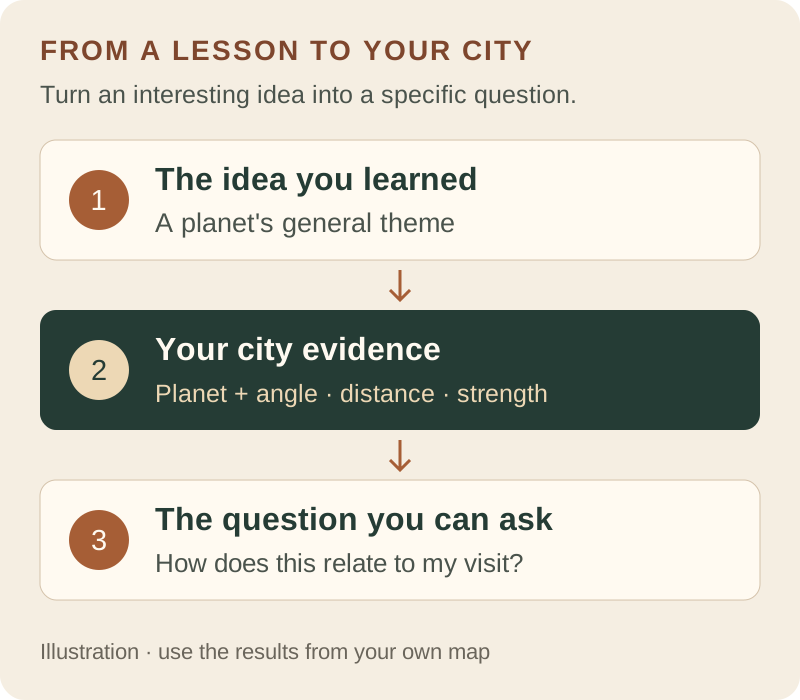
An independent practice sequence for your own map; not a personal calculation or course excerpt.
Travel and Relocation: Compare Places for Your Goal
Helena Woods astrocartography content addresses travel and finding a home. A short visit may prioritize exploration; a move raises different questions about routines and emotional stability.
A lesson about a planetary theme can give you something to look for. Choosing a destination adds another question: how does the combination around this city relate to the purpose of your stay? Write down that purpose before comparing. Costs, accommodation, and transport remain your research; the map does not calculate them.
Open Compare Cities, choose Travel & exploration, and add two to four locations from your shortlist. Read each city’s main support, caution signal, and ranking explanation. The question is how the calculated evidence relates to this visit, rather than which city is universally best.
While learning about Venus, you might display only that planet. Compare Cities uses all calculated planetary lines, including hidden ones. An unexpected ranking may reflect evidence absent from your filtered view. Check the support and caution signals before treating the difference as a contradiction.
The follow-up becomes specific: “Which signal supports this trip, and what complicates it?” Support can coexist with caution. If the evidence is weak, practical preferences may carry more weight; a ranking alone does not tell you whether you can afford or enjoy the visit.
If your plans shift to a permanent move, try Home & emotional stability. Keep each result with its original goal. A travel ranking does not automatically become a recommendation for building a home, even when the cities and birth details stay the same.
Place and Timing: Two Different Questions
The Helena Woods astrocartography course covers relocated charts, Parans, Local Space, and timing through transits and progressions. Her separate Zodiacal Releasing offering explores life’s timing. A question about where to go and one about when to go therefore call for different outputs.
Start by checking the city’s themes, then examine time separately. Changing the destination on a birth-based map does not calculate a departure window. Keep your original birth details in the form; the future trip belongs in the timing question, not in the birth date field.
Open AstroCarto’s Best Time to Move from the map results or a checked city. Confirm the destination, choose Travel or Relocation, and select Find My Best Time. Generating the preview requires sign-in and a confirmed, exact birth time.
When windows are found, the free timing preview shows their number, the overall outlook, and timing strength for the next twelve months. This gives you a concrete distinction to investigate: a city can be worth exploring while its timing signals remain mixed or quiet.
Full timing results provide window dates, Why this time matters, strongest dates, and a Month-by-Month Outlook. These require the separate unlock shown in the tool. Read the explanation before comparing periods with your practical travel or moving arrangements. A promising window is something to investigate, not an instruction to ignore other constraints.
If no strong window appears, the tool gives a quiet-period explanation. You can try another city or goal, or use the period to prepare. Distinguish your interest in a destination from its location evidence and timing outlook. No strong window is a result, not a missing answer.
This calculation does not reproduce Helena Woods astrocartography instruction or her Zodiacal Releasing readings. Compare the question, method, city, and period before comparing conclusions. Likewise, a map’s angle label does not replace the relocated houses or Local Space directions discussed in her teaching.
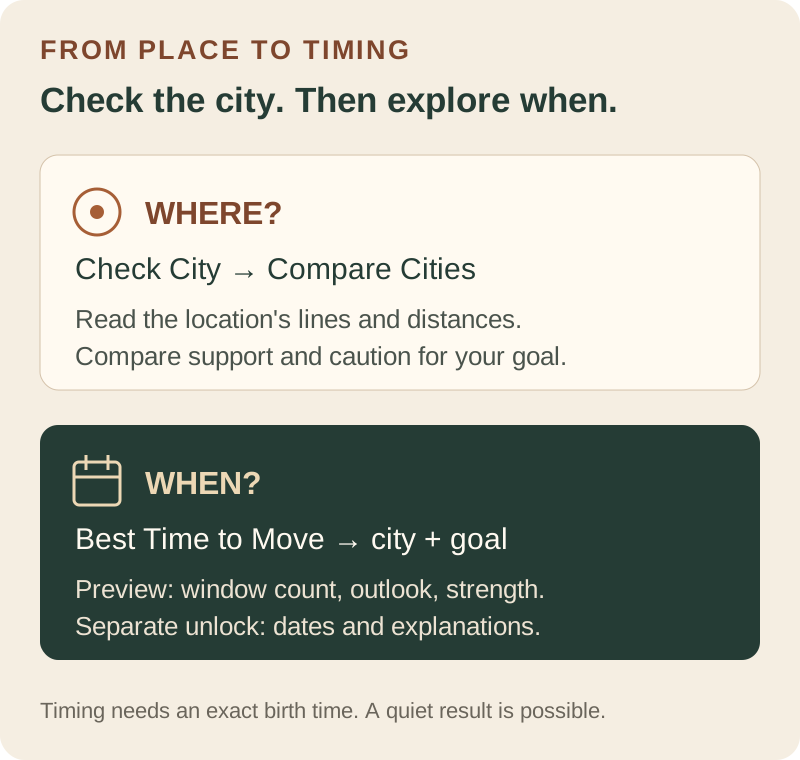
Two connected tool paths: examine the place first, then investigate its timing. This diagram illustrates the workflow, not a personal calculation.
Helena Woods Astrocartography Readings and Follow-ups
Helena Woods astrocartography services include personal guidance; her site also provides a reader directory. A consultation offers an astrologer’s perspective. The independent tool here helps you examine your map and prepare a focused question.
Before a consultation, move from “Where should I live?” to “What does this line emphasize in the city I can visit?” Bring that place, result, and concern to the discussion. A precise question gives the reader a clearer starting point than a list of favorite planets.
Use Ask AI in Check City for an immediate explanation. It carries the city’s name, coordinates, and displayed planet, angle, distance, and strength. Add your purpose, such as a three-week solo trip. The city check does not supply that context, so tell the assistant what you want to understand.
After checking a city, try: “Explain this relationship theme for a short visit. Which displayed line supports it, and what remains uncertain?” This is a suggested prompt, not an actual AI response or a quotation from Helena. Its purpose is to connect the explanation to evidence already on your screen.
For a question about two destinations, launch AI from the comparison. That route includes its goal and city evidence, so you can discuss the displayed trade-offs without reconstructing a second result in a single-city conversation. Choose the entry point that matches the question you are asking.
AI can clarify a label or trade-off; it cannot speak for Helena. When returning to a lesson or booking guidance, bring the unresolved question and its evidence. Keep track of which explanation came from the tool and which came from your teacher or reader.
Choose a Course, a Reading, or a Self-Check
If you are researching Helena Woods astrocartography, start with what remains unclear after checking one city. Recognizing a line, learning to interpret several lines, and discussing a personal decision call for different kinds of help.
| Where you are stuck | What to examine in your result | A useful next step |
|---|---|---|
| “I can see Venus DS, but I do not understand how to read it alongside other lines.” | Open the place explanation and its evidence. Identify which part you cannot explain: the planet, angle, distance, or combination. | A structured course fits the goal of learning an interpretation method you can apply across maps. Use this city as a practice question. |
| “I understand the labels, but I want to discuss a move alongside my relationships and family circumstances.” | Keep the city, your concern, and the support or caution that prompted it together. | Consider a personal reading when you want an astrologer’s discussion of your situation. Check that the service you book covers that question. |
| “I only want to compare two places for this trip.” | Review Main support, Caution signal, and Why it ranks here under the same travel goal. | Continue the self-check. If an explanation remains unclear, ask from that comparison with its evidence attached. You do not need to choose a course to begin exploring. |
Helena Woods astrocartography teaching also has a separate certification route. If your aim is to read maps for other people, investigate that training and its assessments. Completing a city check here does not provide a professional qualification.
These choices can overlap. You can study while practicing on your map, or bring one unresolved result into a reading. A self-check helps you identify what you need next: an explanation of a label, a method to learn, or a conversation about your circumstances.
When a Venus Lesson and Your City Comparison Seem to Disagree
After exploring Helena Woods astrocartography teaching, a learner considers a three-week solo visit to Lyon or Nantes. They associate Venus with connection and expect the place near a Venus line to win. This is an independent teaching exercise, not a quotation from her course; no personal calculation or city ranking is asserted.
Separate the concept from the destination claim. “Venus relates to connection” is a general theme. “Lyon is the better place for my visit” is a conclusion about a particular city and purpose. Use Check City to examine the full line label, distance, and strength. If Venus DS appears, that gives the learner a relationship theme to investigate at that location. It does not establish how Lyon compares with Nantes or promise that meeting people will be easy.
If the comparison favors Nantes, inspect what contributed. Keep the birth record unchanged and select Travel & exploration. A Venus-only map can draw attention to one theme, while Compare Cities considers all calculated lines. Read Main support, Caution signal, and Why it ranks here for both places. An additional line may help explain the result. The learner can now ask, “Which signal adds support for this trip, and which complicates the Venus theme?” The ranking alone cannot answer that.
If changing the goal changes the order, identify the new question. A comparison under Home & emotional stability addresses a different priority from the three-week visit. The learner should keep the travel result with the travel question and inspect the new explanation separately. A change of order does not, by itself, show that the lesson was wrong or the map contradicted itself.
If the evidence is weak or the difference remains unexplained, keep the conclusion open. Do not invent a missing influence to make the preferred city win. From the comparison’s Ask AI entry, try: “For my three-week solo trip, explain why these support and caution signals led to this order. What does the Venus theme explain, and what does it leave unanswered?” This is a suggested question, not an actual AI answer. Check the response against the displayed evidence; practical travel research still matters.
The learning outcome is specific: a planetary theme, a filtered map, and a goal-based comparison answer different questions. Return to the course or a reading with the actual labels and the remaining uncertainty. You now have something concrete to discuss, rather than asking a teacher to reconcile a general Venus association with an unexplained city ranking.
Turn Curiosity into a City You Can Examine
Using AstroCarto alongside Helena Woods astrocartography research adds personal context: the lines around your city, their meaning, and evidence for comparing your options. Begin with one place and your original birth details.
Let your next action follow the question. For a line’s meaning, inspect its label and distance. For two destinations, choose a comparison goal. For possible travel dates, open Best Time to Move after checking the city.
The core map is free. Previews, premium signals, comparisons, reports, and AI have access conditions shown in the tool; full timing results have a separate unlock. Helena’s courses and personal services are separate offerings, not purchases made through this form.
Continue Your Map Practice
These pages help with specific questions that may arise while practicing with your map:
- Read your map step by step when the labels are still unfamiliar.
- Understand distance from a line when a nearby region and your actual city seem to tell different stories.
- Explore travel questions when you are planning a visit rather than a permanent move.
03 / QUICK ANSWERS
Helena Woods Astrocartography Questions
Courses, readings, and what you can explore with your own map.
Is this the official Helena Woods astrocartography website?
No. This is an independent AstroCarto page with an AstroCarto map. It does not contact Helena, enroll you, or reserve a reading. Use her own channels for her courses and personal services.
What does Helena Woods astrocartography offer?
Her offerings include education and personal guidance covering maps, relocated charts, and other techniques. Choose between learning a method and discussing personal circumstances. You can inspect your map here before deciding which topic you want to study or what you want to ask.
Does the free map include her course or a personal reading?
AstroCarto’s basic map is free. It does not include her course or a personal reading. Check the tool’s access conditions for deeper analysis; subsequent actions are not all unlimited or free. Course enrollment and consultation bookings are separate from this tool.
Can I import a map or reading from Helena Woods?
Enter your original birth details to create a new map. This workflow does not import her maps, account, or recordings. When comparing outputs, check the location, visible layers, and technique before interpreting differences as disagreement.
Can I explore a short trip without planning to move?
Yes. Her work also addresses travel. Check your destination and choose Travel & exploration for a comparison. Keep the visit’s purpose and duration in view: a few weeks do not test every aspect of permanent life there.
What if I do not know my exact birth time?
For a basic map, use the unknown-time option rather than inventing precision. Birth-time uncertainty affects angular lines, so verify your input before relying on fine differences between nearby places. Best Time to Move requires a confirmed, exact birth time and cannot be generated from an unknown or estimated time.
START WITH YOUR MAP
Put Your Location Question on the Map
Exploring Helena Woods astrocartography? Start with one place you are curious about. Create your free AstroCarto map, inspect the city's lines, and see which question deserves a closer look.
Create My Map and Check a City