
Looking for an Astrodienst free horoscope? Explore daily readings, natal interpretations, and location maps below. Curious what your personal map shows near a city? Enter your birth details in AstroCarto, generate a free map without signing in, then click that city to read an available location preview and inspect its evidence. This is an independent AstroCarto tool; previews are limited and deeper reports require separate access.
Astrodienst Free Horoscope
Generate Your Map, Then Choose a City
Choose the Right Astrodienst Free Horoscope
The Astrodienst free horoscope search leads to several kinds of experience rather than one universal report. The free directory includes Personal Daily Horoscope, Personal Portrait, interactive chart interpretations, and AstroClick Travel. Some longer reports are offered as try-out editions. Identify the specific reading before assuming what “free” includes.
What you can try here first
You can explore a place without first reading an Astrodienst free horoscope or planning a move. Start with your current city, somewhere you enjoyed visiting, or a destination that interests you. Your question can be as simple as: which life area does the available map interpretation emphasize here, and what visible signal explains it?
| Your action | What you can see | What it helps you understand |
|---|---|---|
| Enter your birth details and generate the free map | Your personal map with the planetary lines available to you | Where your own map places those lines, rather than someone else’s sample |
| Click a city while a location preview is available | Start with the answer, a brief interpretation of the selected place | Whether the visible signals emphasize relationships, home, career, or another theme; a quiet location can also have a neutral answer |
| Expand See why we reached this answer | Available line labels, distances, and nearby context | Which evidence supports that summary, instead of judging only by a line’s color or proximity |
The first useful outcome is a personal place answer you can examine. The free map does not require sign-in; location previews have a limited allowance. A full Personal Report is a separate, deeper output with its own access requirements. The saved report later in this guide demonstrates how to interpret a mixed result; it is not the package promised by your first free click.
Generate your map and choose a city. Keep your birthplace in the birth-location field; choose the city you want to explore on the generated map.
A useful starting question is what you want to understand. Is it today’s experience, a recurring personal theme, or a place you might visit or live in? Those subjects can matter to the same person while requiring different evidence. A reflection about communication does not contain a comparison of two cities simply because you are considering a move.
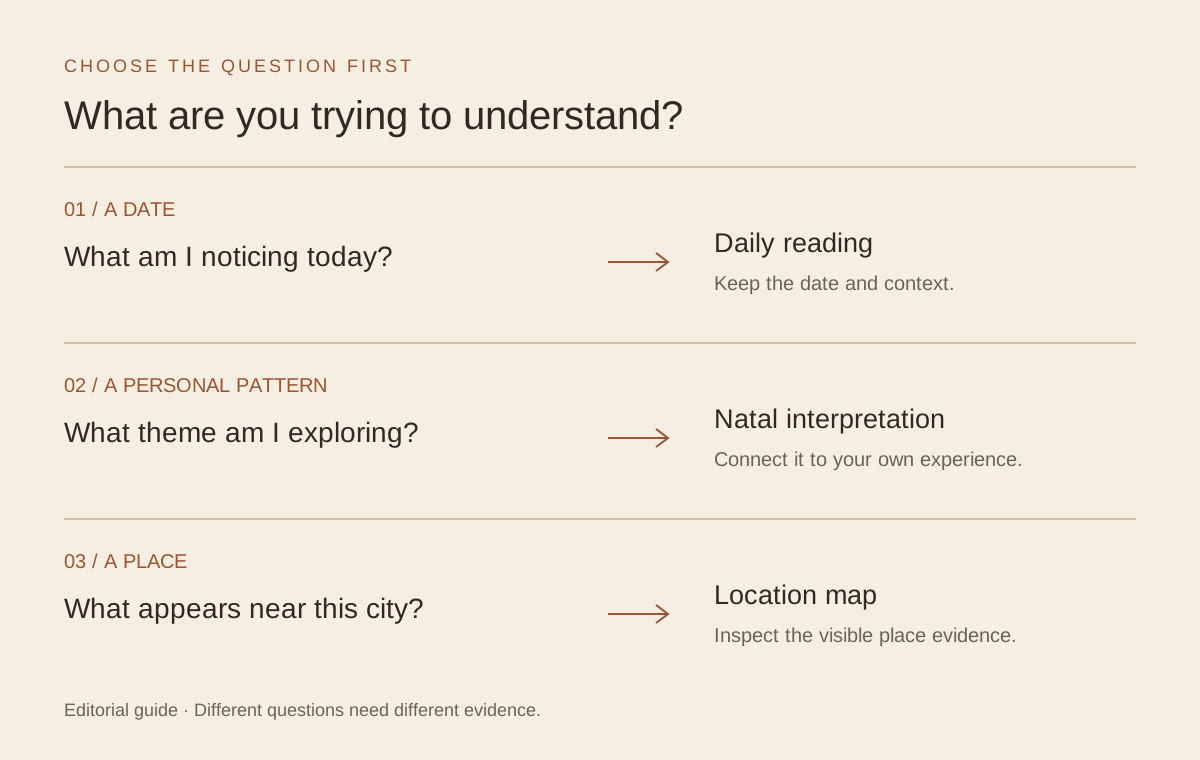
An editorial guide to choosing the question. These are categories, not screenshots or personal predictions.
| Your question | A relevant starting point | What to carry forward |
|---|---|---|
| What does this reading say about the day? | Personal Daily Horoscope | The date, theme, and your own observations |
| What personal pattern am I reflecting on? | Personal Portrait or AstroClick Portrait | A particular theme and an example from your life |
| What does location astrology show near a city? | AstroClick Travel or an independent AstroCarto map | The selected place, visible signals, and limits of the interpretation |
Choose an Astrodienst free horoscope by the question it can address. If the question remains about today’s reading, a location map is unnecessary. If you have a destination and want to investigate it, the map above provides a direct first step without requiring you to translate a horoscope paragraph into a geographic prediction.
Personal Daily Horoscope: Keep the Date in View
The Personal Daily Horoscope has a dated interface and directs new visitors toward birth data and a user profile; returning visitors can log in. For someone seeking an Astrodienst free horoscope, this is a reading tied to a day, distinct from a natal portrait or a geographic map.
Imagine someone curious about a city where they might spend more time. An Astrodienst free horoscope prompts reflection about belonging, but they do not need to decide on a move. They can first ask what their personal map emphasizes near that city, then examine whether the themes connect with their experience.
Keep the reading date and the selected city in separate notes. A new daily interpretation is not new evidence about the city; corrected birth information or a different selected location changes the map investigation itself.
If you only want to understand today’s Astrodienst free horoscope, stay with that reading. If you have a city in mind, the location workflow below adds a specific place and inspectable evidence to the reflection.
Personal Portrait and Interactive Chart Readings
Another Astrodienst free horoscope route is Personal Portrait, a short natal interpretation attributed to Robert Pelletier. Its introduction describes birth potentials while acknowledging that circumstances influence how people express them. This is useful context for a reader who recognizes a theme but cannot see how it fits every part of their life.
AstroClick Portrait lets you select a chart element to view its interpretation. It offers a way to focus on one topic rather than read a whole report at once.
Suppose the reader’s own reflection is that they prefer meaningful conversation to crowded events. That is an author-created example, not a quotation from an Astrodienst free horoscope. It can become a practical requirement: look for recurring, smaller gatherings instead of assuming that a larger city automatically provides the right social experience.
A relationship-related location theme can then be examined alongside that preference. The map supplies an interpretation; the format and availability of local activities still need your own research.
An Astrodienst free horoscope and a location reading answer different questions. A personal preference can help you evaluate a map theme, but it cannot determine which planetary signals will appear at a city.
Location Maps: Ask a Geographic Question
Astrodienst already provides AstroClick Travel, so a location question does not require pretending its tools stop at natal readings. The interactive map lets users select lines and locations for explanations. Its introductory guidance presents it as exploratory entertainment and cautions against using it as the basis for important life decisions.
For an Astrodienst free horoscope reader with a city in mind, AstroCarto offers a place answer that can be opened up to inspect its evidence. The worked example below shows how support and qualification can produce different questions about the same hoped-for change. This is an independent analysis from your inputs, not an imported Astrodienst result or a claim of superior accuracy.
An Astrodienst free horoscope can raise the personal question; a map gives you a separate place-specific lens. For the community scenario, select a city you are curious about and name the question: what does the available interpretation suggest about belonging here? That keeps a broad wish for belonging connected to one actual place, without treating every neighborhood or group as an identical experience.
For detailed map controls and line explanations, use the AstroClick Travel guide. Here the important distinction is the job each reading is doing: reflection about your experience, followed by a focused investigation of a place you could actually choose.
A Community Question With Saved Place Evidence
Imagine an Astrodienst free horoscope reader looking at Akureyri and wondering, “A relationship line is very close. Does that mean this is a straightforward choice for feeling at home?” A saved AstroCarto Personal Report gives a more layered answer. Its birth profile is fictional: June 15, 1990, at 08:15 in New York. The report evidence is saved product output; the reader scenario and practical questions below are author-created examples.
The relevant report category is home, family, and community, which includes belonging but is not a dedicated friendship score. Its conclusion for Akureyri is mixed. The saved explanation identifies these three pieces of evidence:
| Role in the saved explanation | Evidence | Measurement |
|---|---|---|
| Primary support | Venus 120° to ASC | 28.1 km away; exact residual 0.35° |
| Main trade-off | Mars 60° to MC | 13.6 km away; exact residual 0.28° |
| Conflict to watch | Moon–DSC line | 0.5 km away |
The first two entries are angular aspects, not ordinary Venus–ASC and Mars–MC lines. Keep their angles when recording them. The residual in degrees is separate from the geographic distance in kilometers. This is a report-level example, not a promise that a free location preview includes all three entries.
For this Astrodienst free horoscope reader, the report adds something the initial reflection did not contain: a location-specific combination of social openness, pressure to perform, and emotional responsiveness to investigate together. The following interpretation uses the product’s general planetary and angle meanings; it does not reconstruct the report’s full scoring calculation.
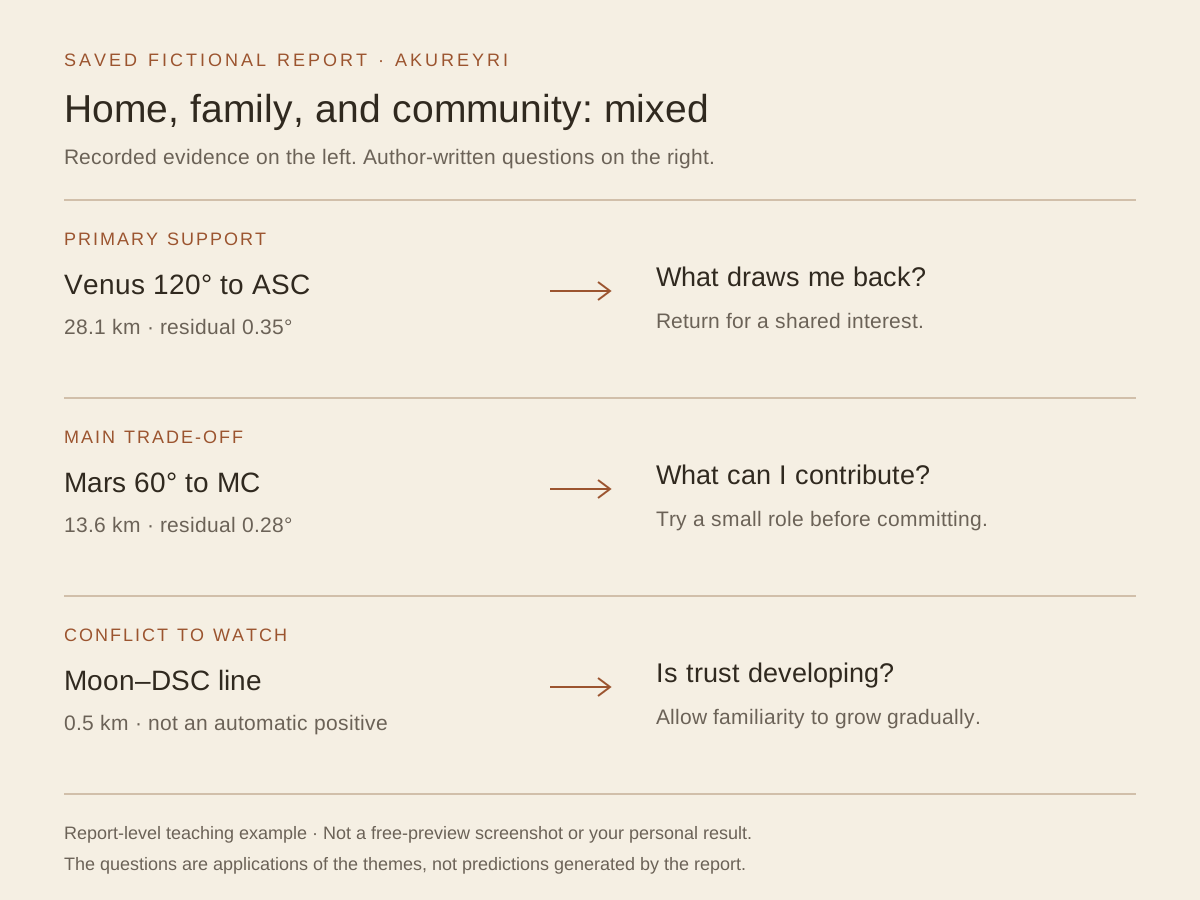
An explanatory diagram based on the saved fictional report. The questions are the author’s applications, not generated predictions or a screenshot of the free preview.
Support: read the theme behind the favorable evidence
The Venus–Ascendant theme concerns social openness, ease, and attraction. With the 120° aspect preserved, the saved support invites a more useful question than “Will people like me?” The reader can ask which setting would let them participate comfortably: an interest-based group, a recurring class, or a shared project.
For this reader, social openness might mean trying a recurring activity with a shared interest. That is an application of the Venus theme, not an activity recommendation produced by the report.
Trade-off: keep the competing theme in the reading
Mars–MC relates to drive, ambition, and pressure in public or working life. The report names its 60° aspect as the main trade-off for this goal. For a newcomer, one possible application is noticing whether the wish to contribute becomes pressure to demonstrate usefulness immediately.
One author-written application is to clarify a small contribution before accepting ongoing responsibility. The report has not evaluated a group or predicted its demands; it supplies the theme being examined.
Qualification: notice expectations of other people
Moon–DSC concerns emotional closeness, care, and responsiveness in relationships. Its short distance does not make it an unconditional positive: this saved community explanation explicitly lists it as a conflict to watch. That distinction is important for an Astrodienst free horoscope reader tempted to keep only encouraging details.
One author-written question follows: am I expecting a new group to provide the reassurance of established friendships immediately? That makes the qualification understandable without claiming to predict the people of Akureyri.
Why the nearest line does not settle the question
The Moon–DSC line is only 0.5 km away, much closer than the other two entries. Yet the saved explanation places it under conflict to watch, while the more distant Venus aspect supplies support. Distance tells you about proximity; it does not, by itself, tell you whether a theme supports this particular goal. The planet, angle, aspect, and role in the explanation matter together.
For an Astrodienst free horoscope reader, this is the useful change in understanding: “close” and “helpful for belonging” are different claims. The report’s mixed answer keeps the appealing Venus theme visible without erasing the Mars trade-off or Moon qualification. It does not mean the city is bad, nor does it justify converting three measurements into a friendship score.
A completed place-reading note
Place and goal: Akureyri; home, family, and community. Saved result: mixed. Support: Venus 120° to ASC, 28.1 km. Trade-off: Mars 60° to MC, 13.6 km. Conflict: Moon–DSC, 0.5 km. What changed my reading: the closest line is not the supporting evidence for this goal. I need to consider social openness, pressure to perform, and expectations of closeness together.
Someone arriving from an Astrodienst free horoscope now has more than a hopeful impression of the city: they can explain why the result is mixed. One practical application is to try a recurring shared-interest activity, keep any contribution manageable, and observe how familiarity develops. Those are the reader’s choices, not activities found or prescribed by the map.
The reason to try your own map is to discover which themes actually appear at your selected place. You may see a different life area, a neutral answer, or insufficient visible evidence. In a basic preview, record the answer and accessible signals you receive; do not expect the full report’s goal verdict or copy Akureyri’s three entries into your result.
If an Astrodienst free horoscope has left you curious about a place, start with your own map. Read the available answer first. Consider a deeper report only when you have a question the preview leaves unresolved, such as how several signals relate to a particular life goal.
Compare the Same Task Before Choosing a Tool
If your Astrodienst free horoscope search includes a geographic question, compare AstroClick Travel and AstroCarto for investigating that same destination. Both offer location exploration. The meaningful comparison is the sequence from birth details to a selected point, an explanation, and a record you can use.
| Shared task | AstroClick Travel | AstroCarto on this page | What to keep consistent |
|---|---|---|---|
| Start a personal map | The public entry directs new visitors to birth data and a user profile, or existing users to login | Enter birth details here; core map generation does not require sign-in | Use the same person and reliable birth information |
| Inspect one destination | Select a location, line, or crossing to obtain an explanation | Click a place and read the available location answer | Investigate the same location and name your question |
| Examine the basis | Map explanations accompany the selected elements | Expand the available evidence beneath the answer; record labels and distances | Distinguish the interpretation from the measurements shown |
| Investigate another city | Select the other location for its explanation; a combined comparison workflow was not confirmed in the reviewed public material | Inspect both places, then use Compare Cities with its applicable access steps | Keep the same goal when reviewing your notes |
| Continue into more detail | Check the terms of the particular Astrodienst service; the free directory also contains report try-outs | Additional signals and Personal Report have separate access requirements | Decide which missing question the next output would answer |
This comparison does not require an Astrodienst free horoscope reader to switch services. Someone who already understands the map explanations may prefer that workflow. Someone who wants to start from a place answer and then inspect its supporting evidence can try that sequence here. The reason to fill in the form is to apply this sequence to their own location, not to receive a duplicate of the original horoscope.
Compare the outputs you actually receive. A basic preview and a full report have different scope; an unfamiliar label or a restricted signal is a reason to check that scope, not assume that either service has supplied a complete assessment.
Turn Reflection into a Place You Can Inspect
Start with your birth date, most reliable birth time, and birthplace in the form above. Your birthplace stays the place where you were born; do not replace it with the city you want to investigate. Use the unknown-time option when necessary, and keep location-sensitive interpretations provisional when the input is uncertain.
After reading an Astrodienst free horoscope, you may have a particular destination to investigate. Generate your map and click that place. In an available location preview, read Start with the answer and expand See why we reached this answer. This lets you connect the summary to the evidence actually shown rather than guessing from the shape of a line.
Your note can stay short: selected city, visible conclusion, supporting label, qualification, and one unresolved practical question. Include only evidence available in your result. The Akureyri example illustrates why a close line and a favorable conclusion are not interchangeable; your own answer may emphasize different themes.
If you have two realistic candidates, inspect each before using Compare Cities. If you need a broader assessment, Create Personal Report is available through the results flow with its sign-in and access requirements. The personal report guide explains that scope. These are independent AstroCarto actions; selecting a city does not guarantee its inclusion in a report.
Continue With the Question You Actually Have
For the wider website, the Astro.com site guide explains the main entry points. For learning the map itself, the step-by-step reading guide explains planets, angles, and distance. These guides serve different tasks from selecting an Astrodienst free horoscope and deciding whether it raises a place question.
Keep the original Astrodienst free horoscope separate from the place evidence and your observations. An inspiring paragraph can start an investigation; a useful location record helps you continue it with a specific city and a realistic next step.
03 / QUICK ANSWERS
Astrodienst Free Horoscope Questions
Free readings, personal questions, and using your own AstroCarto map.
Is this the official Astrodienst free horoscope page?
No. This is an independent AstroCarto guide. Astrodienst operates its own services under the Astro.com name. The form on this page generates an AstroCarto map; it does not log you into Astrodienst, retrieve its personal readings, or reproduce its authors’ interpretations.
Which Astrodienst free horoscope should I choose?
Start with the question. A dated personal reading, a natal interpretation, and a location map provide different contexts. The directory names the available services and identifies some longer readings as try-out editions. Check the individual offering before assuming you receive a complete report.
Can I get an Astrodienst free horoscope from this form?
No. Entering your birth details creates an independent personal location map in AstroCarto. Use it when you want to investigate a city or destination. You do not need to paste horoscope text, provide Astrodienst credentials, or transfer an account to begin.
Can an Astrodienst free horoscope tell me where to move?
A daily or natal reading can prompt reflection, but it does not select a destination. A location map adds geographic evidence to investigate. Keep that interpretation alongside independently checked housing, work, and social arrangements before making commitments. Revisit your notes after a trial stay, marking which expectations were supported, contradicted, or still untested.
Is every result on this page free?
The core map is free to generate without signing in. Available location previews have limits, and deeper tools or reports can require sign-in and additional access. The interface shows the relevant steps. Paying for more detail does not make uncertain birth information precise.
Should I read an Astrodienst free horoscope or check a place first?
Begin with the question you already have. If a reading prompted a reflection, state that reflection before opening a map. If you already have a city to investigate, start with your own map directly. You do not need a favorable horoscope as permission to explore a destination.
START WITH YOUR MAP
What Does Your Map Show Near Your City?
Start with a city you know or a destination you are curious about. Generate your map, click that place, and read its available location answer before deciding whether you need more detail.
Generate My Map and Explore a City