
An astrocartographer is an astrologer who specializes in interpreting how a birth chart relates to different places. You might consult one about a move, travel, or an experience of living somewhere. Before choosing an astrocartographer, explore your map with AstroCarto: select a city to read its available life themes, support and cautions, then inspect the planetary evidence behind the answer. This is an automated tool with optional reports and AI follow-up, rather than a human consultation booking service.
UNDERSTAND THE ROLE · EXPLORE YOUR MAP
Astrocartographer: Do You Need One?
See what your selected city may emphasize
Generate your map to see the life themes, possible support and cautions in an available place preview, then inspect its planetary evidence. Basic previews are limited; deeper features have separate access requirements.
Explore the role and prepare your question
What does an astrocartographer do?
An astrocartographer connects three things: your birth information, the location you are considering, and the question you bring. The map shows where planets were rising, setting, overhead, or beneath the Earth at your birth moment. Interpreting those positions is a separate step from calculating them. A useful reading makes that distinction visible.
For example, an astrocartographer may discuss what a Venus line traditionally symbolizes, which angle it belongs to, and how that theme relates to your reason for visiting. The same symbol can prompt different questions for someone seeking creative collaborators and someone considering a quiet retirement. The astrocartographer should explain that connection rather than treating a planet name as a complete answer.
An astrocartographer may also work with the natal chart, a relocated chart, Parans, or timing techniques. These are not interchangeable additions. A relocated chart examines a birth moment from another location; a timing method addresses change across dates. Ask which methods the astrocartographer actually includes, especially if your question is about when to move rather than where.
What you receive also varies. An astrocartographer might offer a live conversation, a recorded reading, written notes, or a combination. Ask whether you can question the astrocartographer about the conclusions; receiving a document does not automatically include that opportunity. A short discussion can be useful if it resolves the specific uncertainty that brought you there.
The work is interpretive. An astrocartographer cannot establish that a particular person will hire you or that a relationship will begin in a named city. Look for explanations you can understand, alternatives you can consider, and clear limits on what the reading can answer.
When can an astrocartographer help?
You do not need an astrocartographer simply to discover which lines appear near a city. A map can show that information. A conversation with an astrocartographer becomes more useful when you need to discuss your history, reconcile competing priorities, or ask why an interpretation fits your circumstances. The missing answer should determine the next step.
| Your current question | A useful starting point | What to ask an astrocartographer |
|---|---|---|
| Which planet and angle appear here? | Generate a map and select the actual place. | How does this specific combination relate to my purpose? |
| Why does an appealing line come with a caution? | Read the accessible evidence, including surrounding signals. | How would you weigh both themes in my situation? |
| Why did a supposedly supportive place feel difficult? | Describe the experience and check the original inputs. | What other factors or interpretations could explain the mismatch? |
| Can I ask follow-up questions about a previous reading? | Check the original service scope. | Is clarification included, and what would require a new session? |
An astrocartographer is most helpful here as someone who can explain their reasoning and respond to you. A human session does not automatically offer more information than an automated result. Before booking, ask the astrocartographer what they would examine that your current result has not explained. Repeating a line description without addressing your question leaves the central task unfinished.
If you only want to understand a visible symbol, begin with the map and the reading guide. If you want a structured overview of the site’s automated options, see Reading Services. Neither step commits you to hiring an astrocartographer or purchasing a report.
See what your own map can answer first
Before contacting an astrocartographer, enter your birth date, recorded time, and birthplace in the form above. Generate the map, then select the city or coordinate you want to understand. Look for Start with the answer in the place panel. Read the available explanation before opening the supporting evidence.
Give the astrocartographer the planet, angle, and approximate distance together when available; “the pink line” does not identify the signal. A selected city may have more than one nearby signal, and the visible result can depend on which layers you are displaying. Record what you actually see, not what you hoped would appear.
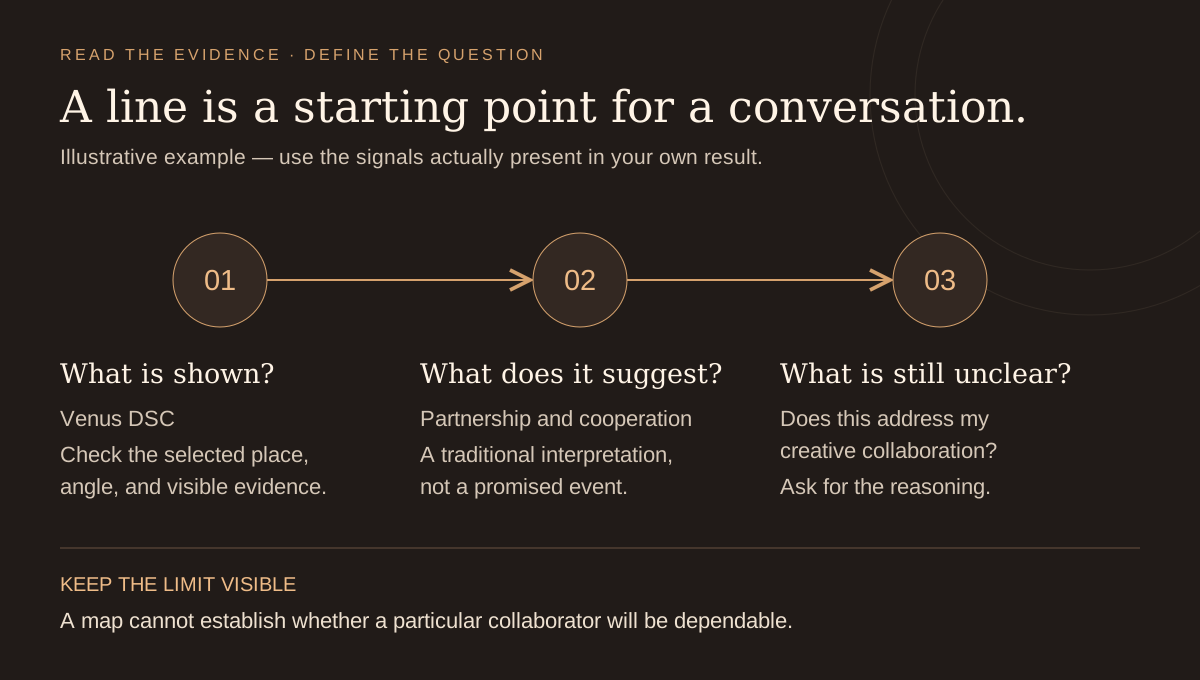
Read the life area highlighted by your accessible preview, its planetary theme, and the support or caution described. Then inspect the planet, angle, and available distance behind it. Use that answer now, or take a remaining personal question to an astrocartographer.
For a neutral result, there may be too little visible evidence for a strong location theme. If details are locked, keep them unresolved; an astrocartographer should know what you have not inspected. Deeper features retain their own access conditions.
Explore a city on your own map, then use the example below to decide whether your next question needs more evidence, an explanation, or a conversation with an astrocartographer.
How an astrocartographer can answer the same question
An illustrator based in Boston is considering six months in Montreal for a creative collaboration. A short recommendation says, “Your Venus line makes this a great place.” They want an astrocartographer to address their concern about building working relationships while living alone for the first time.
Assume Venus DSC and Saturn IC for this exercise; neither city has been calculated here. An astrocartographer would need to verify the actual inputs and labels. Both replies are author-written teaching examples, not real consultations, testimonials, or AstroCarto-generated answers.
The illustrator asks the astrocartographer: “How do you weigh the partnership theme against the home theme when my concern is living alone? What supports your interpretation, and what would you leave undecided?” Compare how the two replies address that same question.
A reassuring reply that leaves the question open
Imagine an astrocartographer answers:
Venus is favorable for relationships and creative work. Montreal sounds like an exciting opportunity, so focus on the connections you could make.
The astrocartographer mentions only Venus, omitting the angle, Saturn IC, and the client’s concern. The reassuring tone leaves the requested connection unexplained.
A reply that explains the relationship and its limits
For the same assumed evidence, an astrocartographer could instead explain:
Venus DSC suggests partnership and cooperation, relevant to working with other artists. Saturn IC raises responsibility and structure at home. Because living alone is new for you, that theme deserves attention alongside the partnership theme. These labels alone do not tell me which experience would dominate. We have two matters to discuss: shared expectations in the collaboration and the private routine you would need. I cannot infer whether a studio will welcome you or whether an apartment will feel comfortable.
This astrocartographer has answered more of the brief without promising a better outcome. The difference is visible in the reasoning:
| What the client asked for | What the astrocartographer explains | What still needs attention |
|---|---|---|
| Explain the evidence. | Venus DSC is linked to cooperation; Saturn IC to private responsibility. | An astrocartographer must verify the actual chart before applying either label. |
| Address living alone. | The home theme is connected to the client’s stated concern. | The client needs to describe the support and routine they would want. |
| Explain how the themes interact. | Partnership appeal does not erase the separate home question. | More evidence would be needed to justify giving either theme greater weight. |
| Say what remains undecided. | The reply identifies limits instead of declaring the city suitable. | Studio arrangements and accommodation require direct investigation. |
Use this comparison when evaluating an astrocartographer: can you point to the part that answers your question, the evidence supporting it, and what remains open? Length alone does not establish quality. A concise reply can be sufficient; a long explanation can still avoid the issue.
An astrocartographer can acknowledge a limit and still answer well when the reason is clear. Ask for a specific missing connection before commissioning another broad reading.
Return to your map and read your selected place. If you want a visible signal explained, use the available AI follow-up and add your purpose. This may resolve a question before you contact an astrocartographer. AI access has separate requirements; it does not provide a human astrocartographer session.
How to choose an astrocartographer
Start with the question you need answered, then look for an astrocartographer whose stated work fits it. For the Montreal brief, ask whether the session covers one location, several candidates, or timing. Compare prices after the astrocartographer has explained the method and deliverable; those scopes answer different questions.
An astrocartographer should be able to describe relevant training and experience. If a certification is claimed, ask who issued it and how you can verify the claim. Continuum, for example, maintains a practitioner directory connected with its training and examination process. Confirm that the astrocartographer is accepting clients; a listing alone does not establish availability or guarantee an outcome.
Ask the astrocartographer for a sample explanation or a description of how they handle mixed evidence. You are looking for a chain you can follow: the input, the relevant chart feature, the interpretation, and its limits. Testimonials can describe someone’s experience, but they do not show how your question will be analyzed.
Before paying, clarify these points with the astrocartographer:
- Scope: which locations and personal questions are included?
- Method: will the astrocartographer examine the natal chart, relocated chart, map, or timing, and why?
- Delivery: is this live, recorded, written, or a combination?
- Clarification: can you ask the astrocartographer about a confusing conclusion afterward?
- Terms: what is the total cost, what information is required, and how are recordings and birth details handled?
Be cautious if an astrocartographer promises a precise event without explaining the basis, ignores an uncertainty you disclosed, or treats every concern as a reason to buy another session. Useful guidance leaves room for your priorities and for a conclusion that remains open.
An astrocartographer can be a good fit without telling you what you hoped to hear. The important question is whether you understand the reasoning and the limits well enough to decide what to do with it.
What to prepare for an astrocartographer
Give the astrocartographer enough information to answer the question you are actually bringing. Record the source and confidence of your birth time, the locations under consideration, your purpose, and the uncertainty you want to resolve. If the record is incomplete, tell the astrocartographer what is uncertain rather than supplying invented precision.
For the illustrator, a useful brief to an astrocartographer would look like this:
| What the astrocartographer needs | Completed example |
|---|---|
| Purpose | Explore a six-month collaboration in Montreal, while keeping Boston as the current base. |
| Birth information | Supply the actual date, place, recorded time, and time source privately; verify these before the session. |
| Available evidence | For this exercise only: Venus DSC and Saturn IC. In a real brief, copy the labels and distances actually shown. |
| Personal context | Working with others is appealing; living alone would be a new experience. |
| Main question | How do partnership and home themes interact in this situation? |
| Requested outcome | An explanation of both themes, their basis, and what remains unresolved. |
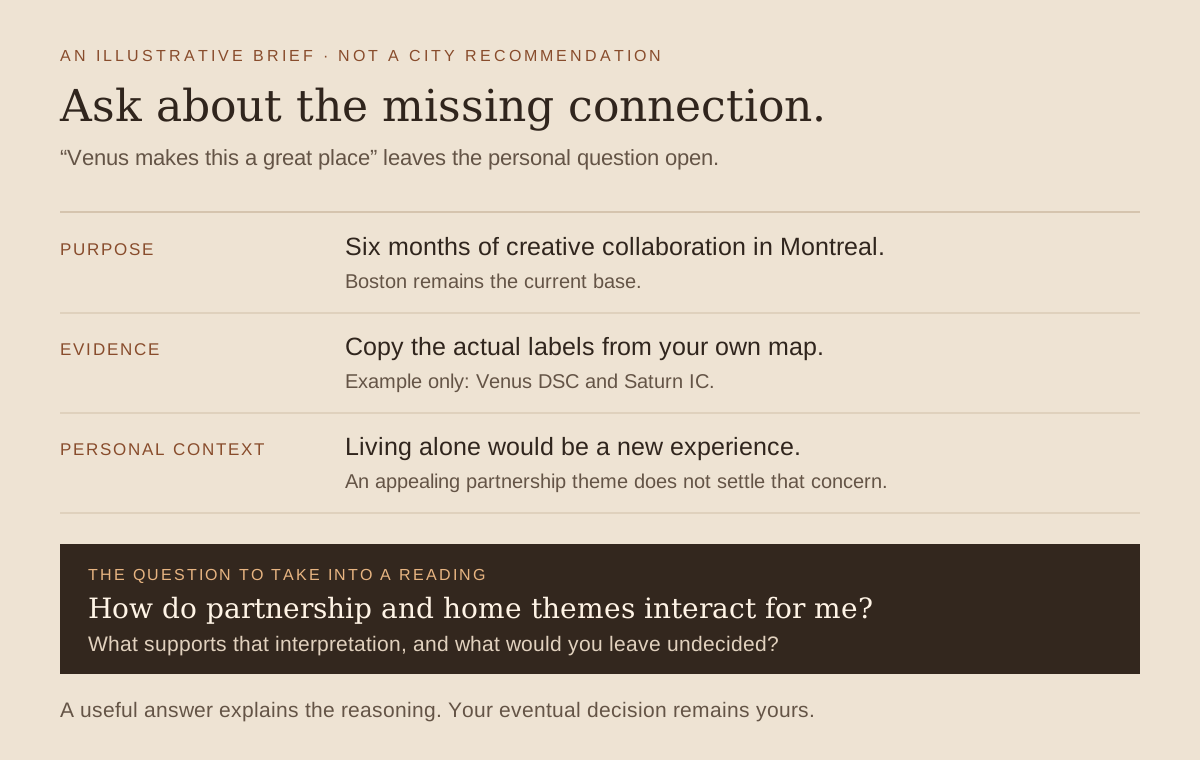
Send the astrocartographer the brief through the method they request, with only the personal information needed for the session. A screenshot can help identify the result you mean, but the astrocartographer may need to calculate their own chart rather than infer your settings from an image.
If you have already paid for a reading, tell the astrocartographer which part needs clarification. Quoting the particular conclusion is more useful than asking for an entirely new reading. This also lets the astrocartographer explain whether the follow-up fits the original agreement.
The brief is something you prepare yourself. AstroCarto does not send it to an astrocartographer or book an appointment. Your map and available explanations can supply a starting point; you decide whether to take that material into a separate consultation.
After a reading, decide what to ask your astrocartographer
After speaking with an astrocartographer, compare the reply with your original brief. For the illustrator, the test is whether the response addresses collaboration and living alone, explains its basis, and names what remains uncertain. If it does, you can use that explanation without automatically buying another session.
If a gap remains, identify whether the astrocartographer needs to clarify an answer, agree to a new scope, or reconsider the input. Each calls for a different next action.
The original question was not answered
If the astrocartographer discussed creative partnerships but omitted the home concern, quote the original question and identify that omission. A focused request is: “You explained Venus DSC. Could you clarify how you considered the assumed Saturn IC theme alongside my concern about living alone?” Ask the astrocartographer how clarification fits the agreed follow-up terms. An unanswered part of the original brief is different from requesting a new reading.
Your new question changes the service scope
Suppose the illustrator next asks an astrocartographer which month to begin the stay. That introduces timing, while the original brief concerned a location and personal circumstances. Ask which method would address the new question, whether it is included, and what another deliverable would contain. An astrocartographer should explain the scope before you decide whether to continue. Do not assume that more detail about Venus answers a question about dates.
The input behind the interpretation is uncertain
If the birth time was guessed or a different record emerges, tell the astrocartographer before relying on precise angular-line conclusions. Confirm what input was used and what can be checked. Ask which parts of the interpretation remain provisional and whether recalculation would be needed. Another confident explanation does not resolve an uncertain time; the astrocartographer needs that limitation recorded.
You can revisit your own map to keep the available labels beside the question. The personal report is a separate automated option when its scope fits your needs; it cannot clarify what an independent astrocartographer meant. Keep software output and a practitioner’s explanation identified separately. Once the consultation has answered its brief, your eventual choice about the stay remains yours.
Questions about working with an astrocartographer
Is an astrocartographer the same as an astrologer?
An astrocartographer specializes in the relationship between astrology and place. An astrologer may work in other areas without offering location readings. Ask about the person’s actual methods and experience instead of assuming that either title describes the full service.
Can I explore my map without hiring an astrocartographer?
Yes. Generate your map here, select a place, and review its available explanation and evidence. That can answer an initial question or help you decide what you want to discuss with an astrocartographer. It does not include a live human session.
How much does an astrocartographer cost?
There is no single price established by the job title. Ask the astrocartographer for the total cost and included locations, methods, delivery, and follow-up. A quote for one recorded answer and a quote for an extended live consultation describe different services.
Does an astrocartographer need my exact birth time?
Precise angular lines depend on birth time. Tell the astrocartographer what is recorded and what is uncertain before asking for a city-specific interpretation. A guessed time should not be presented as verified; ask what can reasonably be discussed with the information you have.
Is AstroCarto a human astrocartographer service?
No. This page provides a real automated map and access to the site’s interpretation tools. It does not match you with an astrocartographer, verify a reader’s credentials, or schedule a consultation. Basic previews are limited, and advanced features have separate access conditions.
Can an astrocartographer guarantee the best place to live?
No. An astrocartographer can discuss a location through an astrological framework, but cannot guarantee an outcome or resolve every practical constraint. A useful reading explains possibilities and uncertainties while leaving you free to choose a different place.
Explore your map before choosing an astrocartographer
Start with your own map and one place. Discover what the available explanation answers, then decide what you would still like an astrocartographer to explore with you.
Explore my map