
AstroCarto is an astrocartography website for exploring how different places connect with your birth chart. Create your personal map and explore location readings for the city you call home, your next trip, or somewhere you might move.
YOUR CURRENT CITY · A DIFFERENT EVERYDAY QUESTION
An Astrocartography Website to Explore Your Places
Generate your map, then explore your current city
Your birthplace goes in the form. Choose the place you want to explore on the resulting map. The core map is free; location previews have limits and deeper tools have separate access requirements.
Explore life in your current city
What can an astrocartography website tell you about a place?
Your first visit to an astrocartography website can begin with a personal question: “Does my current city emphasize work, relationships, home, or how I express myself?” Generate the map, select your city, and read Start with the answer when a preview is available. You do not need to recognize every symbol first.
The answer connects a visible planetary theme to an area of life. For a concrete astrocartography website example, if a meaningful Mercury MC line is the primary visible signal in an accessible preview, the explanation connects communication and learning with career direction and public image. It also describes a possible difficulty: increased mental activity can make slowing down harder. This is a conditional illustration of the tool’s explanation, not a calculated verdict for your city or for Orlando below.
An astrocartography website turns “Is this city good?” into a theme you can examine. It offers a starting point for reflection, not knowledge of your employer, schedule, or future opportunities.
Use See why we reached this answer to connect the explanation to available signal labels and distances. The core map on this astrocartography website is free; previews have limits, and a Personal Report is a separate output.
Try the astrocartography website with your birth details, select one place, and follow its available answer. Your themes may be entirely different from the illustration; that is why generating your own map matters.
Use your birthplace to explore where you live now
The first important distinction on an astrocartography website is between the place you were born and the place you want to investigate. Enter your birth date, birth time, and birthplace in the form. Once the map appears, select the city where you live now. Your present address does not replace your birthplace.
Our example imagines a person born in New York who now lives in Orlando and has no moving plans. New York is the birth input; Orlando is the map selection. Their residence and everyday situation are fictional teaching details, not facts inferred from the chart.
Before using an astrocartography website, check the date, morning or afternoon time, and selected birthplace; cities can share names. If the birth time is unknown, use that option and keep angle-sensitive conclusions provisional. A precise-looking map cannot resolve uncertain input.
If an answer changes, check the birth inputs, selected coordinate, visible layers, and access. A different view or more access does not mean the city has become more favorable.
Start with one part of your week you want to change
Our Orlando resident has a stable home and no travel plans. Their week feels repetitive, and they say, “I want to do something different.” Before interpreting their astrocartography website result, they write down two moments behind that feeling: passing over an interesting beginner class and struggling to explain a work project during a meeting.
Those moments point to different needs. The class is about willingness to begin something unfamiliar. The meeting is about communicating something they already know. Treating both as “this city is not right for me” would skip the actual problem. An astrocartography website cannot determine which concern matters more, but its themes can give the person language to examine them separately.
They keep the same city and birth profile throughout. The map supplies location symbolism; finding an activity, venue, or suitable schedule requires ordinary research.
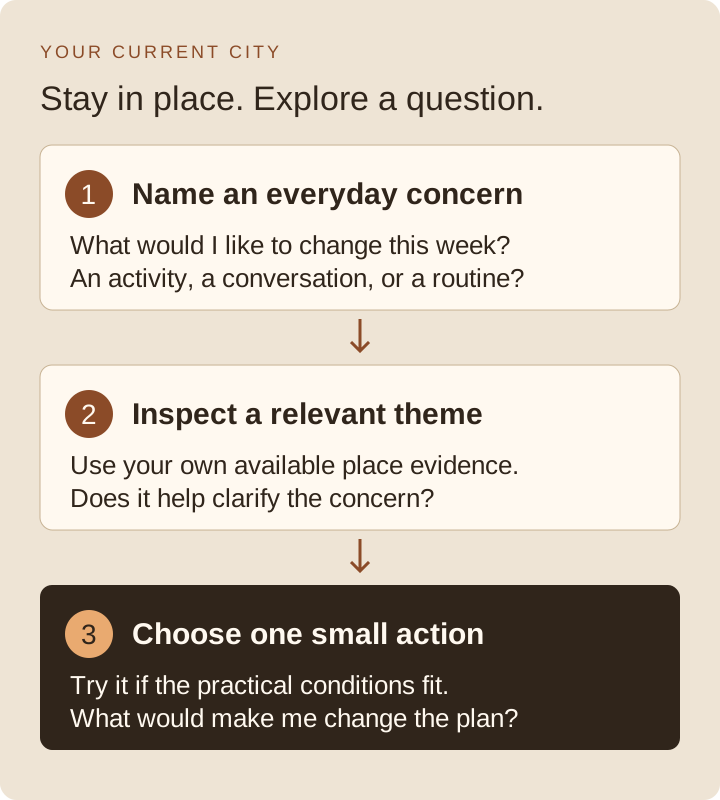
An editorial exercise for a fictional resident, not a product screenshot, generated action plan, or prediction.
Before opening more details on an astrocartography website, finish this sentence: “In my current week, I would like to change ____.” Choose something recognizable, such as avoiding unfamiliar activities or leaving colleagues unclear about an idea. A concrete starting point makes it easier to notice whether the interpretation adds anything useful. If it does not, you can leave it aside rather than inventing a connection.
An astrocartography website example in the same city
This example uses saved calculated evidence for fictional birth details: June 15, 1990, at 08:15 in New York. The selected place is Orlando, Florida. We use those existing measurements for our imagined resident; their work meeting, class interest, and later choices are author-written circumstances. The figures come from a sample Personal Report, not a live query or a customer’s experience.
Two entries are enough to show why labels matter:
| Saved evidence | Measurement | How to read the entry |
|---|---|---|
| Jupiter ASC, an ordinary planetary line | Approximately 155.5 km | Keep Jupiter together with the ascendant angle and the line distance |
| Mercury 60° to MC, an angular aspect line | Approximately 63.7 km; residual 0.71° | Keep the aspect and MC angle; the degree residual is not a second kilometer distance |
These are selected facts from a larger report. They do not show the whole city analysis, identify the nearest available line, or predict what your free preview will display. Your own profile, selected coordinate, visible layers, and access determine what you can inspect on this astrocartography website.
“Mercury is better because 63.7 is smaller than 155.5” would be the wrong conclusion. An astrocartography website describes different relationships here: an ordinary Jupiter ASC line and a Mercury aspect to MC. Distance is not an overall city rating. Instead, examine which theme helps clarify the resident’s question.
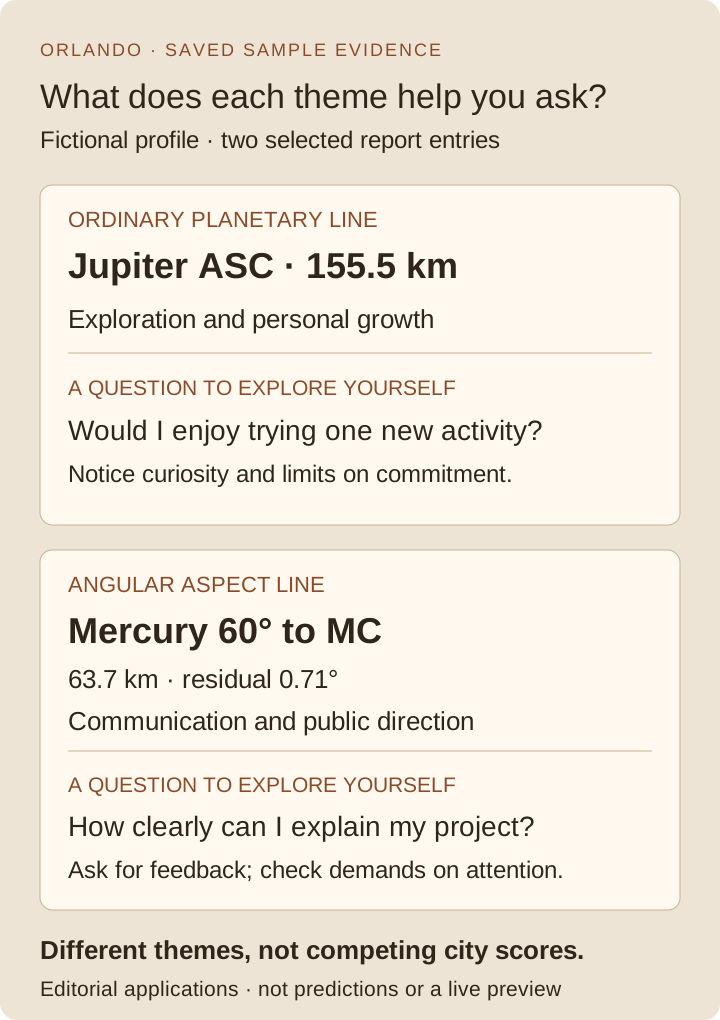
Saved fictional report evidence paired with general theme explanations. The application questions are teaching suggestions, not extra report conclusions or a free-preview screenshot.
From personal confidence to a specific activity
Reading Jupiter ASC on an astrocartography website brings exploration, openness, and personal growth into focus. The reader might consider one introductory class they have been reluctant to try. Their question becomes: “Would I enjoy participating as a beginner, without committing to every opportunity at once?” The caution about overcommitting comes from the broader Jupiter interpretation; it is not evidence that a particular class in Orlando will be available or suitable.
Mercury 60° to MC concerns communication in a public or professional role. Our reader could explain a small project, ask whether the message is clear, and check whether the actual work routine allows focused discussion or constant interruption. Keep the aspect label: this is not an ordinary Mercury MC line.
These themes help distinguish two everyday needs without requiring a new city. Neither establishes that Orlando caused a problem or tells the resident which need matters most.
For your own astrocartography website session, keep the complete accessible label and its units; leave unavailable fields blank. Your themes may differ. The map-reading guide explains planets and angles in more depth.
Know why a result looks quiet or incomplete
A place query can show several kinds of incomplete-looking result with different causes. Before changing your birth data or searching another city, identify whether the issue is visibility, distance, access, or uncertain input.
On an astrocartography website, a display issue, a neutral interpretation, an access restriction, and uncertain birth information require different responses:
| What you see | Appropriate next step | Keep out of your conclusion |
|---|---|---|
| No visible lines | Restore a relevant visible layer and reselect the place | “There are no planetary influences here” |
| A neutral interpretation | Read the explanation and consider practical fit | “This city is bad for me” |
| A locked or limited preview | Note what remains unavailable | “The hidden signal must be positive or negative” |
| An uncertain time | Keep precise comparisons provisional | “A precise-looking display means precise input” |
These distinctions help you decide whether to change something on the astrocartography website, obtain clearer birth information, or work with the answer already available.
Choose one small change before asking for more results
The next useful step after an astrocartography website session is not necessarily another city search. Our resident asks which of their two concerns is pressing this week. They have an upcoming project discussion, so they choose communication first. That priority comes from their calendar, not from Mercury being closer than Jupiter in the saved evidence.
A work question with a clear stopping point
The resident prepares a short explanation of the project and asks one colleague to describe the intended outcome back to them. They want to learn where the message becomes unclear. This is an ordinary communication exercise prompted by reflection on the Mercury theme; the astrocartography website does not schedule the conversation or predict the colleague’s response.
They define a useful outcome beforehand. A specific question might expose a missing explanation. An accurate summary might show that wording is already clear and the difficulty lies in responsibilities, interruptions, or missing decisions. Those findings call for different actions. An astrocartography website prompts the question; feedback from the workplace determines what to address next.
A different week can call for a different action
If the missed class matters more, the resident can instead investigate one introductory session. They check the subject, cost, travel time, and whether beginners are welcome before committing. On an astrocartography website, the Jupiter ASC theme prompts a question about openness and personal growth. It does not select a suitable provider or promise confidence.
The resident could decide to try one session before choosing a longer course. Their observation question is: “Did I enjoy being a beginner enough to return, and can I fit this into an ordinary week?” That is more useful than requiring instant comfort. Interest alongside nervousness might justify another visit; an exhausting schedule might justify finding a different format.
The same astrocartography website result supports reflection on either priority. These are alternative applications, not a prescribed sequence; changing priorities does not require changing birth details.
| Concern the resident chooses | One manageable action | Information that could change the plan |
|---|---|---|
| My project explanation feels unclear | Ask a colleague to summarize it after a short explanation | The idea is understood, but responsibilities remain unclear |
| I keep avoiding an activity that interests me | Check one beginner session and try it if practical | The subject appeals, but the schedule or format does not fit |
Before leaving an astrocartography website, choose one question and one action. You do not need to pursue both themes, buy a report, or make a long-term commitment for the session to have a useful endpoint.
What to keep from your astrocartography website session
A useful follow-up records what happened outside the tool. Our resident can keep a short note that separates the saved evidence, their chosen question, and information still missing. Here is an author-written example before the work conversation:
Place and context: I already live in Orlando and am not considering a move. Saved sample evidence: Jupiter ASC 155.5 km; Mercury 60° MC 63.7 km, residual 0.71°, for the fictional New York birth profile. My priority this week: Explain the project more clearly. Why this action: A project discussion is coming up; the Mercury theme prompted a communication question, but the calendar determined its priority. Next step: Ask one colleague what they understand the outcome to be. Still unknown: Whether the difficulty is wording, responsibilities, or the meeting itself.
Afterward, the resident adds observations without rewriting the original question to fit the outcome. If the colleague understood the idea immediately, they record that. If the conversation never happened, they record that too. Neither a supportive theme nor a completed astrocartography website session substitutes for the missing feedback.
Likewise, enjoying a class does not prove the location symbolism, and disliking an instructor does not make the city unsuitable. The experience might change the activity you choose while leaving your wish to learn intact.
When you use an astrocartography website with a familiar city, familiarity can make almost any description feel plausible. Keep one relevant observation and one detail that does not fit. Consider ordinary explanations such as workload, prior experience, the people involved, or available time. The purpose is a clearer personal question, not a retrospective story in which every event confirms the chart.
Your own result may contain different themes. Replace the Orlando sample with the accessible evidence for your profile; do not copy its distances or assume that Mercury and Jupiter must be relevant. If a signal does not help you express your concern more clearly, leave the connection open. An astrocartography website is not obliged to explain every part of your week.
Generate your map and explore your current city. Start with one available answer, inspect its evidence, and bring a question from your own daily life. The practical exercise can remain small while you learn whether this way of reflecting is useful to you.
When a different tool becomes relevant
You can finish here without researching a move. If a real travel or relocation question emerges later, keep that new purpose explicit before comparing places. The personal report overview explains the broader output and its separate access requirements. Use it when its scope matches the question; more information is not automatically the next step after a first astrocartography website session.
Questions before using an astrocartography website
Can I use this astrocartography website for free?
You can generate the core personal map without signing in. Location previews have an allowance, and additional signals or deeper tools have separate access requirements. Follow the current messages in the results to see what is available. Free map generation does not mean that every report or interpretation is included.
What details does an astrocartography website need?
Use your birth date, birth time, and birthplace for your personal map. Select your current city afterward. If your time is unknown, use the relevant option and keep precise angle-based conclusions provisional. Your present address does not replace your birthplace.
Is an astrocartography website the same as a birth-chart website?
The tasks are related but the outputs differ. Here you explore planetary relationships across a world map and at selected places. A natal chart focuses on birth-chart placements. Use the birth chart calculator if that is the result you actually need.
Why does an astrocartography website show different messages when I hide lines?
The available location explanation uses the visible line context. Hiding lines changes what you are inspecting, even though your birth information is unchanged. Restore the relevant layers and reselect the location before comparing the new answer with an earlier note.
Can I use this astrocartography website without planning a move?
Yes. Explore your current city and connect an available theme to a concrete part of your week. You might clarify what you want from an activity or a work conversation. The map does not diagnose the cause of dissatisfaction or require you to relocate; your experience and practical circumstances remain separate sources of information.
Will my result match the Orlando example?
Not necessarily. The astrocartography website example uses a fictional birth profile and selected saved report evidence. Your inputs, selected place, visible signals, and access may differ. Use the example to connect complete signal labels with distinct questions, then work from the information available in your own result.
Try this astrocartography website with your own details
Explore the place you already call home. Use your own available signals to clarify one everyday question and choose a small next step you can actually try.
Generate My Map and Explore My City