
Get a clear astrocartography explanation with AstroCarto’s personal map. Explore the meaning of planetary lines near places you care about, with location readings and the evidence behind them.
YOUR MAP · THE MEANING · THE REASON BEHIND IT
Astrocartography Explanation: Understand Your Map
Explore a place on your own map
Generate your map, then select a place to see its available reading. Core map generation is free; previews, AI and reports have separate access limits.
Understand your map and its meaning
What an astrocartography explanation tells you
An astrocartography explanation connects a place on your birth map with the symbolic meanings of nearby planetary lines. The map identifies a planet, an angle and a geographic relationship. The interpretation combines those details into themes such as public visibility, close relationships or belonging. It does not establish what will happen to you there.
Generate your map, choose a place, and read the available Start with the answer section. A heading about career should have an identifiable reason in the result rather than being a general description attached to every city.
The useful outcome of an astrocartography explanation is a more precise understanding of the place you selected. Instead of remembering only “this is a Venus place,” you can identify which Venus line is involved, what area of life its angle describes, and which parts of the interpretation still need your personal context.
Three tools help you reach that understanding. The map gives you a personal starting point. See why we reached this answer exposes the available line evidence. Check City provides a city-specific line check with an AI follow-up option when that result and access are available. Together, they connect a readable answer to your own map and question.
Why your birth moment becomes a world map
The starting point is one moment in time. At that instant, the sky has a different relationship to the local horizon and meridian at different places on Earth. A planet can be rising from one location, setting from another, or crossing the upper or lower meridian elsewhere. Astrocartography draws the places that share those angular conditions as lines.
This is the geographic foundation of an astrocartography explanation. The lines do not show planets traveling along roads, nor do they show where a planet will be when your holiday begins. The birth map remains tied to your birth moment while you inspect different destinations on it.
Enter your birth details to establish the chart; select your destination afterward in the results. Replacing your birthplace with a destination does not check that city on your existing map. The map-reading guide covers the full interaction sequence.
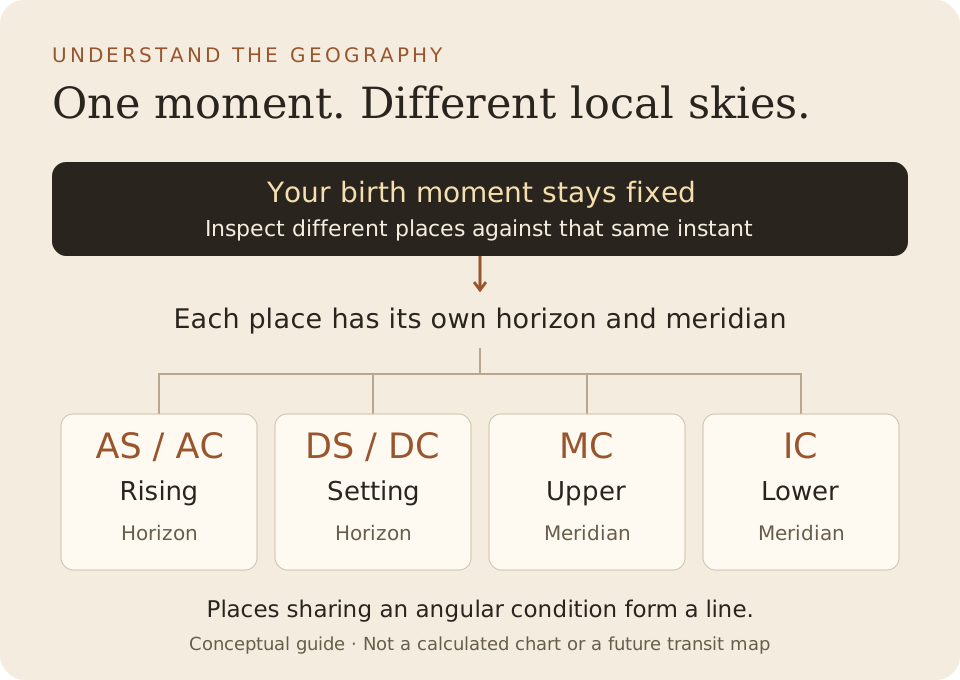
Conceptual diagram: the four labels describe different angular positions. It is not a calculated map or a depiction of a specific city’s sky.
The calculated position and its symbolic interpretation are separate parts of an astrocartography explanation. Knowing where Venus is angular is a geometric question. Connecting Venus with sociability, beauty or values belongs to astrological interpretation. An accurate distance does not prove the life outcome suggested by that interpretation.
From a Venus MC label to a useful reading
Consider a designer investigating a city for work involving regular contact with clients. Suppose an accessible result identifies Venus MC as the primary visible line. The example below explains those conditions; it is not a measured city result or a recorded user experience.
Venus is a restricted line; this astrocartography explanation assumes access. If it is locked, use the Sun-line exercise below within your available preview allowance.
A first reaction might be “Venus means love, so the city must be good for dating.” An astrocartography explanation should make that conclusion more precise. Venus supplies themes such as sociability, attraction, aesthetic judgment and values. MC identifies the public and career-facing area of life. Together they invite questions about professional relationships, presentation and the value other people see in your work.
What the location answer adds to your astrocartography explanation
When you open a place reading, the primary line’s angle identifies the life area, its planet supplies the themes, and proximity helps determine the strength of the wording. Here is how those parts contribute to the Venus MC example:
| Information to inspect | What it adds to the astrocartography explanation |
|---|---|
| Venus | Sociability, attraction, beauty and values; also a tendency to over-accommodate or choose comfort |
| MC | Places those themes in public life, career direction and reputation |
| Actual distance and strength | Qualify how prominently the line is described; they do not measure the chance of getting work |
| Client-facing design work | Gives the reader a reason to examine portfolio presentation and professional relationships; this goal comes from the reader, not the map |
For this designer, the astrocartography explanation highlights how their work is presented and how they relate to clients. The MC label does not establish that they will meet a romantic partner or win a contract.
What the evidence contributes
Open See why we reached this answer and look for the complete line label and approximate distance. Confirm whether the answer actually concerns Venus MC; do not replace an unfamiliar label with the one from this example. Also distinguish a point selected on a line from a city you intended to investigate.
In your astrocartography explanation, separate “the panel identifies Venus MC” from “I want to explore client-facing work here.” One is a map finding; the other is your purpose. Connecting them requires interpretation.
Read the complete astrocartography explanation
A short astrocartography explanation can now combine those parts. No distance or strength has been supplied for this hypothetical result, so the wording below does not claim the influence is strong. It is an authored example, not a quotation from the tool or an AI response:
Venus MC connects social and aesthetic themes with your public and professional life. For client-facing design work, this could be a useful lens for how you present a portfolio, communicate its value and build working relationships. The accompanying caution is over-accommodation: being approachable can become agreeing to terms that do not suit you. Your actual line distance and other available evidence qualify the reading; the label alone does not predict a contract.
The gain from this astrocartography explanation is specific: “Venus means love” becomes a professional question with an identifiable basis. The designer can ask, “How can I communicate the value of my work while keeping clear client expectations?” That is an application of the themes, not an additional fact calculated by the map.
Keep Venus, change the angle
The same planet does not give every place the same meaning. To understand why, keep Venus constant and change only the angular label in a conceptual comparison. This isolates the part that changes the life area in an astrocartography explanation. It is not a comparison of four measured cities.
| Line | What stays with Venus | What the angle changes |
|---|---|---|
| Venus AC / ASC | Sociability, attraction, beauty and values | Personal presence, self-expression and how you enter new situations |
| Venus DC / DSC | The same planetary themes | One-to-one relationships, partnerships and mutual expectations |
| Venus MC | The same planetary themes | Public presentation, professional relationships and reputation |
| Venus IC | The same planetary themes | Private comfort, home surroundings and what feels personally welcoming |
AS and ASC refer to the same rising angle; DS and DSC refer to the same setting angle. Different abbreviations do not mean additional lines. MC and IC refer to meridian positions; MC does not necessarily place a planet directly overhead at the zenith.
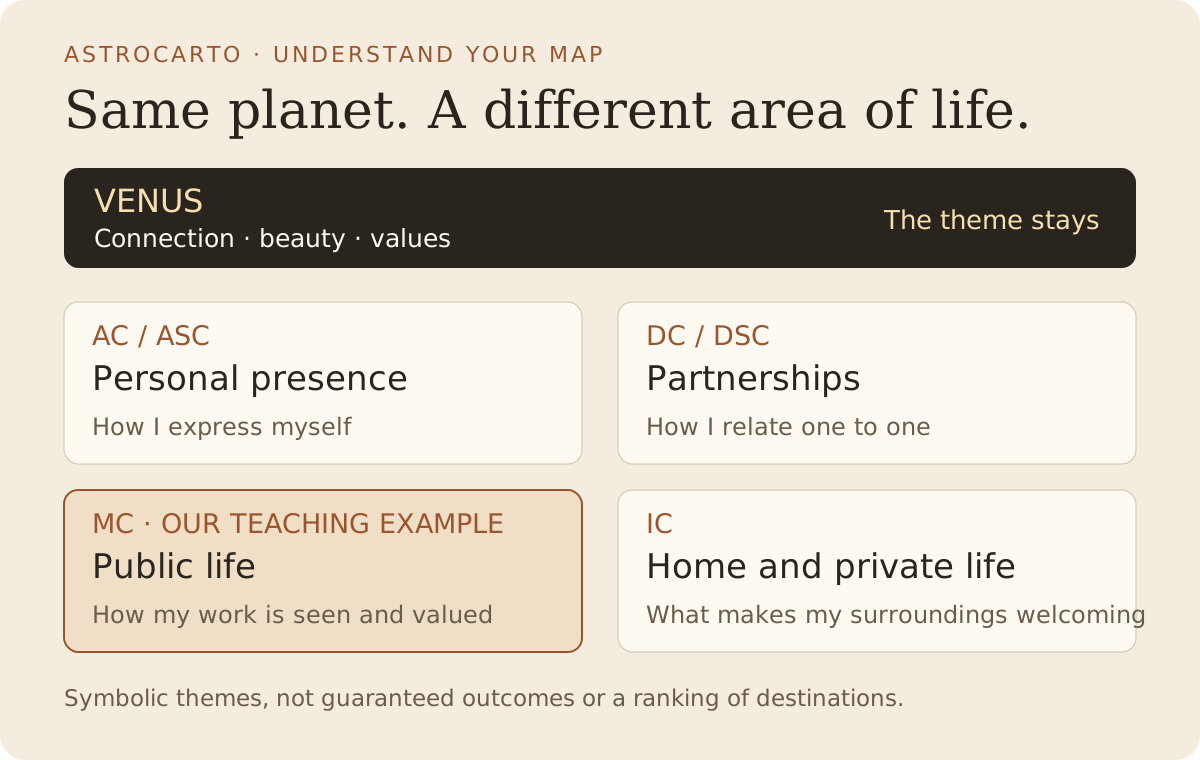
Keep the planet constant to see what the angle adds. These are symbolic reading prompts, not four destinations ranked from best to worst.
For the designer, a Venus IC interpretation might raise questions about a pleasing home studio or private surroundings. Venus MC instead invites attention to public presentation. Neither label establishes that one city is objectively better. A useful astrocartography explanation identifies the different questions before trying to choose between places.
Try the same distinction with a line actually shown in your result. Read the planet and angle together, then say the meaning in your own words. If the sentence would stay identical after replacing MC with IC, your astrocartography explanation probably has not accounted for the angle. The planetary line reference can help with other combinations.
Try an astrocartography explanation with a visible Sun line
You can practice without unlocking Venus. Sun is among the unrestricted planetary lines, while location previews still follow the current allowance. Select a visible Sun line on your map, open the available reading and check its actual angle. This exercise explains the selected line; it does not establish that every nearby city has the same overall result.
For a Sun MC selection, an astrocartography explanation combines visibility, confidence and recognition with public life. A useful question for the same designer is, “How do I want my work to be seen, and how comfortable am I with public evaluation?” Notice how this differs from the Venus emphasis on social ease and aesthetic value.
If the selected line is Sun AS instead, shift the question to personal presence: “How do I introduce myself and take initiative?” Keep your actual label rather than changing the answer to match the example. Read the available distance and strength alongside that meaning.
You have completed the exercise when you can explain both parts of your label and name a question relevant to you. Your astrocartography explanation now rests on a line you can inspect, rather than an inaccessible example or a borrowed recommendation.
Use the evidence to qualify the answer
An astrocartography explanation needs both meaning and proportion. In the map’s basic answer, words such as strongly, noticeably or gently are connected to proximity bands for the primary visible line. They are not percentages of success, compatibility ratings, or a measurement of how much you will like a city.
For the teaching example, a shorter Venus MC distance can make the line more prominent in the reading. It cannot turn “social and aesthetic themes in public life” into “you will get clients here.” The planet-angle meaning and the strength wording answer different questions. Keep both when reading your own astrocartography explanation.
The evidence panel also matters because a place can have more than one relevant line. Inspect what is actually available rather than treating the headline as a complete report. A direct line selection deliberately focuses attention on that line; a location check starts from the selected place. Return to the intended city when your question is about living or working there.
| What you find | A useful qualification |
|---|---|
| A clear primary line | Explain its planet and angle, then inspect the other available context |
| Distant visible lines | Keep the interpretation modest; do not manufacture a dominant theme |
| Additional nearby lines | Note that more than one theme may matter; the headline is a starting summary |
| A locked or unavailable result | Treat it as an access limit, not an unfavorable assessment of the city |
Use these distinctions to check an astrocartography explanation before applying it. If the wording sounds absolute while the evidence is limited, narrow your conclusion. “This suggests something to investigate” is different from “this settles my decision.” You can retain a useful symbolic reading without pretending the map knows your future.
When a question requires information you cannot access, name what is missing. An astrocartography explanation becomes less reliable when it fills an unavailable result with an assumed favorable or unfavorable answer.
Ask AI about a specific city question
Use Check City in your generated results, then its Ask AI action when available. This entry attaches the checked city and its line evidence, including planet, angle, distance and strength. The assistant still needs you to state your purpose; the map does not supply your occupation or plans.
For an astrocartography explanation about the designer’s Venus MC scenario, a focused question would be:
I am considering client-facing design work in this city. Using the attached evidence, explain what Venus contributes and what MC contributes. How do those themes relate to presenting my work and managing client expectations?
This is a suggested question, not a recorded exchange. Replace Venus MC if your city result shows another line. Use the city check’s AI entry so your astrocartography explanation starts with the relevant evidence; a generic chat entry may not attach that same result.
An answer that only says “Venus brings good relationships” misses the MC part. A useful astrocartography explanation should connect public presentation to MC, social and aesthetic themes to Venus, and client expectations to the goal you supplied. It should also keep the actual proximity and other attached lines in view.
If that connection is unclear, ask: “Which part of your explanation comes from Venus, which from MC, and which from my work goal?” The purpose is to understand your result well enough to use it, not simply to receive a longer description. AI access follows the options and credit requirements displayed in the tool.
Bring the explanation back to your own result
You can preserve the outcome of this astrocartography explanation in three short sentences: what the result shows, what the combination means, and what you want to understand about your situation. This is a note you can write yourself, not a new saved-note feature or a generated assessment.
| Part | Conditional teaching example |
|---|---|
| Map finding | The selected result identifies Venus MC; I record the actual distance separately |
| Meaning | Venus themes are being interpreted through public and professional life |
| Personal question | How do I balance an approachable presentation with clear client expectations? |
With your own astrocartography explanation, use the real line label instead of copying these answers. You should be able to explain why the meaning fits that label and what the interpretation leaves unanswered. That is a more useful stopping point than collecting additional reassuring descriptions of the same place.
For a broader astrocartography explanation, the results offer Create Personal Report, with separate sign-in and access requirements. The personal report page describes its scope. A report is not required to understand basic line vocabulary.
Questions about your astrocartography explanation
Can I get an astrocartography explanation for free?
Core map generation is free, and basic location previews are available within the current allowance. Extra previews, restricted signals, AI and personal reports have their own access conditions. Read the displayed scope before continuing. A free astrocartography explanation should describe the result you can access, rather than imply that every deeper feature has been unlocked.
Is this the same as a birth chart explanation?
A natal chart describes planetary placements for the birth chart itself. An astrocartography explanation focuses on their angular relationships to locations around the world at that birth moment. The map can help you explore a place question; it does not replace a full account of natal houses, aspects or every other astrological technique.
Why does my friend get a different explanation for the same city?
Compare the complete labels before comparing the prose. Different birth information can produce different line relationships to that city. Even similar labels may have different distances and surrounding context. Your friend’s astrocartography explanation is therefore not a ready-made recommendation for you. Generate your own chart and check the city against your own evidence.
Does moving change the lines on my birth map?
Moving changes the place you inspect, not the birth moment used for the map. An astrocartography explanation for a new destination refers to that destination’s relationship to the existing lines. A relocated chart is a related but separate view. Do not change your birthplace in the birth form to simulate a move.
What if I do not know my exact birth time?
Use the tool’s unknown-time option honestly and treat precise angular comparisons cautiously. Do not use an uncertain time to make confident claims about a line being especially close to a particular address. An astrocartography explanation should carry the uncertainty of its inputs rather than disguise it with a detailed paragraph.
Does a clear explanation prove a place is right for me?
No. An astrocartography explanation can make the symbolic logic understandable without establishing a prediction. The geometry identifies lines and distances; interpretation adds themes, and your circumstances determine what is relevant. Work, relationships, affordability and lived experience remain separate sources of information when you decide how to use the reading.
Get an astrocartography explanation for your own place
Start with your birth details and a place you care about. Read its available answer, inspect the supporting lines, and explore what the themes mean for your question.
Generate My Map