
Create your astro cart, a personal astrocartography map, with AstroCarto. Enter your birth details to explore the planetary lines near a city that interests you and their themes for relationships, home, or work. If a friend recommended the place, your own map helps you check that recommendation for yourself.
YOUR BIRTH DETAILS · YOUR MAP · PLACES TO EXPLORE
Astro Cart: Explore a Place for Yourself
Generate your personal map
Enter your birth details, then check the city you have in mind. Core map generation is free; previews and deeper tools have their own access limits.
Check a recommendation for yourself
What can you bring from someone else’s recommendation?
A friend describes a city as their favorite place to meet people. A video calls it a Venus destination. You want to know whether that recommendation has anything to do with your own astro cart. Keep the city, but reopen the question: what does your map show there, and does that interpretation address the experience you want?
Here, astro cart is used as an informal short name for an astrocartography map. It uses birth information to place planetary lines around the world. It is personal: another person’s lines do not become yours because you share a destination, a zodiac sign, or an interest in traveling together.
A recommendation usually combines three different things. First is an experience: your friend enjoyed a lively neighborhood. Second is an explanation: they associate that experience with a line on their map. Third is a suggestion: you should go there too. Those statements need different kinds of checking.
| Part of the recommendation | What you can carry forward |
|---|---|
| A real experience | A useful account of what that person enjoyed, with dates and circumstances |
| A personal map interpretation | A description to understand, not evidence about your own birth map |
| A proposed trip | A possibility to investigate against your purpose, available map evidence, and practical needs |
Your astro cart helps with the personal map question. It cannot verify a travel story or establish that a planetary line caused it. Ask which part of the recommendation matters to you before treating the whole story as one claim.
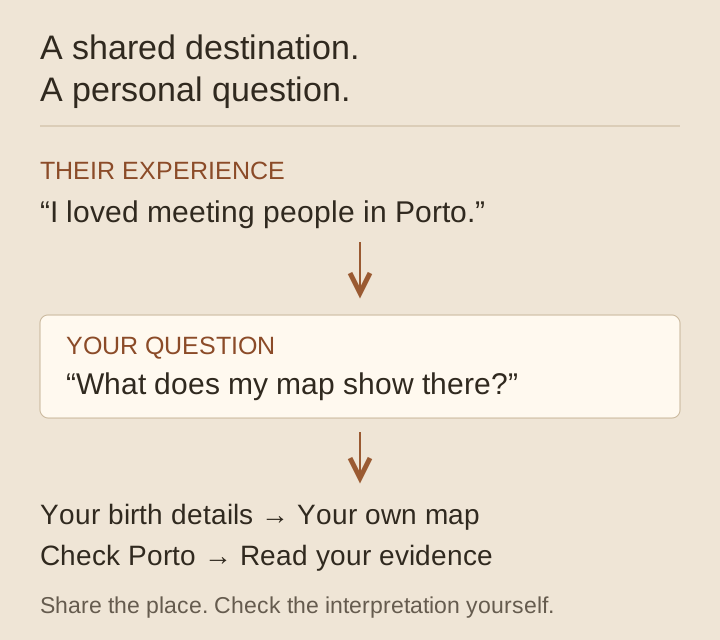
Conceptual workflow. A city recommendation can be shared; personal planetary lines cannot simply be transferred between people.
You also do not need another person’s private birth details to start. Your astro cart can examine your own relationship to the destination independently. Unless they choose to share their actual result, leave their claimed line unverified rather than trying to reconstruct it from a photograph or anecdote.
Put the recommended city on your own map
Generate your astro cart using your birth date, local birth time, and birthplace. Enter the original birthplace even when the recommendation concerns a future holiday. The destination comes afterward. If you have stored birth details available, confirm that the selected person is you before generating the result.
Use the unknown-time option when appropriate. An uncertain time limits how confidently you can interpret location-sensitive lines. Do not adjust it to reproduce your friend’s attractive result: that would change the information being checked instead of resolving the original question.
After generating your astro cart, open Check City and enter the destination with its country. Confirm the place returned, especially for names shared by several cities. The summary checks nearby visible planetary lines and shows available labels, approximate distances, strength, and context under the current access conditions.
Keep the complete planet-and-angle label from your astro cart. DSC means Descendant; the city result may label it DS. Venus DSC concerns relationships and one-to-one connection; Venus IC concerns home and private comfort. Both involve Venus, but a recommendation about meeting people does not automatically answer whether you would feel settled living there. The line meanings reference can help with unfamiliar combinations.
You can also select a location on your astro cart and read the available Start with the answer explanation. Expand See why we reached this answer to inspect its supporting evidence. Treat the city summary and the selected-location explanation as related views with their own scope, rather than assuming every field is identical.
Write down what your astro cart actually shows: your profile, the destination, its visible signals, and the question you brought. Do not fill a missing line or distance with information from the recommendation. If the expected planet is hidden or restricted, note that limitation; absence from your current view is not proof that it is absent from the calculation.
Your first useful astro cart result may be modest: a named city, a complete label, and an explanation you can connect to your purpose. You do not need to unlock every tool or interpret every line before recognizing whether the recommendation is about the same question you are asking.
A friend’s social trip and your language week
Imagine a friend recommends Porto after an enjoyable social holiday. They describe their own astro cart as having Venus DSC nearby. You are considering a week there to practice Portuguese, and you hope conversations will feel easier than they do at home. Your interest overlaps with theirs, but the activity and the expectation are more specific.
In this hypothetical astro cart example, suppose your city result shows Mercury DSC and Saturn DSC. These are assumed signals for learning the method, not a calculation for Porto. When you try it, use the lines, distances, and strength shown in your own result.
A conversation theme is not the same as effortless social ease
On your astro cart, Mercury DSC would connect communication, learning, and exchange with one-to-one relationships. For the language week, that suggests a question about conversation: will you have opportunities to speak with someone who can respond, correct, and engage with you?
That is different from inheriting your friend’s Venus explanation. The useful connection is to your chosen activity, not a promise that everyone will welcome you. A language exchange, a recurring class, or a planned conversation could provide a practical setting for exploring that theme. Your astro cart does not find those opportunities or confirm their quality.
Saturn DSC on the same astro cart would introduce seriousness, responsibility, distance, or commitment pressure in relationships. In this teaching scenario, that raises a second question: would clear expectations help you participate, or would a demanding arrangement make a short visit feel burdensome?
The pair gives you a more specific inquiry than “Porto is social.” You could ask a class organizer about group size, attendance expectations, and whether beginners get time to speak. Compare those answers with how much structure you want during a short visit.
Keep the recommendation and the evidence separate
| Item | What it means in this conditional example |
|---|---|
| Friend’s report | They enjoyed meeting people and attribute it to Venus DSC; their map has not been verified here |
| Your astro cart evidence | Assume Mercury DSC and Saturn DSC appear; their actual distances and strength still matter |
| Your interpretation | Conversation and learning deserve attention, alongside expectations and interpersonal pressure |
| Your practical question | Can the planned activity offer enough conversation without demanding more commitment than the trip allows? |
Your astro cart has changed the question without disproving your friend. Their holiday can remain enjoyable and their recommendation sincere. What does not carry over is the inference that their personal line guarantees the same experience for you.
Do not label the complete city “mixed” solely because this example contains an encouraging theme and a caution. Two selected signals cannot reconstruct an overall tool result. Read the available explanation and wider evidence on your own astro cart, including anything that complicates the story you hoped to confirm.
Three ways your result can change the recommendation
The point of using an astro cart is not to force agreement with a persuasive story. A personal check can support a similar interpretation, suggest a different one, or leave the question unresolved. Each outcome deserves a different next step.
Your evidence supports a similar theme. Perhaps your result also contains a relationship-oriented signal relevant to meeting people. Record its full label and context. The overlap means you can explore a related symbolic question; it does not establish the same distance, strength, circumstances, or future experience as your friend’s.
If your astro cart shows Venus MC while the recommendation described Venus DSC, preserve that difference. Public appeal and creative work are not identical to one-to-one relationships. A shared planet name is only partial agreement. Read the angle before writing that both maps say the same thing.
Your evidence suggests a different emphasis. The language-week example shifts attention from easy social connection to exchange and expectations. Keep the destination as a candidate while reconsidering the reason for choosing it. You might still want the trip because the course, schedule, and accommodation meet your needs.
A different astro cart does not make the recommendation dishonest. It means the personal explanation has not transferred. Ask whether the place remains interesting without that borrowed explanation. If the answer is yes, you have separated a real travel preference from the story that first drew your attention.
The evidence is not sufficient to decide. An unknown birth time, a restricted preview, hidden planetary layers, or only broad nearby context can leave the specific claim untested. These situations have different causes, but none authorizes a confident conclusion that the city is good or bad for you.
Keep “not checked” as a valid astro cart outcome. Where possible, resolve the specific gap: confirm the place, restore relevant available layers, or obtain more reliable birth information. If you cannot resolve it, make practical plans without pretending that the missing evidence agrees with the recommendation.
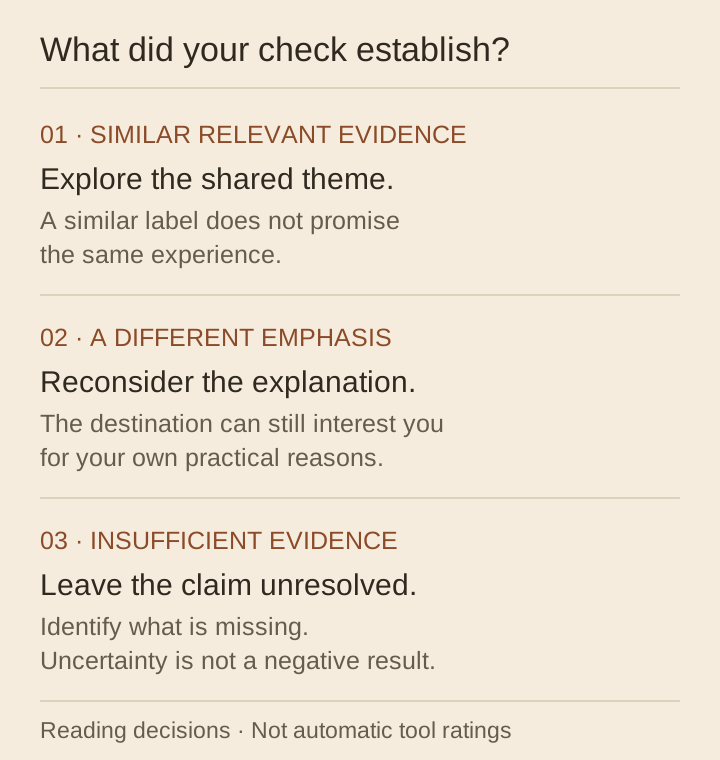
These are reading decisions, not product scores or automatic labels. Similar evidence does not promise a similar experience.
Ask a question that uses your actual city evidence
The Ask AI about this city evidence action in Check City carries the current city evidence into the AI workflow. It can help you ask about the labels and context you have just inspected on your astro cart. Access and credit requirements remain those shown by the tool.
Add the recommendation in your own words and say what you hope to do. The AI does not automatically receive your friend’s birth map, their social post, or an earlier result from elsewhere. Keep supplied background distinct from the evidence attached by your current city check.
For the Porto example, you could ask:
A friend recommended Porto because they enjoyed meeting people there. I am considering a week of Portuguese conversation practice. Using my attached city evidence, explain which themes relate to learning and one-to-one interaction, what cautions matter, and what remains uncertain. Please distinguish my result from my friend’s experience.
This astro cart question asks for an explanation of existing evidence. It does not instruct the AI to invent Venus DSC or confirm that Porto is destined for you. If your current result contains different signals from the teaching example, those actual signals should drive the answer.
A useful response should connect each interpretation to something present in your astro cart evidence. It should distinguish a planet’s theme from the angle’s life area, preserve available distance or strength context, and acknowledge missing information. A confident city recommendation without that connection is not enough to settle your question.
You can then ask a narrower follow-up: “Which part of this interpretation concerns conversation, and which concerns commitment?” Keep the exchange focused on your available result. The tool can clarify symbolic meaning; whether a particular class welcomes beginners remains a question for the organizer.
Rewrite the recommendation after checking your map
After exploring your astro cart, return to the recommendation that brought you here. Write its original wording in your own notebook before replacing it with a more personal conclusion. In the Porto scenario, the starting claim might be:
Porto was easy for meeting people, and I associate that with my Venus DSC line. You would love it there too.
Keep the experience in its original context. Your friend enjoyed a social holiday. That remains a reason to be curious about Porto, even if your map emphasizes something different. Keep “my friend enjoyed it” attached to the friend; changing it to “this city makes meeting people easy” would turn one person’s experience into a general claim.
Rewrite the personal explanation. In the conditional example, Mercury DSC and Saturn DSC on your astro cart point you toward exchange and expectations. Your question concerns Portuguese conversation practice. Replace the borrowed Venus explanation with those themes and that purpose. You can still investigate the same destination while changing the reason it interests you.
Leave unsupported conclusions open. Whether you will enjoy the visit remains unknown. Your friend’s account does not establish your line distances, strength, or wider city result. When a relevant signal is unavailable, write which part of the recommendation you could not check. Keep that gap visible instead of filling it with the most appealing part of their story.
For the hypothetical astro cart example above, the rewritten recommendation could read:
My friend enjoyed meeting people in Porto. I am interested in practicing Portuguese there. If my astro cart shows Mercury DSC and Saturn DSC, I would examine conversation opportunities alongside expectations and responsibility. That gives me a personal question to explore; it does not establish that I will share my friend’s experience. I still need the full available context for my own result.
Use your astro cart result to replace the conditional sentence with what you actually found. “My result also highlights a relevant relationship theme” records a limited similarity. “I could not inspect the relevant signal” records an unanswered question. Neither statement needs to become a verdict about the whole city.
If you revisit your astro cart, update the part of the note affected by new evidence. Corrected birth information may change your personal interpretation; a new story from your friend adds to their experience. Keeping those sources separate lets you explain why your conclusion changed without rewriting what first attracted you to the place.
Generate your map and check the recommended place. Bring one recommendation, inspect your own evidence, and leave with a version you can explain. For help interpreting the labels you find, use the step-by-step reading guide.
Questions about your astro cart
What does astro cart mean here?
It is an informal way of referring to an astrocartography map. This page uses that meaning: personal planetary lines calculated from birth information and examined against locations on Earth. The shorthand can have other meanings elsewhere, so check the context rather than assuming every similarly named service provides this tool.
Can I create an astro cart for free?
You can generate the core map without signing in. Planetary access, city checks, location previews, AI, and deeper reports have their own allowances or requirements. Follow the messages displayed for the action you choose; free map generation does not mean unlimited access to every interpretation.
Will a city that suits my friend suit me?
Their experience is useful background, but it does not supply your planetary lines or predict your experience. Check the city on your astro cart and ask whether the available interpretation addresses your purpose. Shared interests and practical arrangements matter independently of the map.
Can I use someone else’s astro cart screenshot?
It can help you understand what they are discussing, but it cannot replace your own calculation. Generate your map from your birth details and select the city yourself. This page does not import screenshots or recover another person’s complete chart from an image.
Why does my astro cart show something different?
Birth information, selected coordinates, visible layers, and calculation settings can differ. First establish whose map is being described and which location was checked. A different label is not automatically an error. It may simply mean that the recommendation and your result concern different people or questions.
Must I avoid a place when the result is unclear?
No. An unresolved map interpretation is not a warning about the city. Keep the uncertainty explicit and investigate practical suitability directly. If you use your astro cart again, try to answer the specific missing question instead of repeatedly searching for a more reassuring label.
Check that recommendation on your own astro cart
Start with your birth details and one real city. See what your map actually shows before carrying someone else's interpretation into your plans.
Generate My Map