Generate · Test · Compare
Free Astrocartography Test: Generate Your Map, Then Check It
This free astrocartography test starts with your calculated map, not a personality label. Generate yours, choose a place you know, and compare its nearby lines, distance, strength, and crossings with lived experience. Or take the six-question quiz and use missed answers as a map-reading checklist.
- Free core map
- No sign-in to generate
- Real place inspection
Use the result as a structured comparison, not proof, a prediction, or a substitute for practical location research.
01 / GENERATE THE EVIDENCE
Generate the Map You Will Test
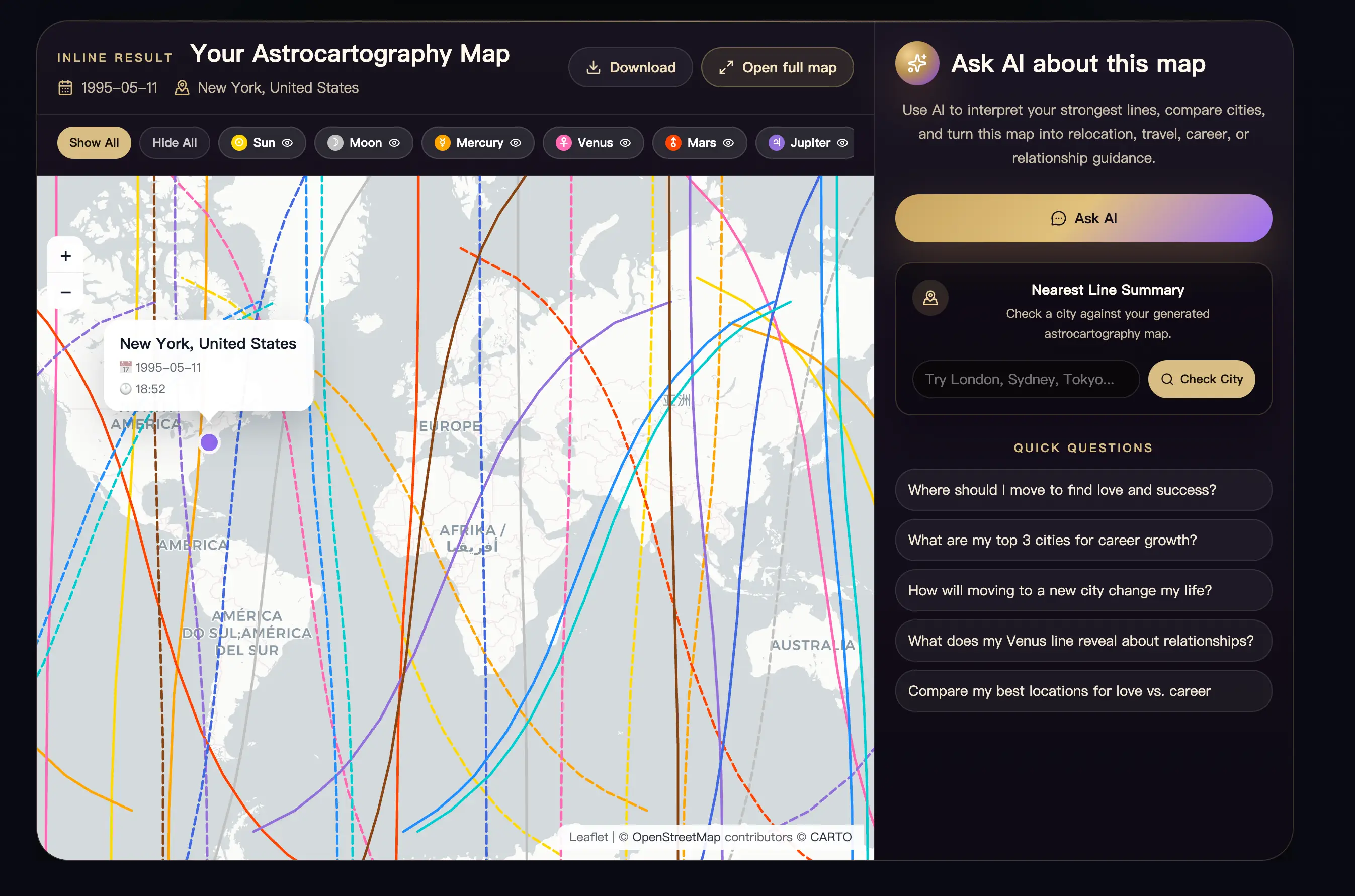
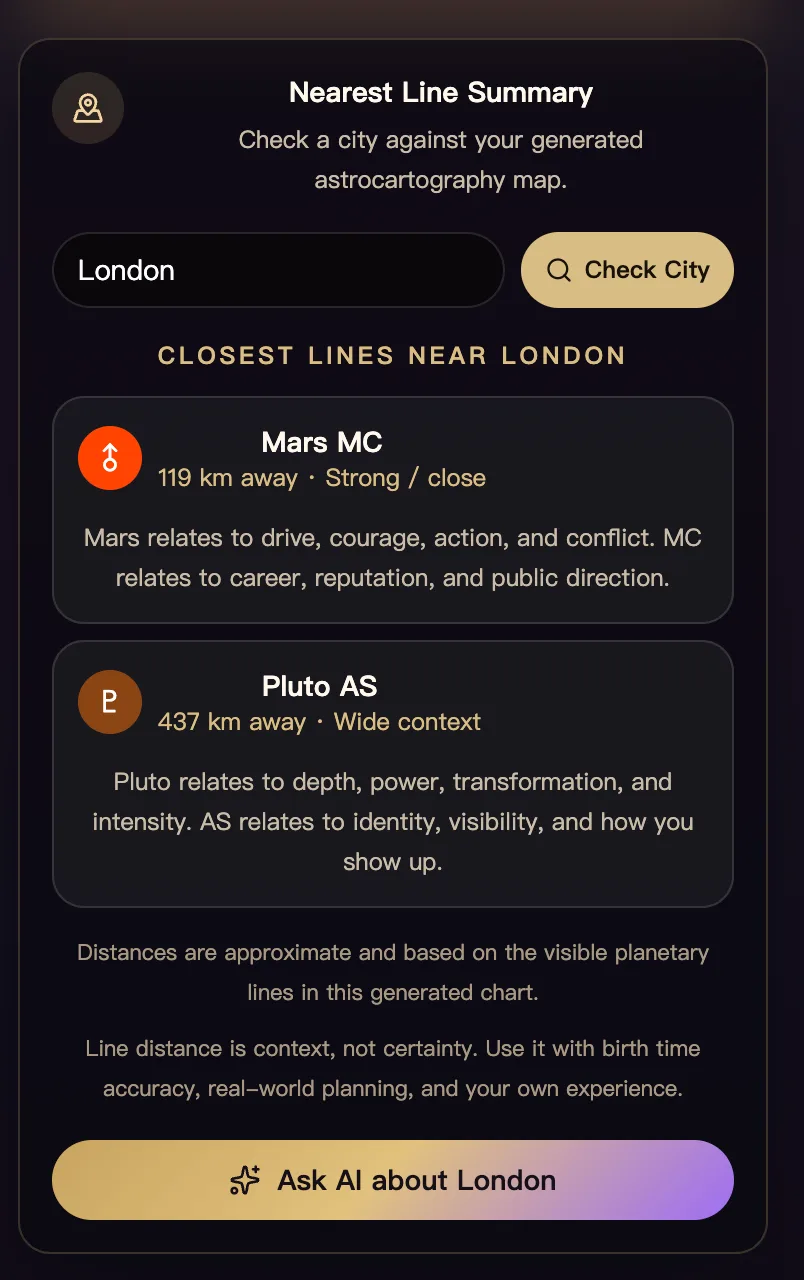
Enter your birth details, then click a familiar location or use Check City to inspect nearby lines, distance, strength, and available crossing evidence.
- 01Generate
Create your calculated map from birth date, time, and birthplace.
- 02Check
Inspect one familiar place before choosing a dream destination.
- 03Compare
Keep match, mismatch, and inconclusive results available.
02 / CHECK YOUR READING
Take the Astrocartography Quiz
The result shows a score, the correct reasoning, and review actions tied to any question you missed. It does not measure intuition, spiritual ability, or whether a city will make you successful.
Every score leads back to the real map. A missed distance question points you toward Check City; a missed comparison question points you toward a second place or Compare Cities.
Six questions test whether you can separate calculated map evidence from assumptions and guarantees. Your score measures map-reading readiness, not personality or future success.
0 / 6 answered03 / TEST A KNOWN PLACE
Run the Astrocartography Test on One Familiar Place
Start with somewhere you have lived, worked, studied, or spent enough time to describe before seeing the lines. A dream destination gives you hopes; a familiar place gives you observations.
- Record input confidence. Note whether your birth time comes from an official record, family memory, an estimate, or the unknown-time setting.
- Write before reading. Describe ordinary patterns involving work, home, relationships, pressure, learning, or change before opening the place result.
- Inspect the same coordinate. Click the map or use Check City. Record the nearest line, planet-plus-angle label, distance, strength, and any available Angular Aspect or Paran evidence.
- Classify the comparison. Mark each observation as match, mismatch, or inconclusive. Use inconclusive when the place signal is weak, the visit was brief, or a practical cause explains more.
Use concrete observations, not one-word impressions. “I managed a larger team for three years” is easier to compare than “the energy felt strong.” A stable household, repeated moves, a difficult commute, a dense social network, sustained isolation, or a change in study also gives the test something specific to examine.
| Area | Write down before the result | Check after clicking the place |
|---|---|---|
| Work and visibility | Responsibility, recognition, or competition | Relevant MC evidence, distance, and strength |
| Home and belonging | Stability, privacy, support, or strain | Relevant IC evidence or a low-signal result |
| Relationships | Partnership, community, collaboration, conflict | Relevant DSC evidence without forcing every contact |
| Energy and change | Drive, pressure, fatigue, disruption, learning | Close signals, wider context, and stronger real factors |
Repeat the same process with a second known place. A contrast is more informative than editing one city’s story until it fits.
04 / CLICK FOR PLACE EVIDENCE
Read the Clicked Place, Not Just the World Map
A static screenshot can show colors and curves, but it cannot reliably tell you how far a city is from a line or which supported signals are available at that coordinate. AstroCarto’s clickable map turns a visual impression into a place-specific evidence set.
When you click, separate four layers:
- Calculation: nearby visible lines and supported crossing signals.
- Distance and strength: whether a signal is close, wider context, or absent from the result.
- Interpretation: the symbolic meaning commonly associated with the planet and angle.
- Reality check: whether that wording helps with a concrete observation after work, money, housing, relationships, health, climate, and timing are considered.
A useful astrocartography test may show that a visually close line is farther away than expected, a memorable city has no strong nearby signal, or two influences point in different directions. Those are results, not errors to hide. If a match looks persuasive, test a second place before relying on the pattern.
For a full interpretation sequence, use How to Read Your Astrocartography Map after you have a real place result.
05 / CONTINUE WITH PURPOSE
Turn the Result Into the Right Next Action
Do not leave the page with a generic conclusion such as “Mars fits.” Choose the next tool from the question the comparison created.
| Your situation | Next action | What it adds |
|---|---|---|
| One place result is mixed or unclear | Ask AI from that result | Carries visible place evidence into a focused follow-up question |
| You want to test another city you already know | Check City | Applies the same distance and strength check to a second location |
| You have two to four realistic options | Compare Cities | Keeps competing signals and practical trade-offs side by side |
| You do not yet have a destination shortlist | Find My Best Places | Starts candidate discovery from the calculated map |
| You want a structured record you can save or revisit | Personal Astrocartography Report | Organizes the map, locations, themes, and decision questions |
Astrocartography AI is most useful after the map or clicked place has established the evidence. Ask a specific question such as, “Which nearby signal best fits the work pattern I recorded, and what contradicts that reading?”
The core map is free to generate without signing in. Continued chat, saved history, downloads, reports, or other advanced actions may require sign-in, credits, or an eligible plan. The current interface shows the requirement before you continue; this page does not promise permanent pricing or unlimited access.
06 / KEEP THE CLAIM HONEST
What This Test Can and Cannot Establish
One personal comparison cannot prove that planetary positions caused events. Memory is selective, symbolic interpretations are flexible, and cities differ for many practical reasons. This page therefore treats match, mismatch, and inconclusive as equally valid outcomes.
For the broader evidence question—what is reproducible, what is interpretation, and what has not been scientifically established—read Is Astrocartography Real?.
The narrower purpose is useful: test whether a calculated place result helps you organize observations, identify trade-offs, or ask a more precise question. A close line is not a guaranteed event. A match is not scientific proof. A mismatch should not be explained away automatically. Uncertain birth time, weak signals, short visits, or major real-world circumstances can limit the comparison.
For the calculation chain, planetary positions, coordinates, and map geometry, read How We Calculate Astrocartography. Method transparency shows what the product calculated without asking you to accept the interpretation as fact.
07 / QUESTIONS
Astrocartography Test FAQ
01What is an astrocartography test?
An astrocartography test generates your personal map and compares place-specific evidence with a location you know. Record experience first, inspect calculated distance and strength, and allow match, mismatch, or inconclusive results.
02Is the astrocartography test free?
The core map is free to generate without signing in, and the six-question quiz is free to take. Continued chat, saved history, downloads, reports, and other advanced actions may have requirements shown in the current interface.
03Is this an astrocartography personality quiz?
No. The quiz checks your understanding of map evidence and its limits. It does not assign a planetary personality, choose a city, or turn six answers into a prediction.
04Which place should I use for the test?
Choose a city where you lived, worked, studied, or spent substantial time. Ordinary experience gives you more specific observations than a dream destination or a brief trip.
05What if my map does not match my experience?
Keep the mismatch. Check birth-time accuracy, the selected coordinate, distance, strength, and time spent there. The result may remain inconsistent or inconclusive, which is more honest than forcing a match.
06Do I need an exact birth time?
Use the most accurate recorded time available because angle-sensitive lines can move when the time changes. If it is estimated or unknown, treat the comparison as less precise.
07Can this test prove that astrocartography works?
No. A personal comparison cannot establish scientific causation. It can show whether the calculated evidence and symbolic interpretation are specific and useful enough to investigate further.
08Can the test tell me where I should move?
No. For relocation research, compare candidates, visit when possible, and consider visas, housing, safety, work, healthcare, finances, accessibility, climate, relationships, and family needs.
GENERATE · CLICK · COMPARE
Test Your Map With a Place You Already Know
Generate your map, inspect one familiar place, and record what matches, what does not, and what remains uncertain. A useful astrocartography test should make your next question more precise, not make disagreement disappear.