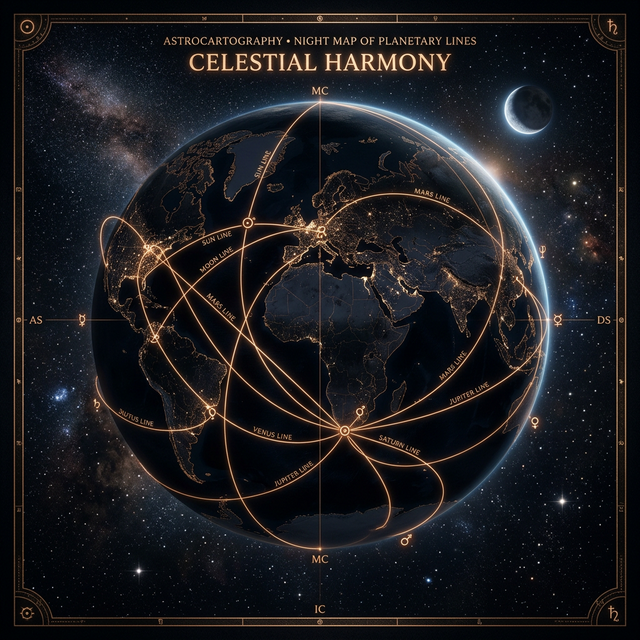
Astrocartography is a way of mapping your birth chart onto the world so you can see which places are linked to different planetary themes in your life. In practical terms, astrocartography is used to compare cities for relocation, travel, work, relationships, lifestyle changes, and personal growth.
If a birth chart tells you what energies are present, astrocartography helps explore where those energies may feel stronger. That is why people often use it when deciding where to move, where to spend time, or why one place feels very different from another.
Astrocartography in Simple Terms
Astrocartography takes the same birth data used in astrology, your date, time, and place of birth, and projects it across a world map. The result is a set of lines showing where certain planets were rising, setting, overhead, or at the lower meridian at the moment you were born.
Those lines are then interpreted as location-based signals. People use them to ask questions like:
- Which cities may feel more supportive for career growth?
- Where might relationships feel easier or more intense?
- Why does one place feel heavy while another feels energizing?
- Is a city better for a short trip, a creative reset, or a long-term move?
Astrocartography does not promise a perfect city. It works better as a decision-support tool than as a guarantee.
How Astrocartography Works
At a basic level, astrocartography starts with your natal chart and tracks where the planets were strongest by angle at the time of birth. Most maps focus on four main angular conditions:
- ASC (Ascendant) - where a planet was rising
- DSC (Descendant) - where a planet was setting
- MC (Midheaven) - where a planet was overhead and linked to public life or visibility
- IC (Imum Coeli) - where a planet was tied to home, roots, and private life
When those angular positions are projected onto the globe, you get lines that represent where a planet may feel more emphasized. People then interpret those lines in the context of a goal: relocation, travel, work, love, study, rest, or reinvention.
What an Astrocartography Map Shows
An astrocartography map does not just show random lines. It shows location-sensitive patterns connected to your birth chart.
In practice, users often look for:
- Planetary lines near a city they care about
- The angle of the line, because the same planet can feel different on ASC, DSC, MC, or IC
- Clusters or crossings, where several signals stack together
- Distance from the line, since many people read a line as influential not only at the exact path but also within a surrounding range
A good way to think about it is this: astrocartography is less about finding a magical place and more about seeing which themes may be emphasized in different locations.
Why People Use Astrocartography
Most people do not use astrocartography for theory alone. They use it because they are trying to make a real-world decision.
Common use cases include:
1. Relocation
Someone is comparing two or three cities and wants a different lens on career, stability, comfort, or momentum.
2. Travel
Someone wants to understand whether a location feels better for exploration, retreat, connection, creativity, or intensity.
3. Career and Visibility
Some people use astrocartography to explore where public visibility, ambition, discipline, or recognition may feel stronger.
4. Relationships and Emotional Ease
Others use it to think about connection, closeness, romance, domestic life, or emotional comfort in a specific place.
5. Personal Reinvention
Astrocartography is also used when someone wants a new environment, a reset, or a more intentional relationship to where they live.
What Astrocartography Is Not
Astrocartography is often misunderstood because people expect it to make the decision for them. It cannot do that.
It cannot reliably replace:
- cost of living research
- visa and residency constraints
- job market reality
- safety considerations
- family obligations
- health needs
- on-the-ground experience
A useful way to frame it is this:
Astrocartography can help you notice patterns, trade-offs, and emphasis. It should not replace practical judgment.
That is also why many people find it more helpful when they already have a shortlist of places in mind instead of expecting the map to deliver one perfect answer on its own.
Astrocartography vs a Birth Chart
A birth chart and astrocartography are closely related, but they answer different questions.
- A birth chart helps you understand your underlying psychological and life patterns.
- Astrocartography helps you understand how location may change the way those patterns are experienced.
In other words:
- Birth chart = what is present
- Astrocartography = where it may feel stronger
That is why astrocartography is especially useful when the question involves geography: moving, traveling, choosing a base, comparing cities, or making a location-based lifestyle decision.
Do You Need an Exact Birth Time?
Exact birth time usually improves astrocartography, especially when reading angles precisely. If the birth time is off, the angular lines can shift, which makes a close city comparison less reliable.
That said, some users still explore the map without a perfect birth time to get a broader directional sense. The result can still be useful as a rough reference, but it should be treated with more caution.
If your birth time is uncertain, it is better to think in terms of broader patterns rather than exact city-level certainty.
How to Start Using Astrocartography
If you are new, the easiest workflow is:
- Enter your birth details
- Generate your chart and map
- Look at the cities you actually care about
- Check which lines are nearby
- Compare those patterns against your real goals
- Use interpretation as support, not as the only decision factor
This approach is more useful than trying to memorize every line meaning all at once.
A Better Question Than “What’s My Best Place?”
One reason people get stuck with astrocartography is that they ask the wrong question. The map becomes much more useful when the question is specific.
Instead of asking:
- What is the best place for me?
Ask:
- Which city looks more supportive for career growth?
- Which location feels better for a long-term move versus a short stay?
- Which place seems better for stability, and which feels better for visibility or change?
The more specific the question, the more practical the map becomes.
Frequently Asked Questions
What is astrocartography used for?
Astrocartography is used to compare locations through the lens of a birth chart. People commonly use it for relocation, travel, career decisions, relationships, lifestyle changes, and city comparison.
Is astrocartography the same as a birth chart?
No. A birth chart describes the planetary pattern at birth, while astrocartography maps those patterns onto the world to show where certain themes may feel stronger.
Can astrocartography tell me where to live?
It can help you compare places and notice patterns, but it should not be treated as a guaranteed answer. Real-world factors still matter.
Do I need my exact birth time for astrocartography?
Exact birth time is strongly preferred because it improves the accuracy of angular lines. Without it, the map can still offer a broader reference, but it becomes less precise.
Is astrocartography only for relocation?
No. People also use astrocartography for travel, short stays, creative retreats, remote work, relationship questions, and lifestyle planning.
Final Take
Astrocartography is best understood as a location-based extension of the birth chart. It helps people compare places, spot patterns, and bring more structure to decisions about where to live, work, travel, or reset.
Its value is not that it removes uncertainty. Its value is that it gives you another framework for asking better questions about the places that matter to you.
If you want to move from theory to your own map, the next step is simple: generate your chart and start with the cities you already have in mind.
Ready to See Your Own Astrocartography Map?
Enter your birth details, generate your Astrocartography Chart, and compare the cities you care about with more clarity.
Generate Your Astrocartography Chart