Astrocartography Reading
How to Read an Astrocartography Map
To read an astrocartography map, start with a real place, find the nearest planetary line, identify the planet and angle, check the distance, and interpret the combination in the context of your actual goal. You do not need to decode the whole world map at once.
Use the interactive chart to compare real places and see how each planet-angle combination changes the way a location is read.
Use this order:
- Choose a place you know or care about.
- Find the nearest planetary line.
- Identify the planet.
- Identify the angle: AC, DC, MC, or IC.
- Check how close the place is to the line.
- Compare the theme with your real reason for considering that place.
Place + Planet + Angle + Distance + Goal = A More Useful Reading
01 / MAP
Create Your Astrocartography Map and Follow Along
Enter your birth details below to generate your personal map. Once the map appears, use the six-step guide below to learn how to read your astrocartography map one location at a time.
For the most precise angle lines, use the most accurate birth time available. If you do not know your birth time, you can still explore the map, but you should treat close line and angle comparisons more cautiously.
02 / GUIDE
How to Read Your Astrocartography Chart in Six Steps
If you have opened your map and wondered, “How do I read my astrocartography chart?”, the most important change is to stop treating it as a puzzle you must solve all at once. Read one location at a time.
The map becomes much easier to understand when every line is connected to a real place and a real question.
Step 1: Start With a Real Place
Begin with a city rather than a planet.
A practical first sequence is:
- Your current city, which gives you a baseline.
- A city you know well, which lets you test the reading method against lived experience.
- A place you are actively considering, which makes the map useful for a real decision.
This is usually more helpful than searching the map for Venus, Jupiter, or another planet before you know which location you are evaluating.
Astrocartography is a location-comparison framework. The useful question is not simply “What does Venus mean?” It is “What might this Venus line emphasize near this place, through this angle, for the goal I have now?”
Step 2: Find the Nearest Planetary Line
After choosing a place, identify the closest visible planetary line or lines.
Each line combines:
- a planet, such as the Sun, Moon, Venus, Mars, Jupiter, or Saturn
- an angle, such as AC, DC, MC, or IC
Do not assume that the line nearest to a city is automatically good, bad, or decisive. Its meaning depends on the full combination, the distance, nearby signals, and what you want from the location.
If several lines are nearby, note each one separately before trying to combine them. A place can emphasize more than one theme at the same time.
For a deeper reference, see Astrocartography Lines and Their Meanings.
Step 3: Identify the Planet
The planet describes the type of theme that may become more noticeable around the line.
| Planet | Beginner theme to investigate |
|---|---|
| Sun | Visibility, vitality, confidence, identity, leadership |
| Moon | Emotions, care, family, belonging, changing needs |
| Mercury | Communication, learning, movement, trade, networking |
| Venus | Relationships, harmony, aesthetics, pleasure, values |
| Mars | Action, courage, competition, desire, conflict |
| Jupiter | Growth, opportunity, exploration, education, excess |
| Saturn | Responsibility, boundaries, discipline, pressure, mastery |
| Uranus | Reinvention, freedom, disruption, independence, change |
| Neptune | Imagination, spirituality, sensitivity, idealization, uncertainty |
| Pluto | Power, intensity, transformation, endings, renewal |
These are starting themes, not predictions. A Venus line does not guarantee love, a Jupiter line does not guarantee luck, and a Saturn line is not automatically negative.
The planet tells you what kind of theme to examine. The angle tells you where that theme is more likely to show up.
Step 4: Identify AC, DC, MC, or IC
The four main angles are the backbone of an astrocartography chart.
| Angle | Also written as | Main area to investigate |
|---|---|---|
| Ascendant | AC or ASC | Identity, embodiment, first impressions, direct experience |
| Descendant | DC, DSC, or DES | Relationships, partnerships, one-to-one dynamics |
| Midheaven | MC | Career, visibility, reputation, public direction |
| Imum Coeli | IC | Home, roots, family, inner life, private foundations |
The same planet can feel very different through different angles. Venus MC and Venus IC are both Venus lines, but one may emphasize public expression and reputation while the other may emphasize comfort, home, and private stability.
If a glyph or abbreviation on the map is unfamiliar, use the Astrocartography Symbols Guide rather than guessing from color alone.
Step 5: Check the Distance
A city does not need to sit exactly on a line to be worth investigating.
Think of distance as a gradual change in emphasis rather than a hard switch:
- a closer line may deserve more attention
- a more distant line may feel broader or less dominant
- several nearby lines may create a more layered location
- no close line does not mean the place is bad or meaningless
Use the calculated city evidence in your map instead of estimating distance by eye. The visual map is useful for orientation, but calculated proximity is more reliable for comparison.
Distance still does not turn a symbolic theme into a guaranteed event. It helps you decide which signals to investigate first.
Step 6: Connect the Combination to Your Goal
Now combine the evidence:
Planet + Angle + Distance + Place + Goal
Ask what you are actually considering the location for:
- a permanent move
- a short trip
- career development
- relationships
- family and home life
- study or creative work
- rest, change, or personal growth
The same line can be relevant in different ways for different goals. A strong public or career theme may be useful when you want visibility but less appealing when you want privacy and emotional rest.
Do not ask only, “Is this a good line?” Ask:
- What part of life might it emphasize?
- Does that emphasis match my goal?
- What trade-off might come with it?
- What other nearby lines change the picture?
- What practical facts still need to be checked?
03 / GUIDE
How to Interpret Astrocartography Planets and Angles Together
To interpret a map clearly, read the planet and angle together rather than as separate facts, and do not treat one line as a final verdict.
For example, Venus is commonly associated with connection, pleasure, aesthetics, harmony, and values. The angle changes where those themes may become more noticeable:
| Combination | Useful questions to ask |
|---|---|
| Venus AC | How might this place affect self-expression, confidence, style, attraction, or the way I meet life? |
| Venus DC | What relationship, partnership, attraction, or people-pleasing themes may become more visible? |
| Venus MC | Could this place emphasize public charm, diplomacy, creative visibility, reputation, or approval-seeking? |
| Venus IC | How might this place relate to comfort, home, private relationships, belonging, or avoidance of necessary tension? |
This method works with every planet:
- Name the planet’s main theme.
- Name the life area represented by the angle.
- Turn both into a question about the location.
- Check the distance and nearby lines.
- Compare the result with your real goal.
This is more useful than memorizing slogans such as “Venus is good” or “Saturn is bad.” Support and difficulty can exist in the same place.
04 / GUIDE
How to Read Astrocartography Lines Without Oversimplifying Them
When people first learn how to read astrocartography lines, they often look for one line that will give a final answer. A map rarely works that neatly.
One line is not the whole location
A city may be close to several lines, or one close line may be modified by broader chart context. Start with the nearest evidence, but do not pretend that it is the only factor.
Strong does not mean easy
A strongly emphasized place can be productive, exciting, demanding, unstable, or emotionally intense. Strength describes emphasis, not whether the experience will be pleasant.
Quiet does not mean bad
A place without a close line may feel less dominated by one angular theme. That can be useful when you want balance, recovery, or room to make decisions without one theme taking over.
Colors are not universal meanings
Do not assume a line is positive or negative because of its color. Identify the planet glyph and angle label, then read the combination.
05 / GUIDE
How Close Does a Place Need to Be to a Line?
There is no single distance that guarantees a specific experience.
Different practitioners use different working ranges, and a map should not be treated as if a line were a razor-thin border between “active” and “inactive.” The closer line is usually the first one to investigate, but distance should be read alongside the planet, angle, other nearby lines, birth-time accuracy, and your reason for considering the place.
A practical approach is:
- Use the map’s calculated city distance.
- Compare the nearest few signals rather than looking at only one.
- Treat close differences cautiously if your birth time is uncertain.
- Compare the city with another real option.
The goal is not false precision. The goal is a consistent way to compare locations.
06 / GUIDE
How to Compare Two Places on Your Map
Once you can read one place, compare it with another using the same questions.
| Comparison field | Record for each place | Ask when comparing |
|---|---|---|
| Nearest line | Planet + angle | Which signal is closest or most dominant? |
| Planet | The main planetary theme | Which theme better matches your goal? |
| Angle | AC, DC, MC, or IC | Which life area matters most right now? |
| Distance | Calculated proximity | Is one signal clearly closer? |
| Life area | Identity, relationships, career, or home | Does the emphasis fit why you are considering the place? |
| Goal fit | High, mixed, or low, plus why | What support and trade-off arrive together? |
| Main support | One concrete advantage | Which support matters in real life? |
| Main caution | One trade-off or source of pressure | Which trade-off can you realistically handle? |
| Practical facts | Cost, visa, work, safety, and community | Does the map still fit the real-world conditions? |
Do not ask only which place has the “better” planet. One place may support visibility but bring pressure. Another may feel comfortable but offer less momentum. A third may look quiet on the map but work much better in practical life.
Astrocartography is most useful when it helps you ask better questions about real options.
Once you have compared cities, open Best Time to Move from your map results to explore when to move. Choose your city and goal, then sign in for a free preview covering the next 12 months. This tool requires an exact birth time.
07 / GUIDE
A Step-by-Step Astrocartography Map Example
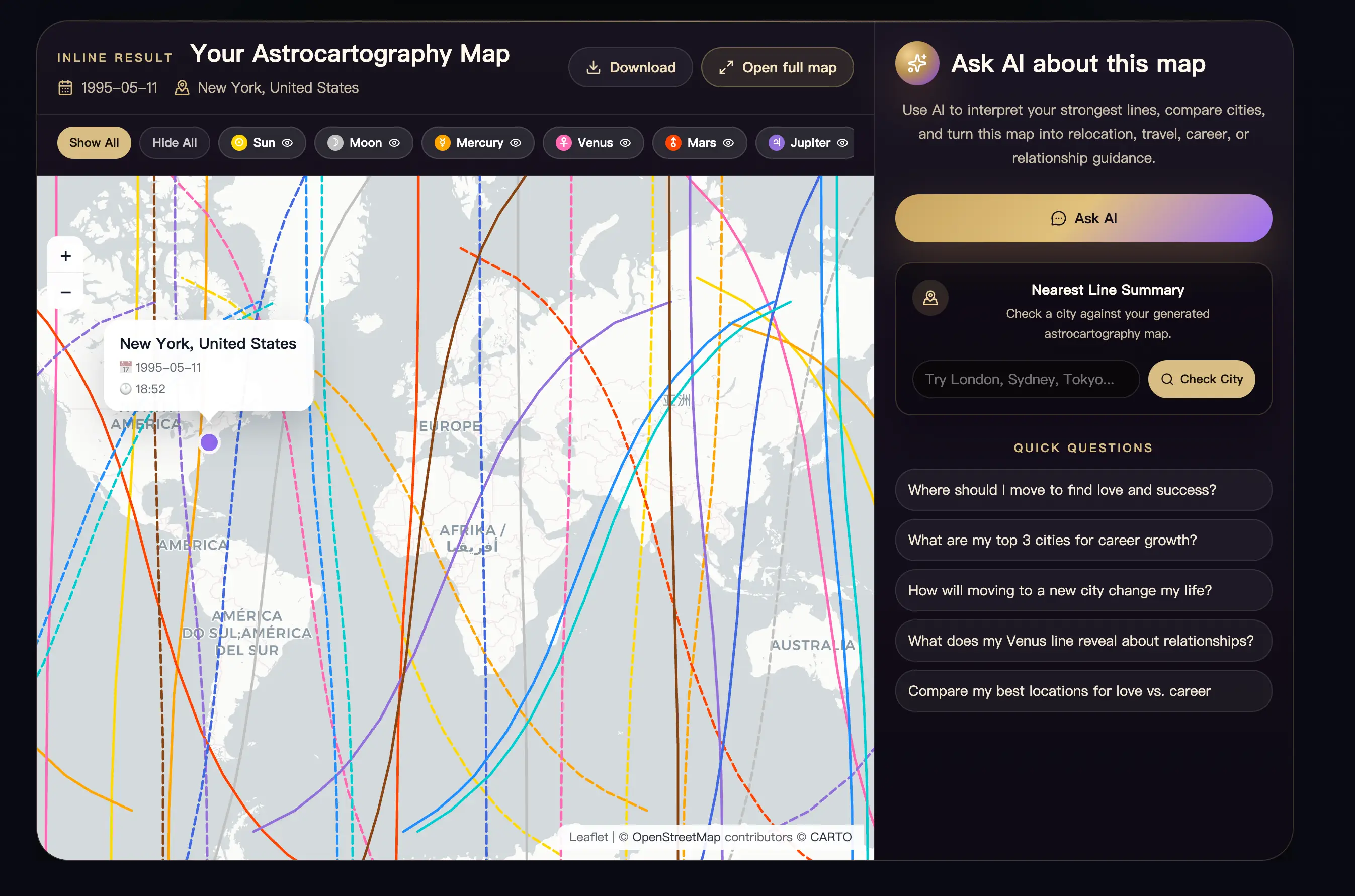
This is a synthetic example designed to demonstrate the method. It is not a prediction about a real person or city.
Suppose you are comparing two places:
- Place A is relatively close to a Venus MC line.
- Place B is relatively close to a Saturn IC line.
Read Place A
- Planet: Venus raises questions about connection, aesthetics, harmony, values, and attraction.
- Angle: MC moves the focus toward career, visibility, reputation, and public direction.
- Combined question: Could this place support diplomatic, creative, relational, or public-facing work? Could approval-seeking or comfort become a trade-off?
- Distance: Check whether Venus MC is clearly closer than other available signals.
- Goal: If your goal is creative visibility or collaboration, the combination may deserve further research.
Read Place B
- Planet: Saturn raises questions about responsibility, boundaries, patience, pressure, and long-term construction.
- Angle: IC brings the focus toward home, family, roots, inner stability, and private life.
- Combined question: Could this place support serious foundation-building? Might it also feel heavy, isolated, restrictive, or duty-focused at home?
- Distance: Check whether Saturn IC is the strongest nearby signal or one part of a larger pattern.
- Goal: If your goal is stability and long-term responsibility, the combination may be relevant. If your goal is lightness and ease, its trade-offs may matter more.
Compare the Two
The example does not prove that Place A is better than Place B. It shows that they emphasize different questions.
The next step is to compare those themes with:
- your actual priorities
- work and financial conditions
- visas and legal access
- safety and healthcare
- family responsibilities
- cost of living
- climate and culture
- first-hand experience of the place
Use the map to organize astrological evidence, not to replace practical research.
08 / GUIDE
Common Mistakes When Learning to Read a Map
Trying to interpret the whole world at once
Start with one city. Add another only after you can explain the first location in a clear sequence.
Reading the planet without the angle
“Venus line” or “Saturn line” is incomplete. Venus DC and Venus MC emphasize different life areas.
Treating every line as good or bad
Jupiter can involve excess. Venus can involve avoidance or over-accommodation. Mars can support courage and action. Saturn can support mastery and durable results.
Ignoring distance
A line on the other side of a region should not automatically receive the same priority as a much closer line.
Ignoring nearby lines
Several lines can create support, tension, or mixed priorities around the same place.
Expecting the map to make the decision
The map can help organize themes and comparisons. It cannot decide whether a location is affordable, safe, legally accessible, healthy, or appropriate for your family.
Making precise claims from an uncertain birth time
Angle lines depend on birth time. If the recorded time is approximate or unknown, treat close calls and small distance differences carefully.
09 / GUIDE
What If You Do Not Know Your Exact Birth Time?
You can still generate a map and learn the reading framework, but the result needs more caution.
AC, DC, MC, and IC are time-sensitive. An uncertain time can shift angular lines and make precise city comparisons less reliable. If you use an estimated time:
- focus on broad themes rather than exact boundaries
- avoid declaring one nearby city definitively stronger than another
- compare the result with places you already know
- be transparent that the time is uncertain
- look for a more reliable birth record when the decision is important
The form’s unknown-time option helps you explore without pretending that the estimate is exact.
10 / GUIDE
Want a Personalized Explanation Instead?
This guide teaches you how to read your own map. If you would rather begin with a generated, personalized explanation, use the Astrocartography Reading page.
The difference is simple:
- This page: learn the method and apply it to your own map.
- Astrocartography Reading: generate a personalized explanation first.
11 / GUIDE
Frequently Asked Questions
How do I read an astrocartography map?
Choose a real place, find the nearest planetary line, identify the planet and AC, DC, MC, or IC angle, check the distance, and interpret the combination against your actual goal. Start with one location rather than trying to decode the entire map.
How do you read an astrocartography chart?
Read the chart in layers: place first, then line, planet, angle, distance, nearby signals, and real-life purpose. The planet describes the theme; the angle shows the life area where that theme may become more noticeable.
What should I look at first on my astrocartography map?
Look at your current city or another place you know well. Find the nearest line and use it to learn the planet-plus-angle method before evaluating unfamiliar destinations.
Should I read the planet or the angle first?
Start with the place and nearest line, then identify both the planet and angle. The planet alone is too broad, and the angle alone does not tell you which theme is being emphasized.
How do I interpret astrocartography lines?
Combine the planet’s theme with the angle’s life area, then add distance, nearby signals, birth-time accuracy, and your goal. Avoid interpreting a line as an isolated promise or warning.
How close does a city need to be to a line?
There is no universal distance that guarantees an outcome. Use calculated proximity to prioritize the closest signals, then compare them with other lines and locations instead of treating distance as a hard on-or-off rule.
Can I read my astrocartography chart without an exact birth time?
You can explore the framework, but angle lines are time-sensitive. Treat close distances and precise city comparisons cautiously, and avoid presenting an estimated time as exact.
How do I compare two places on my map?
Use the same sequence for both places: nearest line, planet, angle, distance, main theme, goal fit, support, caution, and practical conditions. Compare trade-offs instead of asking which place is universally better.
12 / GUIDE
Read Your Own Astrocartography Map
Generate your chart, choose one real city, and work through the six steps:
- Place
- Line
- Planet
- Angle
- Distance
- Goal
You do not need to memorize every symbol before you begin. A useful map interpretation starts with a specific place, a clear method, and honest attention to both astrological themes and practical reality.
Primary action: Generate My Astrocartography Map
Secondary action: Get a Personalized Astrocartography Reading
14 / GUIDE
Editorial Method and Limitations
This guide is designed around the current AstroCarto map workflow: generate a personal chart, inspect a real place, identify nearby planet-angle lines, check calculated distance, and compare locations in context.
Astrocartography is an interpretive astrology framework, not a guarantee of events or a substitute for professional, legal, financial, medical, safety, immigration, or relocation advice. Use it as one input alongside practical research and first-hand experience.